
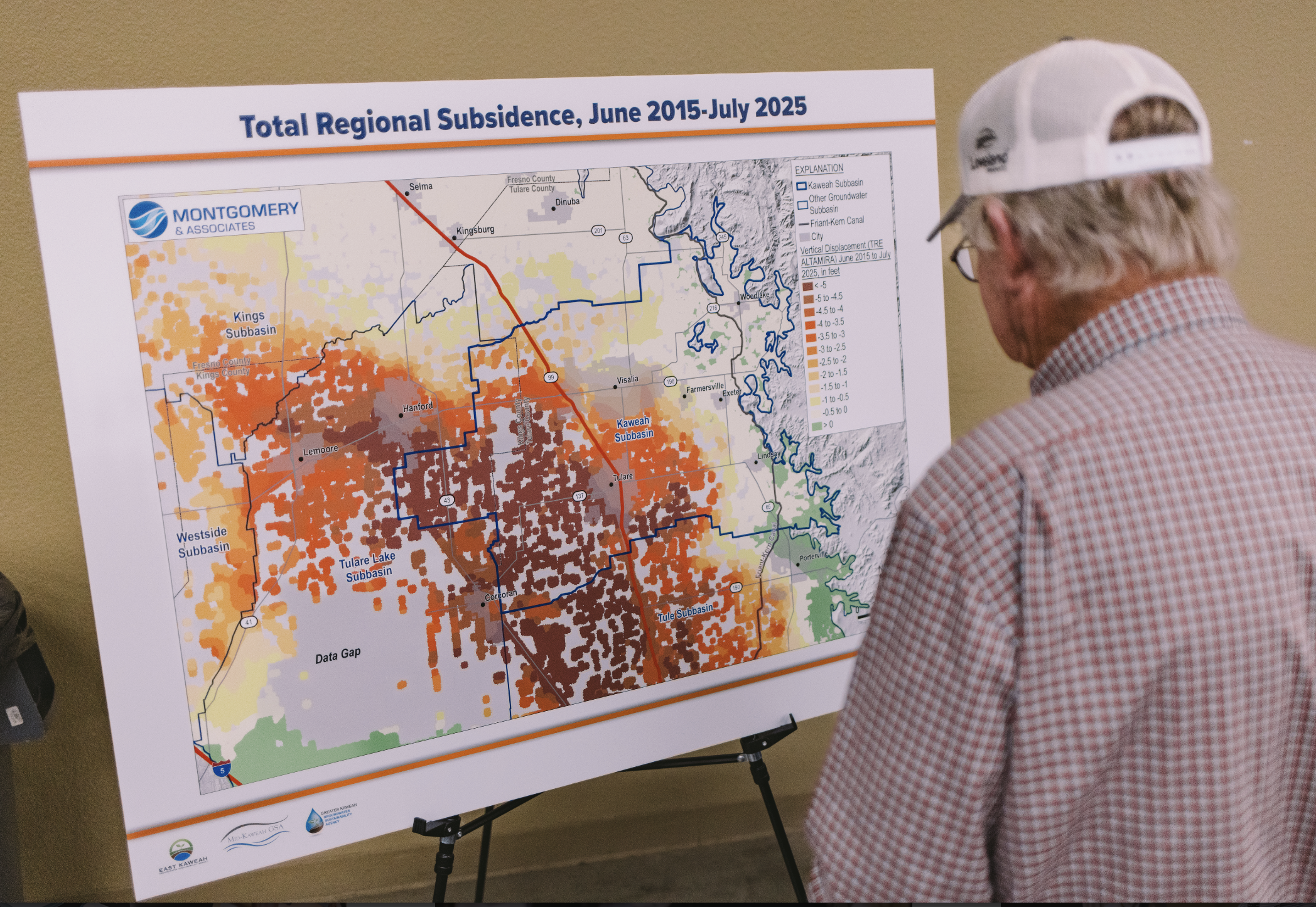
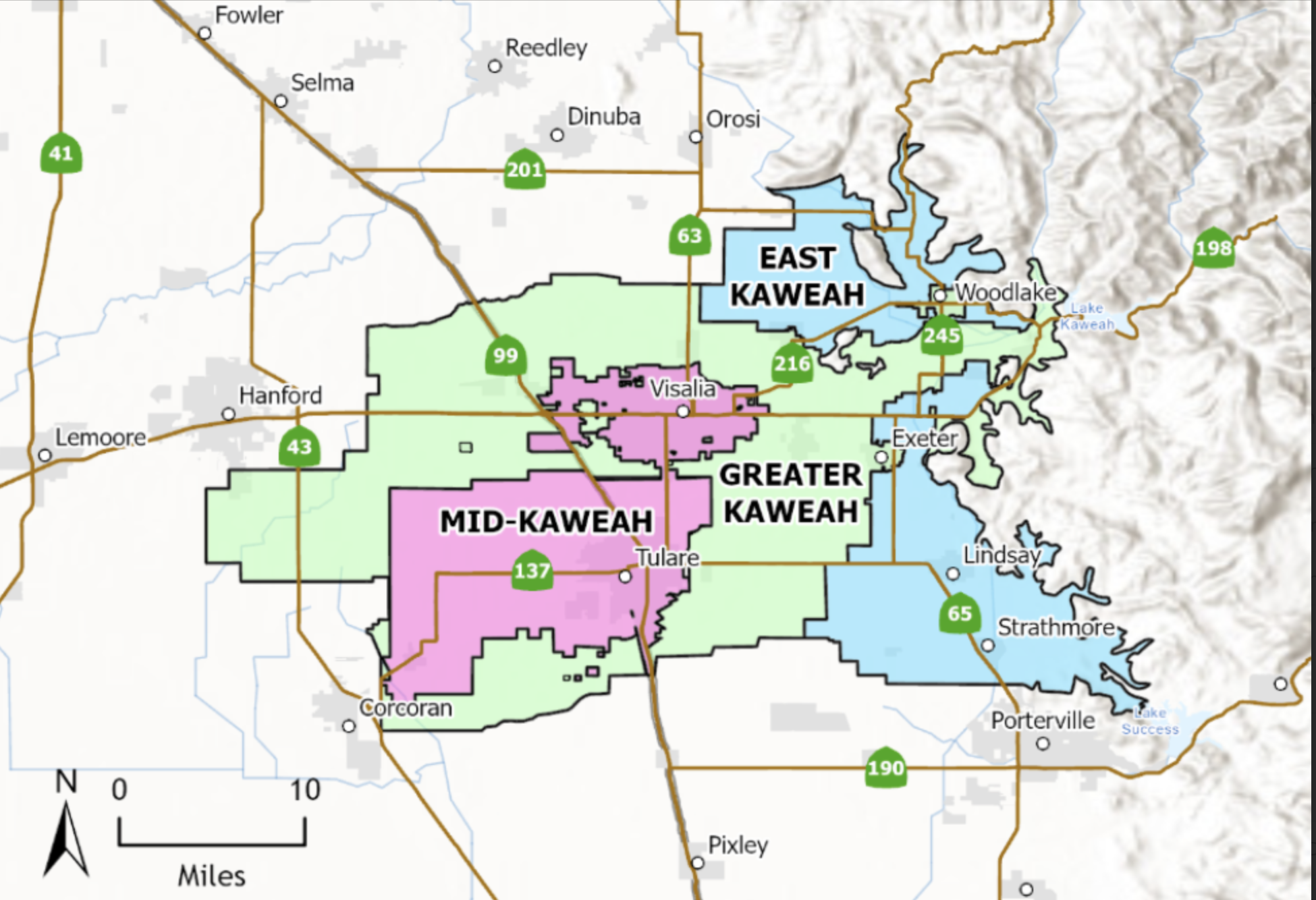
Under SGMA all Groundwater Sustainability Agencies (GSA) are required to reduce groundwater pumping in their jurisdiction as the region faces land subsidence. That’s also true in the Greater Kaweah district that wraps around the perimeter of Visalia.
Studies show an overdraft of the local aquifer by around 180,000 acre feet per year that will be reduced by one third with plans to do recharge and other conservation projects. That leaves 120,000 acre-feet of excess demand – too much to overcome without reduced pumping.
Greater Kaweah administrator Mark Larsen says they have asked all well owners in the district to provide information about their well by registering them with the district. So far that has been a voluntary request. Now that has changed as of Feb 9, to a mandatory requirement with only 150 of the wells registered out of 1800 to 2000 wells in the district to date. These landowners in Tulare and Kings counties now face a mandatory deadline of July 1, 2026.
The district says they need to gather data on the depth, location, and type of wells “to keep us from just flying in the dark” says Larsen.
GSAs are tasked with managing local aquifers to reduce potential subsidence that is damaging hydraulic infrastructure up and down the Valley. Unchecked, the price tag to fix not only the damage but to do restoration of capacity to move water has been estimated in the billions.
Unlike some other Valley GSAs, the Kaweah subbasin avoided state intervention when the state Water Resources Control Board recommended the basin return to the oversight of the Department of Water Resources late in 2025.
In a statement the Greater Kaweah announced “In of the most exciting achievements for the Greater Kaweah and the Kaweah Subbasin as a whole, on December 2, 2025 the State Water Resources Control Board in Sacramento voted to officially remove the Kaweah Subbasin from the treat of probation and pass oversight back to the California Department of Water Resources. The State Board action acknowledged the significant work the GSA made in revising the Groundwater Sustainability and supported the elements developed to reach sustainability by 2040. This has been a multi-year effort and the Greater thanks their GSA partners for a monumental, collaborative effort! “
In general, farmers would rather deal locally with an elected regulatory body – in this case the board of directors of Greater Kaweah- then dealing with the state where costs and oversight are more painful.
If a GSA is on probation, it requires landowners to register their wells with the state at $300 each, report extractions and pay $20 per acre foot pumped.
In the case of Greater Kaweah with acceptance of the local plan by the state, the Greater Board of Directors voted to ease off some of the restrictions relating to groundwater transfers, allowing growers more flexibility and options to manage their water supplies. But they still will get penalties for over pumping.
Subsidence focus
The Greater Kaweah GSA subsidence issues are most concerning around Highway 99 and west of there within the district, says Larsen. This western area within the district coincides with the Corcoran clay soil profile that has seen declining groundwater levels.
It rains about 7 inches less in the western part of the GSA than in the east and the east has more surface water options. There is not one management tool that fits everyone.
Larsen says the real test of the GSA efforts will be in drought years when farmers will turn to their groundwater pumps. “In the past two years we’ve had good water years” resulting in beneficial river flows on the Kaweah as well as supplemental surface water supply.
The GSA needs this information to come up with strategies to reduce groundwater pumping. Right now they rely mostly on aerial Land IQ data that estimates the amount of water used in a particular area.
Larsen says the GSA‘s latest effort is to focus on management areas within the sprawling district down to perhaps 16 sq miles that could result in measures to address issues in that narrowed area
Besides agricultural wells, Greater Kaweah is focusing on any potential impact that groundwater pumping has on domestic wells nearby. Recently the district replaced three domestic wells, and there are three or four more in the pipeline. He says state regulations mandate that GSA‘s address any impact on domestic wells that groundwater pumping by agriculture affects.
Some are anxious
Why are some growers reluctant to register their wells? “Some growers are anxious that the information could be used against them while others recognize the benefit“ observes Larsen.
They need information on agricultural, domestic, industrial and retired wells that have not been destroyed.
The Kaweah subbasin GSAs, which also include East Kaweah and Mid-Kaweah, all have voluntary well registration programs as part of their groundwater sustainability plan. If some Greater Kaweah farmers refuse to submit their well information by the deadline, the Greater board may potentially take the next step to penalize the late comers.That is happening in a Kings County GSA.
This effort here does not just focus on the demand side for water. In December of 2025, with its partner Kaweah Delta Water Conservation District, the Greater was able to import 600-acre feet of CVP Class 1 water into the Kaweah River system, recharging the groundwater table. “We hope this is a first in many such opportunities and partners to help sustainability from the supply side!
The Greater Kaweah Groundwater Sustainability Agency (Greater Kaweah GSA) was formed with the intent to comply with the 2014 Sustainable Groundwater Management Act (SGMA) and initiated its effort by executing a Joint Powers Agreement (JPA) on August 23, 2016. The Greater Kaweah GSA became an “exclusive” GSA for its service area by the California Department of Water Resources in August 2017. The JPA members and partners consist of:
Kaweah Delta Water Conservation District
Kings County Water District
Lakeside Irrigation Water District
St. Johns Water District
Tulare County
California Water Service Company
The Greater Kaweah GSA is one of three GSAs formed in the Kaweah Subbasin that, in total, cover the entire Subbasin without overlap. The three GSAs have each developed Groundwater Sustainability Plans (GSPs) and executed a Coordination Agreement for the Subbasin to utilize the same data and methodologies ensuring consistent interpretations of the Basin Setting.