
-February 25,2022-
Faraday launches production model despite setbacks
 Looking to move-on from its embarrassing news that the company had misrepresented demand for its proposed high-end electric FF-91 car, Faraday Future is live streaming the announcement that is being called the evolution of their production model on February 23 at 7PM, after this article goes to press.
Faraday Future has had its highs and lows ever since it showed the FF-91 model back in 2018, but now wants to move past the controversy to focus on the car itself that is to be manufactured in Hanford. The FF-91 sports 1,050 horsepower and can ramp up to 60 mph in 2.39 second with a top speed of 155 mph. The company says the electric car can travel 376 miles on its battery pack.
A competitor to the Tesla Model X, the car has been delayed from its original production date of 2018. The company recently admitted to misleading its investors but now seems determined to get the car on the road to be made in Hanford.
Kings-Tulare remain epicenter for subsidence
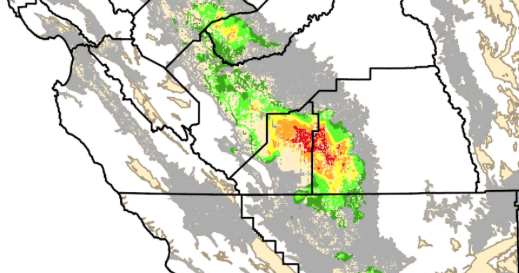 The California Department of Water Resources released new satellite-based data that show subsidence – or the sinking of the land surface due to excessive groundwater pumping – continues in the state.
The areas experiencing the most subsidence during Water Year 2021 are in the San Joaquin Valley, with a maximum of 1.1 feet of subsidence in the greater Corcoran area. That includes part of both Kings and Tulare counties (see map)- what is the state’s most impacted area. Data show that in WY 2021 subsidence of greater than 0.5 feet per year expanded to more areas than observed in WY 2020. However, fewer areas experienced higher rates of subsidence than at the end of the last drought in 2016.
“Californians rely on groundwater during drought, so it’s not surprising that land in some areas is continuing to sink,” said DWR Director, Karla Nemeth. “But it is good news that, compared to previous droughts, subsidence is slowing.
Foster Farms pulls 3 applications to expand in Kings County
Withe rumors that the company is on the sales block, Livingston- based Foster Farms has pulled three applications to open and expand chicken farm operations in Kings County according to Community Development Director Chuck Kinney.
Last June, we reported that Zacky Farms ranches in Kings County that grew turkeys were being converted by Foster Farms to raise chickens or turkeys. Foster Farms acquired the ranches out of bankruptcy in 2019. The former Zacky Farms ranches will now remain idle, perhaps until a new owner is in place at Foster Farms.
Westlands gets zero allocation from CVP
On Feb 23, the Bureau of Reclamation announced an initial allocation of 0% for Westlands Water District and other south-of-Delta Central Valley Project (CVP) irrigation contractors. This is the fourth time in the last decade the south-of-Delta irrigation contractors have received a 0% allocation. Westlands says “with the water district, the continued drought conditions in 2021 resulted in over 200,000 acres fallowed, countless lost jobs, and thousands of acres of food unharvested.”
Solar on canals – first project launched in Valley
Relying on a study by UC Merced researchers, California recently approved a project to cover two canals with solar panels in the Central Valley.
This is a $20 million collaborative project funded by the State of California, involving the Turlock Irrigation District (TID), the Department of Water Resource, the UC Merced, and a solar firm. The project may offer an opportunity to shade California canals to halt evaporation. The company will erect solar panel canopies that span the canal from one side to the other.
Researchers say that a solar panel array over water could generate a 20% to 50% higher return on investment compared to installing the same panels on the ground.
South Sierra sees first snow in two months
This week’s storm was much more substantial in the Valley’s foothills and mountains than on the Valley floor, says Hanford meteorologist Carlos Molina. China Peak near Huntington Lake says they received five to eight inches of fresh snow with cold weather likely to keep the snowpack intact for a while. Molina says while Hanford got just under tenth of an inch, Three Rivers got a third of an inch and Wolverton near Giant Forest saw 6 inches of new snow with a few more possible Wednesday.
“This is the first precip since late December” meaning it has been nearly two months, during the height of the rainy season, since the Valley has seen any precipitation with the Sierra. The Mountains lost much of the good snowpack that was built up in late 2021 due to warm weather.
The latest storm was vigorous in the Tahoe area and Tioga Pass in Yosemite, says Molina, where the pass saw about a foot of snow. As for new storms, Molina says there is a chance we could get wet again around March 2.
Vegetable productions falls – imports up
Vegetable production in the US and Kings County has dropped in recent years even as vegetable imports are up 200%. Americans are eating their vegetables year round these days, providing an opportunity to foreign grown products.
In 2021, the nation’s production for the 26 estimated vegetable and melon crops totaled 679 million cwt, down 4 percent from 2020.
In Kings County 2020 vegetable production including processing tomatoes totaled 37,515 acres while vegetable production without tomatoes was 7924 acres. By contrast, in Kings in 2014, total veggies including tomatoes was on 47,210 acres with vegetables besides tomatoes adding up to 13,207 acres.
The value of utilized production for 2021 US vegetable crops was $12.7 billion, down 10 percent from the previous year.
The US receives fresh vegetables from more than 125 different countries, but most imports originate from Mexico and Canada. In 2020, Mexico accounted for 77 percent of U.S. fresh vegetable import volume, and Canada represented 11 percent.
Both gain an edge by offering greenhouse based imports as well as organic options, which increased choices for consumers. While conventional and field-grown fresh vegetables still account for most imports, organic and greenhouse vegetables are expanding market reach.
Between 1998 and 2020, the volume of fresh vegetable imports increased nearly 200 percent, and the value of fresh vegetable imports grew to exceed fresh exports by $7.6 billion, more than double the same figure a decade earlier.
Summer is historically the primary market window for U.S. producers but fresh vegetable import volumes from Mexico during the summer months have shown substantial increases in the past 15 years.For example, Bell pepper import volume increased by 742 percent to 127 million pounds in the summers of 2018–20 from 15 million pounds in the summers of 2008–10.
Cattle numbers fall – prices climb
The US Department of Agriculture in its annual Cattle report issued Jan. 31 estimated the total US cattle herd on Jan. 1 down 2% from Jan. 1, 2021. The number declined for a third consecutive year and was the smallest since 2016.
The USDA estimated the total herd at 91,901,600 head, including 30,125,000 beef cows, down 2.3% from 2021, and 9,375,000 milk cows, down 0.7%.
The USDA inventory data, and industry outlooks, point to declining beef cattle numbers and continued strong exports, which suggests tighter domestic beef supplies and potentially higher beef prices.
pic one is subsidence credit DWR
2 Attachments