SLO Jobless Rate Up Slightly

December 19,2014

Screen shot 2013-01-19 at 11.41.42 AMThe unemployment rate in the San Luis Obispo County was 5.4 percent in November 2014, up from a revised 5.3 percent in October 2014, and below the year-ago estimate of 6.1 percent.

This compares with an unadjusted unemployment rate of 7.1 percent for California and 5.5 percent for the nation during the same period.

Central Valley Signs Up 51,524 For Obama Care

March 2014

Screen Shot 2014-03-14 at 2.16.43 PMCentral Valley Enrollment Figures Through Jan. 31 Released By Covered California And Department Of Health Care Services

SACRAMENTO, Calif. — Covered California™ and the California Department of Health Care Services (DHCS) announced today that from Oct. 1, 2013, to Jan. 31, 2014, under the Patient Protection and Affordable Care Act, 51,524 consumers in nine Central Valley counties enrolled in subsidized and non-subsidized Covered California health insurance plans. The new total represents a 56 percent increase from the 33,133 enrollments recorded through Dec. 31, 2013.

The Central Valley counties of San Joaquin, Kern, Stanislaus, Merced, Mariposa, Tulare, Fresno, Kings and Madera represent about 7 percent of the statewide enrollment thus far. The local total includes 46,908 consumers eligible for financial subsidies. These counties encompass Covered California pricing regions 10, 11 and 14.

The improving pace of enrollments in the Central Valley is due in part to enhanced aspects of Covered California’s customer service. The agency has increased staff to answer consumer calls, added phone lines, improved its website efficiency, expanded its live Web chat function and upgraded its Spanish-language Web pages.

Covered California recently launched a targeted, grassroots, on-the-ground strategy in collaboration with its community partners to create face-to-face opportunities for enrollment, particularly in Latino communities in the Central Valley and the San Joaquin Valley (Stockton/Modesto and Fresno/Bakersfield).

Since December, the exchange has nearly doubled its advertising campaign targeting Spanish- and English-speaking Latinos, improved its Spanish-language website and informational materials, and increased the number of bilingual Certified Enrollment Counselors and Service Center representatives.

Nearly 1 Million Statewide

In late breaking numbers Covered California officials announced that as of March 9 that almost one million Californians have signed up for health insurance through the new exchange, far exceeding estimates.
“We are at more than 920,000 Californians who have picked a plan through the health benefit exchange,” Covered California Executive Director Peter Lee said. “That has more than exceeded our base estimate.”
The original “enhanced scenario” estimate by UC-Berkeley researchers — if everything went optimally well during the first six-month enrollment period — was 560,000 signups. Exchange officials yesterday said 923,832 people have enrolled as of March 9.

Visalia To Go To District Elections

Screen Shot 2014-02-06 at 12.05.54 PMVisalia will be going to district elections in 2016 as the city decided not to contest a civil right based lawsuit.”We would have had a long fight to defend our position and in the end would have probably lost and be left with a big bill ” says council member Greg Collins. The city has voted “at large”  but will now be divided into 5 districts.

A judgment was entered by Judge Melinda Reed today after the City did not contest the case presented to the court. The judgment ends a lawsuit that was filed against the City on December 19, 2013 by Visalia residents Carlos Medina, Dr. Robert Aguilar, Miguel Fierro and Louis Montion.

The lawsuit claimed that the City’s at-large elections violated the California Voting Rights Act of 2001 (CVRA) because there was a pattern of racially polarized voting that impaired Hispanics from electing their preferred candidates. The lawsuit also cited that there had only been one Latino individual that had ever been elected to the City Council, and that despite having more than 46% of the population, there was currently no Latino member on the Visalia City Council.

At-large and odd year elections have been required in the City’s Charter. The City Council had twice put a question on the ballot, in 1994 and in 2012, asking if voters wanted to go to District Elections, but it was rejected both times by a significant margin.

“This has been a difficult decision for the City Council,” noted Mayor Steve Nelsen. “We respect the will of the Visalia voters to continue with at-large elections that have been part of the City’s charter for more than 90 years.  But legal counsel advised us that based on current California law, and in the interest of minimizing the potentially significant litigation cost to the City, our prudent option was to not contest this case and to accept a court-ordered judgment that moves the City to district-based elections in even years.”

The judgment also extends the terms of the current City Council members by one year, to the next even year, to facilitate the transition to even year elections. Council members Amy Shuklian and Bob Link’s term are extended to 2016, and Mayor Nelsen, Vice Mayor Warren Gubler and Council member Greg Collins term are extended to 2018.

The City Council will consider the next step in the move to District Elections during open session at the Tuesday, February 18 meeting.

Around SLO: Jobs /Airport / La Quinta

January 25,2013

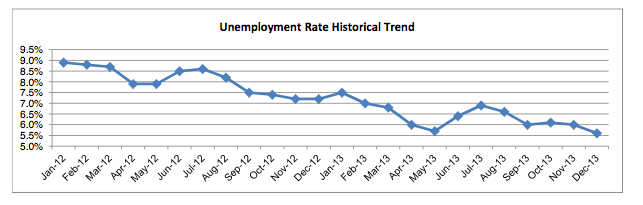
Jobless Rate Falls To 5 Year Low

Screen Shot 2014-01-25 at 7.32.59 AMThe jobless rate in San Luis Obispo County fell to 5.6% in December 2013, the lowest since 2007. The rate fell from 6% in November. Year over year the EDD reports SLO County saw a 1800 nonfarm increase in jobs while farm jobs fell by 100. Figures show the county’s labor force decreased by 900 year over year to 143,100 while employment climbed by 1700.The number of unemployed contracted year over year from 10,400 to 8100.

Again year over year, by category, construction jobs climbed 7%,education and health jobs were up 5.9% while leisure and hospitality jobs climbed 1.3%.

On a month over month basis SLO county saw a a 1500 person drop in nonfarm jobs with 1200 of those government jobs. But 100 of them were losses in manufacturing.

SLO’s 5.9% compared to California’s 7.9% jobless rate.

December Airport Passengers Up 20%

SLO County airport passenger traffic was up 20.3% in December, the best performance of the year. After a slow start during the last quarter  of 2013 traffic increased 14.3%.For the calendar year passenger traffic was up 4.9% to 272,268.In 2012 there were 259,505 passengers.

United had the highest increase between themselves and US Air,now having merged with American Airlines. United traffic has increased from 12,179 in January 2013 to 14,277 by December,adding another flight to LA in December. US Air traffic also increased  on a monthly  basis with 14,277 in December 2013 compared to 12,179 in January.

Assistant manager Craig Piper credited the improvement in SLO county’s economy for some of the increase.

Piper says the airport continues to work with their consultant to encourage United to begin flights to Denver. They are delivering results of an updated leakage study that shows more people using airports other than SLO.

“We are hopeful to hear something in the next month but there is no guarantee.”

Paso Robles La Quinta Expanding

Tourist biz is good in wine country with La Quinta Inn in Paso Robles expanding – adding another 37 rooms being bid out this month for construction.

U.S. CORN ACREAGE UP FOR FIFTH STRAIGHT YEAR SAYS USDA

Corn Futures Fall To $5.16/Bushel
Great news for California livestock farmers including the hard hit dairy industry. Corn prices took a dump today as USDA released planting figures for the new crop. December corn prices on the CBOT  fell to $5.16 a bushel assuring farmers here who depend on the crop for feed will – as of this fall – no longer be forced to pay a high premium for the feed that has severely punished their bottomline for the past two years.
ON Friday June 28 USDA announced that “U.S. farmers successfully overcame a cold and wet early spring this year, planting 97.4 million acres of corn, up slightly from 2012, according to the Acreage report released today by the U.S. Department of Agriculture National Agricultural Statistics Service (NASS).”
“This is the highest acreage planted to corn since 1936 and marks a fifth year in a row of corn acreage increases in the United States.
This growing season did not get off to a good start. Hampered by cold and wet weather in early spring in much of the major corn-producing region, U.S. growers had only 5 percent of the crop planted by April 28, making it the slowest planting pace since 1984. In May, however, the weather conditions improved significantly, helping U.S. corn growers to make great strides in planting. The week of May 19, farmers tied the fastest corn planting pace on record, planting 43 percent of the total crop during that one week. Overall, 63 percent of the corn crop was reported in good or excellent condition as of June 2, compared with 72 percent at the same time last year.”
The bullish USDA report surprised the market who thought planting numbers would be falling. In Chicago the prices for the new crop lost ground, with CBOT corn for December delivery falling as much as 5.2 per cent to $5.11 a bushel before trading at $5.16½ – down more than 27 cents on the day.
Traders had speculated that corn for December delivery would be as high as $6.60 a bushel last summer. But with the big planting and end of the Midwest drought – corn prices appear to be settling down.
By contrast livestock farmers and biofuel makers in California had been paying as high as $7 to 8 a bushel for corn during the Midwest drought last year. Many dairy operators quit the business as the industry is almost totally dependent on imported corn.
Corn price that are still near $7 a bushel in July should fall to around $5.50 by September and further as the year goes on baring some other disaster.

Ag to Valley House GOP: ‘ Inaction Not An Option’ On Immigration

Now that the US Senate has passed a comprehensive immigration reform bill satisfactory to agriculture – what is the House and particularly the California GOP delegation going to do?

The Senate passed the bill 68 to 32 this week (including 14 Republicans voting yes) – “ a big victory for California agriculture “says farmer advocate Manuel Cunha.

But what happens now in the House where the Farm Bill got throttled a week ago?

“I don’t know why the House Republicans want to do their own bill when 99% of agriculture backs the Senate version?” says Cunha.

Adding their voice to the notion has been the California Farm Bureau as well.

California Farm Bureau Federation President Paul Wenger said the bill passed by the Senate will help family farmers and ranchers address chronic problems in hiring an adequate, legal immigrant workforce.

“People who work on California farms make a big contribution to our state and its economy,” Wenger said. “It’s time we provide immigrant farm employees with a system that recognizes their contributions and permits them to work legally on our farms and ranches.”

Cunha has worked for years with all the players to get to this moment.

“We worked 80 hours a week for 9 months to get to this compromise that both farmers and farmworkers advocates including the UFW have agreed to.”

This week the UFW hailed the Senate bill saying “S. 744 is a truly bipartisan comprehensive immigration reform bill that calls for a roadmap to citizenship for the estimated 11 million undocumented immigrants currently living in the country.”

Cunha says House GOP representatives from the Valley Jeff Denham and Hanford congressman David Valadao have broken with their colleagues over a rival bill by GOP Rep Bob Goodlatte that does not back a roadmap to citizenship for unauthorized workers already here.

Cunha say he believes Denham and Valadao will back the Senate version but Bakersfield congressman and House leader Kevin McCarthy and Rep Devin Nunes from Tulare are indicating they may have problems with the Senate version.

“Nunes has told us he has problems with the wages and caps” says Cunha.

“But what we have repeated is that if agriculture can live with it why would you who represent us not back your constituency?”

Cunha says a recent paper by UC Davis professor Phil Martin points out that agriculture would immediately get “a legal workforce” and existing unauthorized workers who currently live here would get a blue card. Farmers would later get legal guest workers.

Secondly, Martin adds “costs should be stable since average hourly earnings in California are well above the minimum wage that must be paid to guest workers as of 2016. California crop workers got an average of $12.56 an hour in 2012” he says.

Martin believes the new law will offer California growers “advantages over farmers in lower-wage ares of the United States.”

“The capacity to hire legal guest workers for up to six years at $9.64 an hour with wage increases limited to 2.5% a year should make it easier to plan investments in labor-intensive agriculture and secure financing for them.”

Dairymen are behind the Senate version as well.

Western United Dairymen President Tom Barcellos said the bill will help California dairy farmers meet their labor needs. “This vote is a landmark step on the road to ensuring that California dairy families have access to a legal, skilled and stable workforce,” he said. “The provisions contained in the legislation not only address agriculture’s current undocumented workers, but would institute a new, market-based visa program to fix this issue once and for all going forward.”
 
Barcellos thanked California Sen. Dianne Feinstein for her leadership on immigration reform. “Senator Feinstein has worked relentlessly over the past decade in pursuit of a workable solution for the farm labor situation. We very much appreciate her willingness to work closely with Western United Dairymen to address our industry’s unique needs all along the way.”
 
Attention now turns to the House, where GOP leaders have indicated they will bring forward their own immigration reform legislation rather than consider the Senate bill. “It is important that the House consider a bill addressing the needs of agriculture. Inaction is not an option,” pointed out Barcellos. “We will be letting House members know the importance of this legislation to our dairy families.”

Local dairy farmer and Republican David Valadao sworn in this year as Kings County’s new representative in the 21st Congressional District seems to heading in this direction.

Rejecting a bill by House GOP leader Bob Goodlatte, Valadao wrote  that “It is time to move forward, not backward. Congress must work together to find middle ground that benefits both the temporary guest workers as well as the agricultural employers. Final legislation must create incentives for farm workers to continue to work in the industry so that the United States can continue to feed the world. We believe in a comprehensive approach to immigration reform that includes earned legal status. This approach is critical for our country, our families, and our economy.”

Martin’s paper concludes that farmers and farmworker advocates will strongly resist changes to what is a “delicately balanced compromise”

A bipartisan group of eight House members that includes input by Valadao is working on its own proposal that is expected to be released soon.

Farm Leaders Urge House To Follow Senate And Pass Immigration Reform

Now that the U.S. Senate has passed comprehensive immigration reform, the leader of California’s largest farming organization says the House of Representatives should follow suit. California Farm Bureau Federation President Paul Wenger said the bill passed today by the Senate will help family farmers and ranchers address chronic problems in hiring an adequate, legal immigrant workforce.
“People who work on California farms make a big contribution to our state and its economy,” Wenger said. “It’s time we provide immigrant farm employees with a system that recognizes their contributions and permits them to work legally on our farms and ranches.”
Wenger said the agricultural program included in the Senate immigration bill represents an agreement among agricultural organizations and the United Farm Workers on a system to benefit both farmers and their employees. It contains an agricultural program that accounts for people who want to enter the U.S. to work on farms and the people who are already in the country and can earn a chance for legal status while continuing to perform farm jobs.
“People who are already in the country would have to pass a background check. If they don’t have legitimate work documents, they should be required to pay a fine. They should also be allowed to come out of the shadows and continue to contribute to our communities,” Wenger said.
He noted that the program in the Senate bill represents a bipartisan compromise.
“It’s not perfect but it’s a big improvement from current programs that don’t work for either farmers or their employees,” Wenger said, encouraging the House to adopt similar reforms.
“A workable agricultural immigration system benefits border security,” Wenger said, “allowing border agents to concentrate on preventing drug dealers and other criminals from entering the country. We will work to make sure our representatives recognize that and create a reformed immigration system for farmers and their employees.”
The California Farm Bureau Federation works to protect family farms and ranches on behalf of more than 74,000 members statewide and as part of a nationwide network of more than 6.2 million Farm Bureau members.

Visalia Biz Briefs

November was good month for local hotels. Smith Travel Research reports that November hotel rooms sold in the Tulare/Visalia metro area jumped 7.9% compared to November of 2011. Occupancy jumped 6.4%.The numbers are the best of 2012 with year-to-date rooms sold up a paltry 1.4%.Perhaps things are picking up.

Visalia building permit activity for 2012 paints a mixed picture. The number of single family homes permitted compared to 2011 was down 6% while residential addition valuation was up 11%. The number of new commercial permits  was up 35% but their overall value was down 64% largely based on one large project in early 2011, the $22 million VWR complex in the industrial park. Total permits were up 2% while total valuation was down 23%.While the number of new home permits increased most months in 2012 compared to the same month in 2011 – December 2011 saw a flood of 77 permits filed to beat the new sprinkler ordinance that went into effect in January of last year.For the year -Visalia permitted 252 new homes, a far cry from the go-go days of 2003-2007 when builders annually did 1000 to 1450 new homes here.

Visalia’s median price home sold in December for $165,000-up 24.6% from November 2011 when they sold for a median price of $133,000 according to DataQuick.

Growth Issue Returns. Visalia City Council and Planning Commission are expected to take up the 2030 General Plan Update January 22 and we should see a lively debate over growth projections. A citizen committee and their consultant have projected faster growth than several recent studies and as a a result their plan requires more land than may be needed to accommodate population growth between now and then says one council member. Councilman Greg Collins expects we can handle city growth “within the current city limits” with enough room, he says, to add another 40,000 to 50,000 residents.Others will argue for a trigger mechanism to allow expansion. Debate will also be heard on allowing new commercial growth beyond Packwood Creek on Mooney and on Highway 99.

JG Boswell’s new ranch office in Corcoran( click to enlarge)

Architectural Firms Merge. Both launched their firms in Visalia over 33 years ago and now the two have joined up. Stan Canby Jr’s Canby Architecture Studio has joined Glen Teter’s larger group,Teter LLP that will now be 87 staffers strong says Canby. The combined company has offices in Fresno,Visalia and Bakersfield. The expanded firm offers both architectural and engineering design and is now the largest such firm between Sacramento and Los Angeles. Canby moved his 10 member group to the Teter building at 125 S Bridge in Downtown Visalia and will lease out his former office on Santa Fe.

Canby is known for his aesthetic design putting his stamp on some familiar landmarks like the Mangano-built Main St Promenade complex and the Visalia Transit Center.  Teter is well regarded for his hands management ability of complex projects. ”We are a one-stop-shop for all types building design.” Both firms have built a number of energy- saving, LEED Certified projects.

Teter is well known for their design of other local landmarks  including the Buckman Mitchell building in Downtown Visalia and the new Tulare City Council/Library building.The firm is taking on design of a new minor league stadium that ties into a mixed-use project in Bakersfield and has recently completed a new ranch office for Boswell Farms in Corcoran. Teter has both a strong ag and industrial portfolio  recently completing one of the largest customer-owned rooftop solar plants in the U.S in Delano for Paramount Citrus.

”We’re bullish on growth for the Valley” says Canby and we “expect to be in forefront. “

Tulare County: 20 Mile Quarantine Expected With 2nd Citrus Pest Find


The discovery of a second find of a single Asian citrus psyllid in a Tulare County citrus grove insect trap near Strathmore is expected to spur CDFA and USDA to establish a 20 mile quarantine on any citrus plant material movement soon. So says Tulare County Agricultural Commissioner Marilyn Kinoshita who expects a formal announcement by CDFA tomorrow, November 20 after she was briefed today.
Kinoshita says this latest pest find dates from October but several tests were needed on the insect by USDA labs resulting in the announcement this weekend, weeks later, of the find by Kinoshita’s office.
“Since it’s the second find this year it looks CDFA will recommend to USDA the 20 mile quarantine zone be established.”
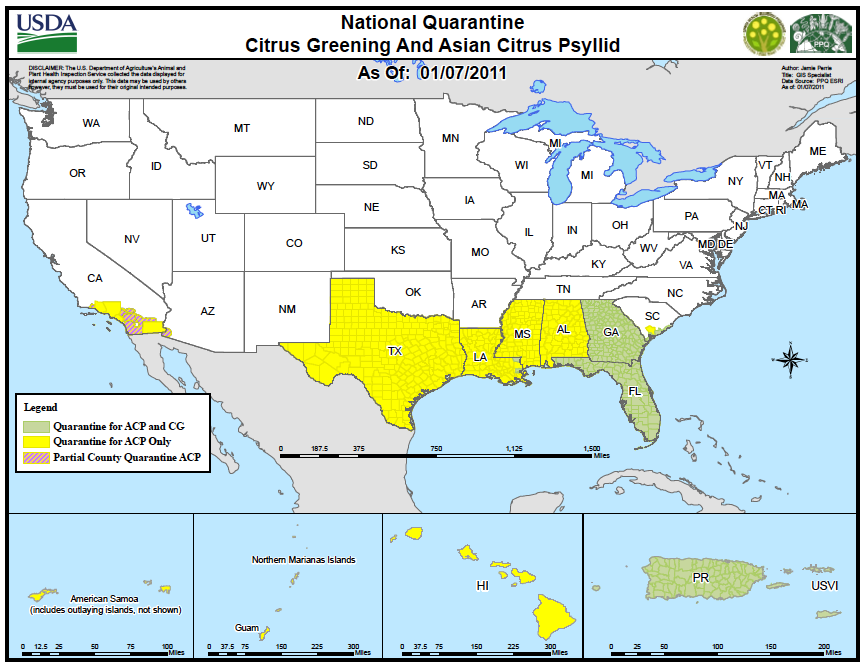
Kinoshita says a map of the zone will be made available on the ag commissioner’s web site but its rough boundaries would go from Woodlake, south to Ducor and the City of Tulare on the west, a large swath of Tulare County’s big citrus growing region along the eastern foothills.
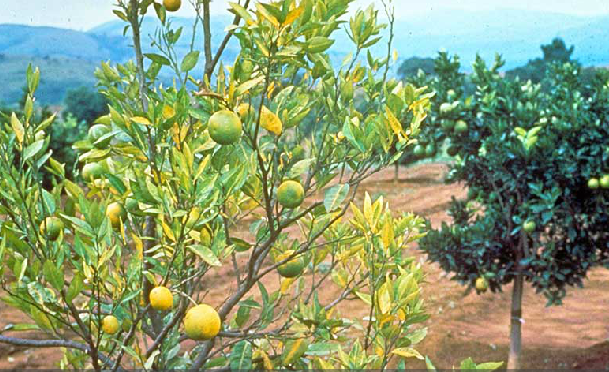
The dreaded pest can carry citrus greening disease that has devastated other citrus growing regions in the world including Florida in the US. The disease kills the trees after just a few years of being infected by the bacteria even as it stunts growth and production (see pic).

citrus tree with greening disease

Kinsoshita says USDA will be testing trees near the find to see if they show any signs of the disease although there is a year long period before symptoms are seen. So far the tiny pest has been found in southern California as far north as Ventura County but not the dreaded disease. The first find of the insect in California came in 2008
The first find of a phyllid in Tulare County came in February 2012 and was found east of Lindsay. After the find, a dense quantity of pest traps were set up in citrus groves to determine if the insect was an isolated ”hitchhiker” from southern California or if the find signaled a potential infestation.
This time around CDFA seem to be worried about an infestation.
The citrus industry is the county’s number two crop after milk,valued at over $600 million annually with about 120,000 acres of citrus trees vulnerable to the voracious pest.
Kinsoshita says impact of the quarantine will hit growers who will now have to run all citrus fruit on rollers to remove any leaves or debris,nurseries who will face restrictions on plant movement unless the nursery trees are being grown under a screen and juice plants who will have to take extra precaution when they bring fruit in and out of the quarantine zone.

current quarantine area in US

Kinoshita also says a citrus grower meeting to discuss the new quarantine zone will be held November 27 at a location to be announced.
Just what if any – impact on citrus exports to foreign countries will be remains to be seen depending on what those governments want to do.
One thing for certain.”Famers lives just got more complicated ”adds Kinoshita.

Table Grape Growers Report Strong 2012 Crop

By Steve Adler

Kern County table grape grower Mark Hall says this year’s season features normal yields and quality. His harvest began around the Fourth of July and will extend into late fall.
Photo/Randall Barker

As California’s table grape harvest works its way northward from the Coachella Valley to the San Joaquin Valley, growers report very good quality with average crop size.

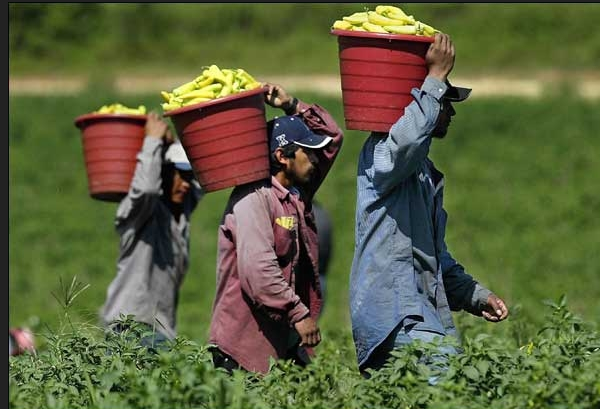
The one concern voiced universally by growers is a tight labor supply. There haven’t been any crop losses reported yet, but growers said they find themselves having to juggle their crews much more than in the past few years.

Observers attribute much of the labor shortage to increased enforcement by U.S. Immigration and Customs Enforcement, coupled with increased violence on the Mexican side of the border caused by drug cartels.

Karen Brux of the California Table Grape Commission said this year’s table grape crop is being projected at 100.8 million 19-pound boxes. California shipped about 97.4 million boxes of grapes during the 2011 season.

The California table grape sector continues to grow. Total volume has exceeded 90 million box units each of the past five seasons, coming close to breaking the 100 million mark. With just over 20 million boxes shipped in the early 1970s, volume has increased by almost five times during the past four decades.

In 2011, there were more than 90,000 bearing acres of California table grapes.

Sequential harvesting from south to north, combined with advanced storage techniques, allows California table grapes to remain available from May to January, the commission said. California produces 99 percent of the commercial fresh grapes grown in the United States, and there has been steady growth through the years.

“We are in the beginning stages of harvest and we are currently harvesting sugraone seedless grapes, a green seedless grape, as well as flame seedless grapes, which is a red seedless grape. We definitely have a very full crop this year and the quality is one of the best I have ever seen,” said Greg White, who markets grapes for a farming operation in Kern County.

“We will take our season until the end of the year. Weather is always a factor when it comes to growing, but overall this season, we have not been exposed to issues as we have been in the past. Heat is a big factor with table grapes and mildew is another issue and we haven’t seen those issues so far this year,” he said.

Another Kern County grower, Mark Hall, said he started harvesting flame seedless grapes around the Fourth of July and he will continue with a number of other varieties as they mature, wrapping up his harvest around Thanksgiving.

“The crop seems to be about normal in its development this year, but what is normal any more? Cluster counts and grape sizes seem to be normal,” he said. “Labor is always tough, but we pay a bit more for our workers so I have not personally had any problems.”

Grape grower Pat Pinkham of Exeter said growers in Tulare County definitely feel the effects of a tight labor supply.

“We also harvest plums and canning peaches, and the labor supply has been very tight. If you need that third crew, you quite often just don’t get it,” he said. “It hasn’t been so tight that crops have suffered so far; it is just taking a little longer to finish a variety than what you had anticipated.”

Pinkham said he works with more than one farm labor contractor “and it is a situation where we all need to watch out for each other somehow.”

The growers said that there have been very few problems with powdery mildew or other plant diseases this year. Water supplies have been adequate as well, they said.

The California Table Grape Commission markets grapes vigorously, both on domestic markets and worldwide. The commission’s trade and consumer marketing campaigns will run throughout the 2012 season, with a strong focus on the health attributes and versatility of usage of California grapes, said Kathleen Nave, commission president.

With 40 percent of the crop exported to more than 60 countries around the world, key export markets will be supported with retail promotions, merchandising, point-of-sale materials and consumer research, Nave said. In 2011, the top five export markets for California table grapes included Canada, Mexico, China, Indonesia and the Central America region.

“The good news is that nearly all U.S. consumers eat grapes and nearly all prefer grapes from California. The challenge is to get them to eat more, while continuing to open up new opportunities in global markets,” Nave said.

While winegrapes were first planted in California by Franciscan friars who established missions up and down the state, the first table grapes in California have been traced to Kentucky native William Wolfskill, who planted the first table grape vineyard near what is now Los Angeles. Fresh table grapes were first shipped to Eastern markets in 1869.

(Steve Adler is associate editor of Ag Alert. He may be contacted at sadler@cfbf.com.)

Permission for use is granted, however, credit must be made to the California Farm Bureau Federation when reprinting this item.