Truce Closer In California Milk Price Fight

CMAB photo

Milk Processors & Producers Move Toward Deal On New Higher Formula

Milk industry stakeholders may be closer to ending a bitter battle over the prices dairymen are paid by cheese makers for their milk in the state. But they are not there yet-  say the processors.

About 43% of California milk goes to make cheese.

Western United Dairymen(WUD) president Tom Barcellos says the two sides came together last Thursday at a Sacramento hearing proposing new legislation. The trade group represents dairy operators.

Friday WUD announced processors and dairymen had “agreed to a process that would ask the CDFA for an increase of 46 cents per hundredweight in the 4b milk price and expand the whey scale to $1 from its existing cap of 75 cents. It is expected that the 4b increase would generate an additional $110 million in the pool.”

Barcellos says the average 1000 cow dairy would see an extra $72,000 a year once the new law takes effect – hopefully by September 1, he says.

“This is a bridge for one year to stabilize the industry” adds Barcellos  who has seen a number of his Valley dairy operators throw in the towel in the past year. According to the CDFA 105 California dairies closed in 2012 squeezed by high debt, low milk prices and sky high feed costs.

Not So Fast

But Rachel Kaldor who heads up the processors trade group The Dairy Institute, says WUD’s announcement may be” a bit premature.”

“We still are a way off”says Kaldor responding to questions about WUD’s announcement of a deal. Kaldor says if there is to be an agreement – it would be a few weeks off when the legislature returns to Sacramento.

A sticking point includes whether the CDFA secretary has some “discretion in making the department recommendation” or whether the legislative language on a price formula was the final word.”We would never agree to that”Kaldor maintains.

Kaldor says the state’s dairy economy “is in recovery and not in crisis” like it was 6 months ago and “we are grateful for that.”

“While California’s number have been bad with some 105 dairies closing last year – Wisconsin lost 500.” This was a nationwide situation, she says.

Citing evidence of a market improvement Kaldor says”We have seen  seen an additional” $415 million in revenue return to the pool through  the first 6 months of 2013 compared to the same period in 2012.”

Help is on the way says Kaldor with markedly lower feed prices in the offing with future prices of corn this fall dropping from around $8 in the past year for a bushel of corn to closer to $5. The Midwest drought stunted the corn crop last year.

Kaldor says they still hope to come to an agreement with producers “but we have to all remember we are in this together.”

“We are looking for long term sustainability of the entire industry.”

The Dairy Institute’s mantra has been that if prices paid the state‘s dairymen are too high – cheese makers will flee the state.

In fact, several smaller cheese plants have or will soon leave the state including a plant in Tulare County moving operations to Idaho where they claim costs are lower.

The Dairy Institute has said it would like to solve the dilemma faced by farmers, but not with market interventions that would lead to higher prices for consumers.

“We need dairy farmers, and they need us,”said Rachel Kaldor, executive director of the Sacramento-based group has said.

Pressure On Ross

The sometimes bitter battle has been going on for several years and has embroiled CDFA Ag Secretary Karen Ross who has been the target of angry dairy operators and even a trade group lawsuit.  Some have  called for Ross’s resignation arguing CDFA has not – to date  -seemed to listen to their pleas. Now Barcellos thinks they may have the ear of the Brown administration on the issue.

The dairy operator’s trade group Western United Dairymen said in release that the potential compromise surfaced “last week as the Senate Agriculture Committee held a special hearing on AB 1038, authored by Assemblyman Dr. Richard Pan (D-Sacramento). The recently introduced bill declares the Legislature’s intent to encourage the CDFA to hold two hearings regarding milk pricing:
(1) A hearing to amend the recent emergency price relief decision, issued by the Secretary of Food and Agriculture on June 24, 2013, to allow for additional emergency price relief.
(2) A hearing to address changes to the whey scale factor that is used to determine the amount paid into the milk pool in California by California cheesemakers.”

Additionally, the bill would charge the California Dairy Future Task Force, whose members are dairy producers and processors, with providing economic research materials and proposed structural changes to the California dairy industry’s milk pooling and milk pricing programs. The bill would require that the administration and activities of the California Dairy Future Task Force, which has been previously established by the secretary, be funded by the assessments collected by the secretary.

The WUD release continues:

“The developments come after lengthy discussions between industry stakeholders. “We are extremely pleased with the hard work that all have put in to help our family dairies,” said Western United Dairymen Government Relations Director Gary Conover. “Although we have already lost hundreds of dairy farms in California, there is a light at the end of the tunnel for those that are still fighting to stay in business.”

California’s dairy industry has suffered more than $2 billion in losses in the past five years, forcing nearly 400 dairy farms in California out of business. The remaining 1,500 dairies are fighting for survival.

WUD President Tom Barcellos said, “We sincerely appreciate the work that lawmakers and the California Department of Food and Agriculture have put in for our family dairy farmers who are losing their livelihoods. Dr. Pan has not relented in his determination to help those whose businesses, home and communities depend on the milk they produce 365 days a year.”
Barcellos also thanked Sen. Cathleen Galgiani, chair of the Senate Food and Agriculture Committee, and Assemblymember Susan Eggman, chair of the Assembly Committee on Agriculture, for their efforts in working with other legislators to help California’s milk industry.”


Hanford Looks To Upgrade Its Airport To Serve Business

The City of Hanford is budgeting a $1.5 million improvement to Foggy Bottom Rd that runs adjacent to the muni airport in the next few years. The idea is to make more of the airport accessible to build private hangars for increasing business travel to Hanford says airport manager Everett Ehda.

The Hanford City council recently approved a city budget  plan that includes seeking the $1.5 million through a FAA grant in 2015. “We re budgeting  hat money because we expect to get it but it’s not a sure thing” cautions Ehda.

“Our airport is increasingly popular for business travel. There are lots of King Air twinprops that use the airport” – planes that carry up to 8 passengers. Among those flying into Hanford are new industry clients like Fry’s Electronics who recently located in the Hanford Industrial Park opening a Central California distribution center here.

The presence of the airport is said to be a factor in the decision to locate a complex here. The company runs a King Air in and out of the airport shuttling between the Bay Area and LA region where all the  retail chains stores are located.

Hanford airport is sometimes used by FedEx says Ehda when they can’t land in Visalia due to fog or other weather factor.

“As business grows it naturally brings more aviation traffic” including ag and industry jets.

Hanford’s airport runway is a mile long and that “can handle all but the largest corporate jets” he says

Extending Foggy Bottom Rd. will open up the airport’s west side to more development.

The airports 2005 master plan forecasts growth of 3% a year.

Over a 20 year period the master plan says the number of based aircraft is forecast to increase to 110 aircraft from around 75 based there as of 2007 before the recessions hit. In 2007 about 78 flights a day used the airport.

Now the economy has improved and the growth is likely going to mean more industry locating nearby in the next few years. Hanford sports more than 100 acres of  industrial land ready to for use – some owned by the city.

The airport is city owned but is still run like a business.”We must earn enough money to operate the airport, which we do.” adds Ehda.

Earlimart’s Biggest Commercial Project To Bring 200 Jobs

Tulare County officials and project developers will attend aground breaking ceremony Monday, July 8 for a new commercial center in the farmworker town of Earlimart – White River Plaza – that includes an Autozone and Dollar General, a supermarket, national fast food restaurants and other food and retail businesses, a total of 12 tenants.
“The White River Plaza project represents the largest retail commercialdevelopment ever built within the community of Earlimart,” said ChairmanPete Vander Poel, who represents the Earlimart area on the Tulare County Board of Supervisors. “The jobs that will be created are welcome in Tulare County. The established national businesses associated with it will provide the residents of Earlimart and the surrounding area with quality services that will sustain and improve the community’s economic well-being and quality of life.”

The project is spearheaded by Tom Hocking and Max Bacerra, based in Delano. Bacerra said both men wanted to help bring more job opportunities to Earlimart to bolster the local economy.”At build-out of the entire project, White River Plaza will bring in200-230 new jobs and will create a better quality of life for the residents of Earlimart, Bacerra said.

Autozone and Dollar General are expected to be completed and open for business by the end of 2013.

All Incumbents Running Again For Visalia City Council

Greg Collins Seeks Seventh Term

Greg Collins threw his hat back in the ring this week for a seat on the Visalia City Council in November meaning all three incumbents on the council up for an election this year will seek office again.

Collins will join Warren Gubler and Steve Nelsen on the ballot.Besides the three incumbents planning commissioner Vincent Salinas has indicated he will run.

For Collins this would make the seventh 4-year term he would serve if  elected since he first took a seat on the council fresh out of college in 1975. Collins did not serve continuously these decades but in Visalia history there has never been a seven term council member.

“I am just lucky Dorothy (Greg’s wife) gave me the green light.”

Gubler has said he does not favor increasing the sales tax in town as one issues he is concerned about in a second term.

Steve Nelsen has been actively involved in Cal water’s rate hike plan that Nelsen questions.

Collins says he hopes to have an impact on improving city reserves,boosting pay for the staff and forging ahead on the city’s East Visalia Civic Center Plan – on the front burner for council direction next month.

State Issues Draft OK To Expand Kettleman Facility

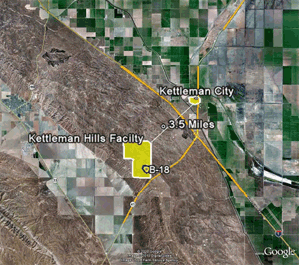
SACRAMENTO, Calif. – The Department of Toxic Substances Control (DTSC) made two significant announcements today that affect California’s hazardous waste management system.DTSC released a draft decision on a permit modification that would allow Chemical Waste Management (CWM) to increase the capacity of the hazardous waste landfill in Kettleman Hills. The Department also announced an effort to reduce the amount of hazardous waste disposed in California by 50 percent by the year 2025. The reduction would affect the amount of wastes going to landfills in Kettleman Hills, Buttonwillow near Bakersfield and Westmoreland in Imperial County.

If approved, the permit modification would allow CWM to increase the size of its landfill, which is operating near capacity, by five million cubic yards. The draft decision is subject to a 60-day comment period.

Brian Johnson, Deputy Director of DTSC’s Hazardous Waste Management Program, said the draft decision to allow expansion of CWM’s Kettleman Hills landfill was made following the most comprehensive review of a permit application in California history.

“We understand the importance of this decision as well as the depth of community interest that this facility is operated safely,” Johnson said. “We looked at all facets of its operation as part of our nearly five-year review.”

The draft permit modification includes extensive and stringent conditions that ensure the community is protected from any potential hazards.

For example, the draft modification requires CWM to significantly reduce the amount of diesel emissions from trucks delivering waste, improving the quality of air. Trucks using the facility must meet model year 2007 emissions standards or be manufactured after 2007, when more restrictive air emission standards went into effect in California. Starting in 2018, trucks will have to meet 2010 emission standards, which are even higher.

DTSC’s review took into account the findings of multiple health studies including the “Cal EPA Kettleman City Community Exposure Assessment,” the “California Department of Public Health Birth Defect Study” and results of a US EPA examination of the risks of exposure to polychlorinated biphenyls (PCBs). DTSC also reviewed air and groundwater monitoring data frothe facility.

The review also took into account the facility’s enforcement record, dating back to 1983. None of the violations, including a $311,000 fine in March 2013 for failing to report 72 small spills, caused offsite impacts.

“The facility’s response to enforcement actions indicates it is able and willing to take all necessary steps to ensure the community is safe,” Johnson said.

Aside from the use of low-emission trucks, additional protections to the community provided by the proposed permit modification include:

Increased air sampling that allows for the detection of very low concentrations of PCBs; Enhanced air monitoring;
Increased sampling and analysis of water that leaches through and collects in a system below the landfill;

Enhanced public outreach;
Improved containment systems to control spills; and
Annual aerial and land surveys of the landfill to verify CWM estimates of remaining capacity.

DTSC will also enhance its surveillance effort at the facility by increasing inspections and collaborating with US EPA’s inspection efforts.

At the same time, DTSC announced an ambitious effort to cut in half the amount of hazardous waste disposed of in California by the year 2025.

California generated an average of 1.7 million tons of hazardous waste each year for the past 10 years. About 600,000 tons ended up annually in the Kettleman or Buttonwillow landfills (the Westmorland facility does not currently accept hazardous waste). Each year, approximately 333,000 tons of waste was shipped to and landfilled in states where environmental regulations are not as strict as California. About 50 percent of the material landfilled at the Kettleman and Buttonwillow facilities comes from contaminated soil removed as part of a cleanup project.

“There is an equity issue for communities that surround the three hazardous waste landfills in California,” said DTSC Director Debbie Raphael. “Despite studies that show the landfills are safe, they are bearing the burden of California’s hazardous waste disposal, often in combination with many other environmental impacts.

“We must start the discussion on how we can end or significantly reduce our dependence on landfills and develop sustainable solutions that protect this generation and generations to come. Setting a goal for reducing hazardous waste disposal will create incentives that can lead to innovations in science and technology and develop sustainable solutions that protect this generation and generations to come.”

DTSC will conduct a dialogue among industry, public interest groups, local governments, elected officials and the public. Meetings across the state will focus on identifying innovative, safe and effective ways for reducing hazardous wastes going to landfills, including developing incentives for reducing the generation of waste.


Raphael said the goal is closely tied to the proposed decision on Kettleman.

“Right now we still generate a significant amount of waste that must be transported, treated or disposed of safely. We want to begin the larger discussion as to how we can greatly reduce hazardous waste going to facilities like Kettleman Hills.”

The 60-day public-comment period for the proposed decision will close September 4, 2013. DTSC will host a community open house on Wednesday July 31 at the Kettleman City Elementary School, a community “drop–in” session on August 1 at the Kettleman City Community Center; and a public hearing on August 27 at the Kettleman City Elementary School.

DTSC will conduct six workshops throughout the state to collect public input on the goal to reduce hazardous waste generation by 50 percent by 2025. The first workshop will take place in the fall of 2013. Locations and times of the workshops will be posted on DTSC’s web site in the near future.


Record Heat Wave

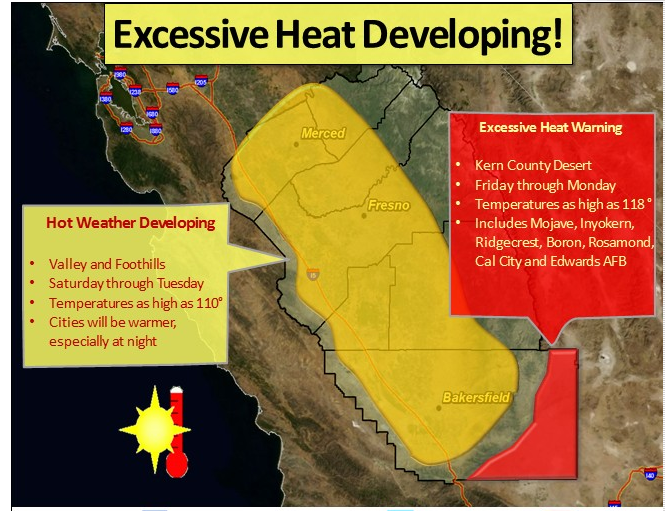
click to enlarge
NWS graphic

We could looking at record consecutive days of heat affecting Central California. NWS Hanford says to expect temps up to110  in foothill locations.Night time temps in Valley cities could be very warm.  On the Coast forecaster John Lindsey says to expect record breaking daily high temperatures in northern SLO county over the weekend into Monday. “The current record for Sunday, June 30 is 107 degrees set back in 1996. Monday’s current record is also 107 degrees that was recorded in 1950. At this time,high temperatures in Paso Robles are expected to range between 107 and 110 degrees during this time frame”On the Coast look for tempos in the 80s on south facing beaches including Cayucos and Avila.Current forecast models suggest Monday could be warmest day of the forecast period.

In Sequoia Kings Canyon no open cmaping fires below 6000ft.

One possibility is that by the end of the heat wave, we may see a record tied or broken for the hottest temperature ever recorded on Earth perhaps in Death Valley which has a 134 F record set in 1913.


Porterville Hospital Lays Off 49

Sierra View District Hospital, a 167-bed, full-service acute care hospital, announced today a reduction of 49 positions effective immediately. The hospital, which serves the Southern Sequoia region of California’s Central Valley, faces financial challenges based on the impact of the Federal Affordable Care Act payment reductions and reduced patient volumes. The hospitl ahas over 700 employes according to the Tulare County Economic Development Corporation.
The hospital’s executive team engaged a third party external agency to conduct a staffing evaluation which reviewed management and staffing levels as they related to the facilities patient volumes. Staffing was compared to other hospitals of similar bed count and utilization. The hospital’s executive team has and will continue to consolidate management across multiple departments. The employees and positions affected were identified through the evaluation process according to hospital policy and legal review.
“I am saddened this has become a necessity. It is a tremendous loss for the organization that weighs heavily upon us,” said Donna Hefner, CEO of Sierra View District Hospital. “However, the reductions were based on industry benchmarks for median staffing requirements and will not affect our high quality patient care,” she explained. All affected employees will be offered a severance package, support services and will be placed on a call-back list for the next six months in the event that patient volumes increase.

Tulare County Cheese Plant Will Layoff 144

Mozzarella Fresca in Tipton will close their Italian cheese manufacturing plant in September laying off 144 workers. The Tulare County plant along Hwy 99 has been in operation since 1997.

Owned by the European dairy firm Lactalis American Group, the company has invested $40 million in a new mozzarella plant in Nampa Idaho that has now expanded and hired new workers.

The company makes fresh mozzarella and other soft Italian cheeses  under the Precious and Galbani label.

Word of the layoffs came in a state WARN notice issued this week to inform workers.

Last year the company told milk supplier California Dairies Inc of the planned closure. The company’s plant manager left Mozzarella Fresca in December to join a new start up in Visalia.

The company announced in February 2012 that construction would start on the $40 million Nampa Idaho plant in March with a 10 month construction schedule.The new 61,000 sf plant would increase production from 7 million pounds currently to 40 million lbs – more than a five fold increase. Some 70 new jobs would be added to the 40 who already work there.

Sources says the Tipton plant employed up to 200 based on time of year. A company spokesman declined to comment.

Mozzarella Fresca is a wholly owned subsidiary of Lactalis American who bought the California company in 2007. At that time it was already the nation’s largest fresh mozzarella maker according to testimony at a 2007 hearing of the CDFA discussing the price of milk in California. The state regulates the milk industry here including the minimum price dairymen get for their milk depending on how the milk is used.

The price of milk was big issue then and may be even bigger now. Lower costs in Idaho may have made a difference here although the Tulare County plant had been cobbled together on a small 1940s footprint and the new Idaho plant was deigned from the ground up.

At that March 2007 hearing CAO of the company Jay Wilverding told a CDFA panel that the high price of milk in California had already caused  them to transfer some 6% of their cheese production to their Idaho plant and that future investment in the small Tipton plant was in doubt because of the regulatory atmosphere in California. The company also closed a plant in Turlock.

Dairymen in California have complained bitterly in the past year that cheese makers in California pay less for their milk than out of state cheese makers pay their milk suppliers. Cheese makers in the state argue their overall costs are higher in California. Their trade group said that small cheese plants in California would be closing and even cited Mozzerella Fresca in testimony last year.

The Tipton plant is a relatively small facility constrained on all sizes from expanding.It is the historic Arden creamery that has been owned by multiple parties until it was converted to make cheese under the Sequoia Cheese label for a time before being purchased and modernized by the then Concord-based Mozzarella Fresca. They relocated production to Tulare County, the number one dairy county in the USA.

Now a new chapter opens for the plant with sources saying is likely to be sold again to a small food manufacturer.

Meanwhile Idaho dairy plants like Chobani Yogurt are on a tear.In December 2012, Chobani Greek Yogurt opened its newest factory in Twin Falls.The company produces 4.2 million cases of yogurt a week and now that total could be doubling. Informed sources say Chobani looked for a plant site in Tulare before deciding on Idaho.

Visalia City Council Weighs Sales Tax Hike … Advisory Committee Votes “No”!

The Visalia City Council is weighing a ballot measure this fall that would increase the city sales tax to perhaps by one quarter percent to 8.50%. A blue ribbon task force has  been meeting this summer to recommend whether to submit the matter to voters.

This week the task force committee voted overwhelmingly “no” on an increase in the tax. Twenty seven of the  hirty eight task force members at the June 18 meeting voted no. More on their reasoning later.

Like the community the city council is divided on the issue even as sales tax returns in the city and across the state have finally shown some improvement.

Council member Warren Gubler points to a June city budget session where staff reported that Visalia was ahead of budget projections on sales tax revenues.

“What I think is notable is that after the city council had adopted a balanced budget for 2013/14 (as part of the 2 year budget cycle), sales tax revenues are ahead of projections by $2,315,500, and total revenues in excess of budget are$1,892,630! “

Gubler said he shared the info with the blue ribbon tax force committee.

“I think these numbers are indicative of an improving economy locally, and should be in the mix when considering whether to impose another sales tax increase on local citizens. If these projections hold up, and the residential real estate market continues to improve, Visalia should be coming out of tough budgetary times, calling into question the need for another sales tax increase.”

Indeed, Visalia forecasts a record-setting $24.1 million in sales tax revenues in the year ending June 30, compared to a high of $23.2 million in 2006-07 – before the recession hit.

Thank higher car sales and better retail numbers at several large new box stores in town. Car and truck sales were up around 25% from 2011-12 statewide.Home improvement stores sales have also bounced back due to the healthier housing economy.

On the other side of the coin is council member Greg Collins who points to staff reports that suggest the city budget has a long way to go to recover from the recession.

Collins says Visalia employees salaries have been stuck at 2008 levels and are just now slated to rise 1% after five years. Deferred maintenance on city facilities around the community is clear as well.

Depleted city reserves that once were as high as $15 million in June 2009 have declined to to $1.3 million as of last June but with new monies coming in should get to $5 million by June of next year.One bit of help  the city is getting $1.9 million from the county in a legal settlement.

Still,city reserves are low after five years of red ink.

“We could squeak by I guess” says Collins,without a sales tax increase ”but the question is whether this is the kind of city we want to be.“

A staff presentation to the blue ribbon group last month pointed to why the city city might want to increase  the sales tax perhaps another 1/4 percent to 8.50 percent.

The state takes away city property tax revenues it once counted on. Visalia loses about $3 million a year on property taxes but imposes  no utility tax like other cities do to make it up. In addition, the state killed the redevelopment agency that had helped to finance local improvements.
Visalia’s historical sales tax dominance has faded.

Visalia imposed a 1/4 percent increase in the sales tax in 2004.  Another 1/4 percent increase would raise $5 million for the city.

The city task force,led by Council-appointed co-chairs Gary Gagliolo and Janice Avila weighed in June 18 recommending not to peruse a sales tax measure arguing three key points.

1.While the City has demonstrated that there are needs and wants exceeding current revenues, it has not demonstrated that these items must be addressed immediately, nor that the only means of addressing them is a new tax stream. In essence, a sense of “crisis” has not been created around these issues sufficient to justify a response of the magnitude represented by a tax increase.
2.Based on the City’s mid-year budget report, it appears that revenues are beginning to rebound as the economy picks up energy and confidence. The City was able to generate a budget surplus in the current year and is now projecting an even larger surplus for the coming year. While these improving revenues will not cover all needs, they do point to opportunities for future resources that can be used to address at least some shortfalls.

3.The survey conducted between May 30 and June 3, 2013, of likely November 2013 voters indicates that adequate support does not exist to ensure passage of the measure. The responses to the survey indicate that the City has not yet successfully convinced the electorate of the immediacy of their need, and the Task Force does not believe that time or resources are available to materially change this situation before this election.

Of course it’s still up to the city council expected to decide next month.

If the Council votes to put the measure on the November ballot, city officials would have to submit the paperwork to Tulare County by or around Aug.10.

California cities and counties vary on the level of sales tax they impose. Visalia currently stands at 8.25%,Tulare County has an 8% rate;Fresno city has 8.225%,City Of Tulare has a 8.5% rate and Selma 8.72%. On a statewide basis higher rates can be seen in Los Angeles, CA (9.75%), Oakland, CA (9.75%), Fremont, CA (9.75%)  and San Francisco, CA (9.5%).

Tulare County’s extra half cent sales tax measure – Measure R – is making possible major improvements to Tulare County’s transportation system and is included in the total 8% as well as Visalia’s 8.25%.

Unlike in some places,Visalians have voted in the affirmative to raise their sales tax in 1994 and again in 2006 for Measure R.

El Nino Coming Back? Unusual Summer Storm Heads For Northern California

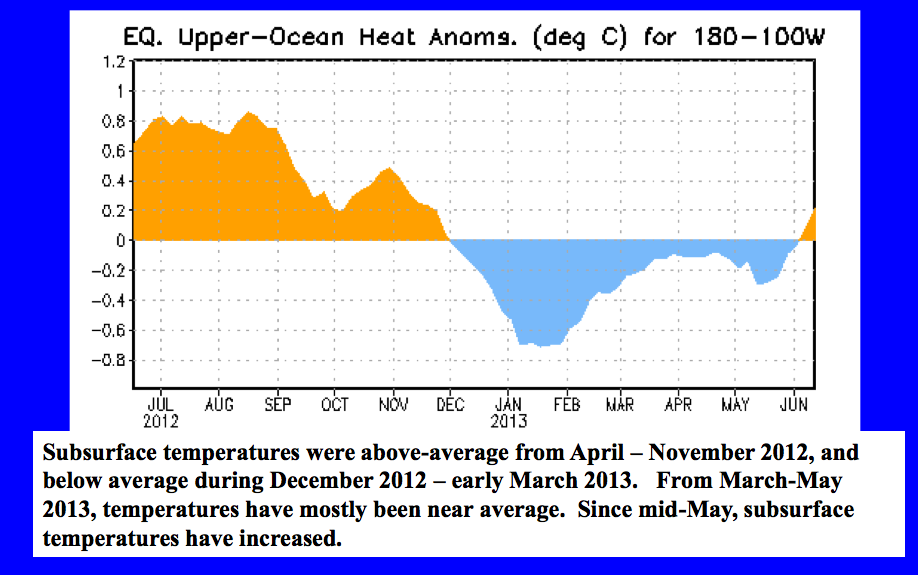
Some long range weather forecasters are seeing a return of the El Nino weather pattern that was around last fall apparently providing a wet early start to winter in California. And then nada. One of the driest Springs on record.

The departure of El Nino this past winter

Notice how the wet weather stopped here in early January just as El Nino lost steam forecaster Alan Fox says.

Now he see a possible come back.
“We are currently seeing a weak, cold La Niña condition (colder than normal sea surface) off the coast of Peru. About mid-summer (late July), weak El Niño conditions are expected to begin, and this is expected to lead to an increase in El Niño conditions through fall and winter months and into the spring months of 2014.”
Agreeing with Fox is Scripps experimental model who is  also forecasting warm (El Nino) conditions for late 2013 and early 2014 heating up water enough to perhaps wet our whistles and rest of this bone dry state.

Groundwater Pumping
After several dry years that would be good news indeed.Central Valley water district mgr water Don Mills says the Sierra will generate only  a 34% runoff this year compared to 40% last year.
“We can’t depend on northern California- we need to capture more of our own runoff and not send it out to sea”
Mills expects another year of groundwater pumping will yield record low water levels and worries that “unless  Central Valley interests move to manage groundwater, the state will.”
“I see in the future if you want to drill a new well you will have to prove a sustainable water supply.That will be an unpopular discussion”
Mills says he has heard spot water sales on the Westside is going for $1200 an acre/ft,” if you can find it.”
Summer Storm?
Meanwhile some relief from the summer dryness is in order over multiple days next week.
Fox says sees a strong weather pattern laying down several inches of rain through the Feather River Basin and south to I-80.
Indeed the NWS is now looking for some records to be broken.

Here is their report this week.
MODELS CONTINUING TO SHOW A TRANSITION TO A WETTER AND COOLER  WEATHER PATTERN IN THE EXTENDED FORECAST PERIOD.

SHORT WAVE  CURRENTLY ROUNDING THE BASE OF THE UPPER LOW IN THE GOA IS FORECAST  TO DEEPEN AND MOVE ACROSS INTERIOR NORCAL SUNDAY. GFS/NAM TRENDING  DEEPER WITH THIS WAVE AND SHOW SOME LIGHT QPF OVER PORTIONS OF  INTERIOR NORCAL…MAINLY NORTH OF I-80.
UNSEASONABLY LARGE AND DEEP LOW PRESSURE SYSTEM MOVES INTO THE EPAC MONDAY WITH 130+ KT POLAR JET TAKING AIM AT NORCAL. THE SYSTEM HAS ENTRAINED TROPICAL MOISTURE FROM THE WESTERN PACIFIC AND ATMOSPHERIC RIVER SETS UP OVER NORCAL WITH PWAT IN EXCESS OF 1.5 INCHES. STRONG ISENTROPIC LIFT COMBINED WITH +5 ANOMALOUS PW PLUME WILL RESULT IN SEASONABLY SIGNIFICANT PRECIPITATION OVER PORTIONS OF NORCAL. MODELS CONTINUE TO SHOW RUN TO RUN INCONSISTENCIES WITH TIMING AND AMOUNT OF QPF BUT HAVE TRENDED WETTER AND SPREAD PRECIP FARTHER SOUTH. POTENTIAL FOR ALL OF THE CWA TO SEE PRECIP MON/TUE WITH DAILY RECORD AMOUNTS POSSIBLE…MAINLY NORTH OF I-80.

MODELS DECREASE PRECIP AND LIFT IT NORTHWARD WEDNESDAY THEN DRY AND WARMER THURSDAY INTO THE WEEKEND AS HIGH PRESSURE FROM THE DESERT SW BUILDS TOWARDS NORCAL.