Sierra Snowpack Still Below Normal Despite Recent Rains

From ACWA

Submitted by Pamela Martineau on Tue, 04/01/2014 – 2:23pm

California’s snowpack still measures far below average despite the state’s recent band of storms, suggesting that the summer snowmelt runoff will offer little relief during the current drought.

Today, snow surveyors with California Department of Water Resources conducted the first snowpack reading of spring, finding that the Sierra snowpack is just 32% of normal. The April 1 reading is considered a bellwether for how much water runoff will be available in the coming dry months of summer for farms and communities.

“We’re already seeing farmland fallowed and cities scrambling for water supplies,”  DWR Director Mark Cowin said in a prepared statement after the snow survey results were released.  “We can hope that conditions improve, but time is running out and conservation is the only tool we have against nature’s whim.”

February and March storms brought some promise to the state after the record-breaking dry months of December and January, but the recent rains have not broken the drought’s three-year grip as reservoirs, rainfall totals and the snowpack remain critically low.

Today’s manual and electronic readings – taken when snowpack normally is at its peak before melting into streams and reservoirs – record the snowpack’s statewide water content at just 32% of average.

Electronic readings indicate that snowpack water content in the state’s northern mountains is 23% of normal.  The electronic readings for the central and southern Sierra are 38% and 31% of normal, respectively.

Reservoirs also are at precipitously low levels. Lake Oroville in Butte County, the State Water Project’s (SWP) principal reservoir, is at only 49% of its 3.5 million acre-foot capacity (64% of its historical average for the date).  Shasta Lake north of Redding, California’s and the federal Central Valley Project’s (CVP) largest reservoir, is at 48% of its 4.5 million acre-foot capacity (60% of its historical average).  San Luis Reservoir, a critical south-of-Delta reservoir for both the SWP and CVP, is a mere 42% of its 2 million acre-foot capacity (46% of average for this time of year) due both to dry weather and Delta pumping restrictions to protect salmon and Delta smelt.

Snow surveyors from DWR and cooperating agencies manually measure snowpack water content on or about the first of the month from January through May to supplement and check the accuracy of real-time electronic readings. This year’s final manual survey is scheduled for May 1.

The year’s first measurement Jan. 3 showed the snowpack at just 20% of average. On Jan. 30, the state’s snow water content measured at a record-low 12% of normal. By Feb. 27, the snowpack reading had risen to 27% of average for that date due to a band of winter storms, but the reading was still well below average.

On January 31, after the winter’s dismal snow surveys, DWR set its allocation of SWP water at zero.  The allocation has not been increased.

The only previous zero water delivery estimate was for agriculture in the drought year of 1991, but cities that year received 30% of requested amounts.

Despite the “zero” allocation, DWR has continued to deliver water essential for health and safety and nearly all people and areas served by the SWP also have other sources of water.

Deliveries could still be boosted by improving hydrology.

The final SWP allocation for calendar year 2013 was 35% of the slightly more than 4 million acre-feet requested by the 29 public agencies that collectively supply more than 25 million people and nearly a million acres of irrigated farmland.  In 2012, the final allocation was 65% of the requested 4 million acre-feet.  It was 80% in 2011, up dramatically from an initial allocation of 25%.  The final allocation was 50% in 2010, 40% in 2009, 35% in 2008, and 60% in 2007.  The last 100% allocation – difficult to achieve even in wet years because of Delta pumping restrictions to protect threatened and endangered fish – was in 2006.

Although 2013 was the driest calendar year on record for much of California, last-minute November and December storms in 2012 – the first year of the current drought – replenished major reservoirs to somewhat mitigate dry conditions.  That reservoir cushion is now gone.

This year is on track to perhaps be California’s fifth or sixth driest year, with its final ranking to be determined.

Electronic snowpack readings are available here. Electronic reservoir readings may be found here.

For a broader snapshot of current and historical weather conditions, see DWR’s “Water Conditions” and “Drought” pages.

(photo: Snow surveyors with DWR measure the Sierra snowpack’s water content on April 1, 2014.)

Construction Projects In Visalia / Porterville

March 29.2014

Screen Shot 2014-03-29 at 11.00.05 AM


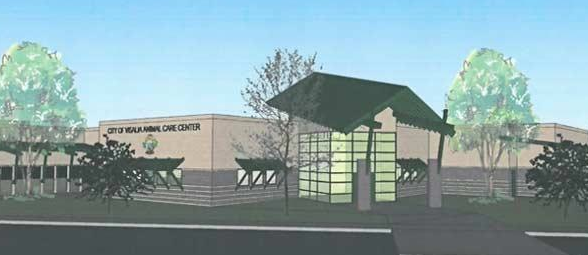
Construction Moving Forward On Visalia Animal Control Shelter

Local firm Forcum Mackey submitted the low bid of $4.6 million to build the new Visalia animal control facility to be built next to the Visalia airport. Mayor Steve Nelson says “we’re doing cartwheels because our earlier estimates were it would cost us $5 to $5.5 million.” The existing shelter is small, built in 1968.


Groundbreaking Set For April 8 For Porterville Cancer Care Center

Sierraview District Hospital will break ground on a new Cancer Care Center on April 8 with construction set to last 15 months.The project includes a second linear accelerator vault, a new and relocated lobby, new exam rooms, a patient consultation room, additional chemotherapy bays and refinishing the exterior to blend better on the hospital campus says spokesperson Ramona Chiapa. “The additional square footage is 3000 sqft. with the  total project area is 12,763 sq ft. “
“We will continue to provide comprehensive care throughout the project, without interruption to radiation or chemotherapy services. There will be parking, drop-off and entrance changes to accommodate the construction areas.  Although inconvenient these modifications will allow us to continue to provide service to the community throughout the project.”
For patients the new facility will mean enhanced treatment options, Improved imaging and patient positioning, Reduce treatment times, minimize patient side effects, improved radiation therapy technology, The best patient experience without leaving the community, to accommodate growth in the community, improve workplace and patient flow and enhance patient experience.

Bids Set For New Porterville Public Safety Building

Bids are due April 22 for the new $4.6 million Public Safety Building in Porterville  in the works for the past few years. The building is expected to improve response times to  provide service  to the community on the south side of Porterville where the city has a 13 acre site . Both federal funds and local sales tax monies will pay for the project.

WOW! Stormy 10-Day Forecast For Cali

Screen Shot 2014-03-28 at 11.17.34 AM

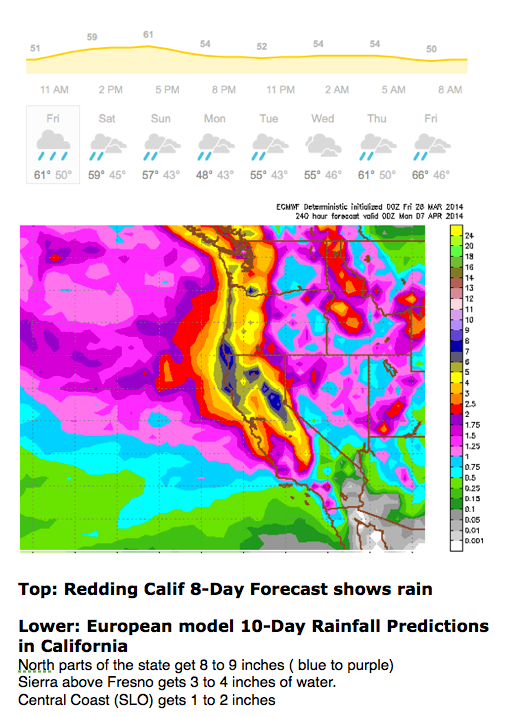
Farmers and communities in Central California awaiting some good news on water might have reason to hope over the next 10 days. Predictions of 8 and 9 inches of water falling in some parts of the state would be far above normal for this time of the year. Redding,next to Shasta Reservoir for example, gets just 2.5 in of rain on average in April. As Shasta fills this Spring there will be water for Valley farmers and communities later in the year.

Bullet Train’s Next Big Step

 HS Rail Final EIR Approval Set For April

The final EIR for the next leg of high speed rail is ready to be certified at a  CHSRA HS Rail2014-02-17 at 8.48.42 AMboard meeting in Fresno next month. That final approval of the  110 mile section through Kings County from Fresno south to Shafter will be heard April 29 and 30th allowing the next steps to buy right-of- way to move forward. The board is expected to both take final testimony on the plan and answer all questions in a marathon event.

Also in Visalia April 8, area small businesses will have a chance to meet the prime contractors who will build this leg called Construction Package 2 and 3. The rail Authority has announced an Industry Forum and Pre-Bid Conference Tuesday, April 8, at the Visalia Convention Center from 10 am to noon. A Pre-Bid Conference, from 1:30 to 3:30 pm will provide networking between prime and sub-contractors.

Water Battle: Judge Halts Local Water Exports

Screen Shot 2014-03-19 at 12.01.18 PMDROUGHT WORSENS PROSPECTS IN SOUTHERN TULARE CO

Lower Tule Water District Gets Injunction Against Sandridge Partners

March 20.2014
Tulare County Superior Court Judge H.N. Papadakis this week granted an injunction sought by Lower Tule River Irrigation District against Sandridge Partners to halt any appropriation of Lower Tule groundwater to property not in the district.

Sandridge acquired farm property in the district west of Porterville in  2012 but grew no crops on it in 2013.

But Lower Tule general manager Dan Vink says the water district is in “overdraft “and as such it is illegal to appropriate water for use on lands outside the district. Vink says the exact amount of water that Sandridge uses outside the district is not yet known but could amount to about 10,000 acre/ft a year.

With an injunction in place Vink says the judge will set the schedule for a trail likely this summer on the issue.

The judge was convinced enough that Lower Tule‘s case had merit that he granted the injunction noting that Lower Tule had established that Sandridge’s pumping of ground water within the district cannot be used on other land; that Lower Tule’s groundwater has been in decline and that Sandridge use of this water outside the district amounted to an appropriation.

Finally the judge found that Lower Tule would suffer “irreparable harm’ from any any continued appropriative use outside the Tule Subbasin.

Sandridge Partners of Sunnyvale is majority owned by John Vidovich.Their attorney told the judge they using water in the Angiola Water District just west of the Tule Subbasin. They claim that Angiola and Lower Tule have agreements in place.

The land Sandridge acquired has six wells and pumps with three of the wells located within the district.

Irreversible Damage

In a meeting with land owners March 5, staff at Lower Tule made a presentation to landowners saying “The groundwater levels and conditions in the Lower Tule and Pixley area have gone past the point of being critical. The current rate of use is not sustainable and is resulting in permanent and irreversible damage impacting the long‐term usability of the aquifer.”

Lower Tule has organized a groundwater task force to come up with some solutions to declining groundwater in the district.
Maps of land west of Tipton and Pixley show declining groundwater levels reaching as low as 280 ft compared to 110 ft in 2012.
The district has told landowners if they do not decide to self-govern, the state is likely todo it for them says civil engineer Dennis Keller.
“We just got a report from Woodville that water levels have fallen 15 feet since January” says Keller.
“Part of the reason we seeing this is that some farmers are irrigating land 365 days a year” he adds,” mostly in support to the dairy industry” to grow feed. It used to be farms needed irrigation water  primarily in the spring and summer months and the water table would rise in the winter.
Major water users in the district include 110 dairies.
Lower Tule is particularly strapped this year with the drought.The district gets a 61,200 af of Class 1 supply from Friant – but this year so far – there is a “zero allocation”.To make matters worse,low rainfall above Porterville means the Tule will not be running much – the only sources besides groundwater.
The Tule landowners presentation also points to land subsidence around Pixley to Corcoran as an issue for farmers with well casing breaks and irrigation canals that no loner flow by gravity. It is also an issue with High Speed Rail with plans to cross the area. “Groundwater overdraft is the cause of land subsidence” says the presentation.
Keller says the land subsidence data shows that continued hard pumping is “damaging the resource. This is just not going to work with collapsing aquifers.”
Keller is not optimistic local farms will get much relief from surface water this year and it has long term implications. “Bankers are telling guys if they cant show a long term supply of water – they are not going to lend them any money.There is simply going to be lots of farms that are going to disappear.”

Around Tulare County: Panera Bread Coming To Porterville

More Non-Farm Jobs In Tulare County

Tulare County’s unemployment rate in January was 15.2% compared to 16.6 % in January 2013 EDD reports. Non-farm jobs climbed by 2600 over the past year while there are 700 fewer farm jobs. Hospitality jobs are up 1100 year over year.

Visalia Building Permits Stay Strong

Visalia building permits were up for the second month in a row over totals for the same month last year. The city permitted 26 single family homes in February compared to 23 in Feb 2013. Commercial improvement permits jumped to 121 vs 79.Total permits numbered 288 vs 226 and valuation increased to $11.2 million vs $10.3 million in Feb 2013. For the year so far, new home permits are up 18%.

Rising Home Values Help Economy

The Federal Reserve reported this week that household net worth rose 14% last year driven in part by a $2.3 trillion increase in the value of real estate. An increases in housing wealth makes it easier for families to borrow on the equity in their homes. In addition this “wealth effect”  helps consumers feel more comfortable opening their pocket books. Meanwhile fewer homes in the US are “underwater.” This week a report said four million homes in the U.S. returned to positive equity in 2013, bringing the total number of mortgaged residential properties with equity to 42.7 million. Still, almost 6.5 million homes, or 13.3 percent of all residential properties with a mortgage, were underwater at the end of 2013, according to CoreLogic Inc. The report said in Visalia-Porterville, 20.8 percent, or 14,314, of all residential properties with a mortgage were in negative equity as of the fourth quarter 2013 compared to 22.9 percent, or 15,729 properties, in the third quarter of 2013. DQ News says the median price of a house sold in Tulare County in January was up 25% compared to a year ago.

Fitch Downgrades Tulare Hospital Bonds

Bond Oversight Committee Losses Confidence In Tower Project

New York-based Fitch Ratings has recently downgraded to ‘B’ from ‘B+’ the rating on $15,230,000 series 2007 fixed rate bonds issued by the Tulare Local Health Care District d/b/a Tulare Regional Medical Center (TRMC). The bonds have been placed on Rating Watch Negative. The ratings firm says “TRMC’s liquidity position is very weak” adding that unrestricted cash and investments were $6.3 million at Dec. 31, 2013 compared to $10.5 million at Dec. 31, 2012 and $24.4 million at FYE 2010.
Looking at TRMC’S delayed tower construction project, Fitch pointed to new efforts by the hospital’s recently hired management firm. “TRMC is leveraging HCCA’s expertise to renegotiate contracts and develop a recovery schedule.” Fitch sounded a hopeful note on TRMC’s declining patient revenues. “HCCA is projecting TRMC to break even by the end of calendar year 2014, which Fitch believes is relatively attainable.”
Also this week the District’s Bond Oversight Committee after hearing a discouraging report on lack of progress on construction of the tower in January heard that the district had just $6.31 million left in their budget for a project that will need $18.5 million to complete.The advisory group said they had lost confidence in the way the tower project was moving and will report that to the District board later this month.

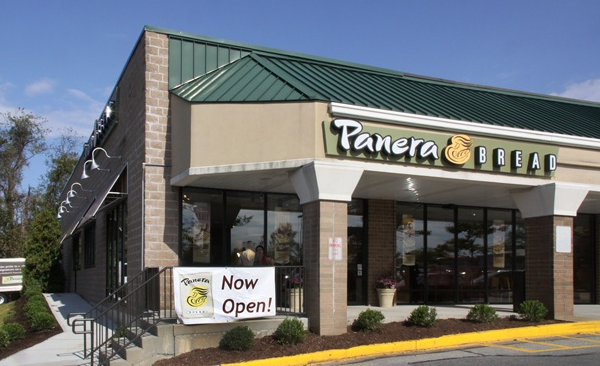
Screen Shot 2014-03-08 at 10.40.16 AMPanera Bread To Porterville

Fast growing Panera Bread will be coming to the Porterville Marketplace shopping center on Henderson in late 2014 in a 4200 sf restaurant space. Plans for the buildlng have been filed with the city. The restaurant already has locations in Visalia and Hanford and across 38 states.

Fresno’s Wathen Castanos Buys Mangano Homes

Wathen Castanos, a Fresno-based builder announced it had purchased Mangano Homes, owned by long time Visalia home builder Andy Mangano. The Fresno company already ahas home projects in Visalia but will take over Mangano projects in Visalia and on the Central Coast.Mangano serves on the Wathen Castanos board.
The sale does not include Mangano Co Inc, owned by brother Craig Mangano who will continue to do mixed-use and commercial projects says Craig.”Andy and I will continue to work together on various projects” says Craig,mostly on the Coast these days.

Coast Firm Plans Asphalt Batch Plant in Visalia

Pismo Beach-based Papich Construction plans to build a new asphalt batch plant in the Visalia Industrial Park with the project being the subject of a public hearing March 24. The plant would be built on 18 acres on Sunnyview Ave. Papich supplies asphalt to large public works projects like Hwy 99 widening, now underway in Tulare County.

Tractor Supply Coming To Dinuba

Dinuba Planning Commission has approved a lot split last month on El Monte Way paving the way for a new Tractor Supply store that will be opening here.The farm and ranch retailer has over 1276 locations in the US. The 2.5 acre lot will be developed by California Gold Development with plans to break ground later this month on a 20,000 sf store.

Gas Prices Head Higher

AAA says So Ca gas price averages are now within a few pennies of $4 a gallon after five straight weeks of price increases in most areas.The state average is $3.891 a gallon for regular, 6.6 cents more than last week.The price is up about 40 cents compared to a month ago with the best price around Visalia at $3.65. Oil companies continue to export more product, pull more oil from US soil and move more oil by pipe and rail but critics say all this activity has not lead to Americans getting some relief at the pump.World oil prices are higher in the past month.

No Milk,Plenty Of Big Gulps

New Study Analyzes Tobacco, Alcohol, & Food in Stores In Tulare County

Screen Shot 2014-03-05 at 12.04.22 PMVISALIA, CA – New data reveals that Tulare County has more stores
that sell candy, mint, and liquor flavored non-cigarette tobacco
products and are near schools than the state-wide average. This finding
is part of new data released today on the availability and marketing of
tobacco, alcohol, and unhealthy food products in stores that sell
tobacco.

The state-wide survey collected information from more than 7,300 retail
stores – including convenience, supermarket, liquor, tobacco, small
market, discount, drug, and big-box stores – in all 58 counties, to
shed light on what products are most promoted in our communities. Nearly
700 public health representatives, community volunteers and youth
participated in the survey.

“There are too many stores near to schools that are marketing and
selling tobacco and alcohol products to our young people here in Tulare
County,” said Dr. Karen Haught, Tulare County Public Health Officer.
“HHSA and our community stakeholders are committed to partnering with
quick mart stores, school officials, and parents in Tulare County to
make our community healthier and more aware of the dangers of tobacco
and alcohol consumption.”

Survey results for Tulare County show positive statistics for the
percentage of stores that accept CalFresh or WIC, stores that feature
healthy exterior advertising, and a lower percentage than the state on
stores that sell e-cigarettes.  However, these negative outcomes remain
a grave concern for Tulare County officials:
●       85.3% of stores sell candy, mint, and liquor flavored
non-cigarette tobacco products and are near schools, compared to the
state average of 75.3%
●       84.6% of stores sell tobacco products and only  31.6% sell milk,
versus the state average of 79.4 and 37.2%
●       Only 33.8% of stores sell fresh fruits or vegetables, compared
to the state average of 42.4%
●       58.9% of Tulare County stores sell sugar sweetened beverages at
the check-out and are near schools, as compared to only 55.6%
state-wide
●       82.6% of stores sell alcohol, versus the state-wide average of
only 71.3%
●       69.2% of stores sell chewing tobacco versus the state average of
only 56.1%

Results suggest a relationship between these negative statistics and
outcomes like:
●       72.5% of adults in Tulare County are overweight or obese as
compared to the state average of only 59.8%
●       41% of youth used alcohol in the past 30 days as compared to the
state average of 35%
●       17.8% of adults and 12% of youth smoke in Tulare County versus
the state average of only 13.8% of adults and 10.5% of youth

“The need for easy availability of healthy fruits and vegetables is
one of the most important issues in Tulare County, and one that can
either lead to a healthy lifestyle, or to a rise in chronic disease and
obesity levels in both our children and adult populations,” said
Tammie Weyker, Media Spokesperson for Tulare County Health & Human
Services Agency. “We want to work with our small business owners on
choosing to carry fresh fruits and vegetables and still meet and exceed
their bottom line so that our families can have the option to feed their
children healthier foods.”

Healthy Stores for a Healthy Community is a statewide campaign – formed
by tobacco prevention, nutrition, and alcohol prevention partners
working in collaboration – to improve the health of Californians by
informing them about the impacts of unhealthy product marketing in the
retail environment.

Reclamation Seeks Review Of Upper San Joaquin River Basin Storage Investigation

Screen Shot 2014-03-03 at 10.57.16 AMTemperance Flat Proposal Aired
March 3,2004

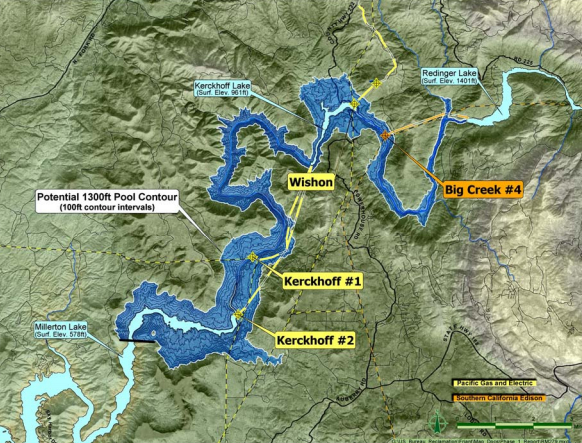
SACRAMENTO, Calif. – The Bureau of Reclamation released a Draft Feasibility Report on the Upper San Joaquin River Basin Storage Investigation that examines the potential to construct a new dam and reservoir on the upper San Joaquin River, between Friant and Kerckoff dams.

Reclamation is releasing this draft feasibility report to share information generated since completion of the Plan Formulation Report in 2008. A Draft Environmental Impact Statement will be prepared later this year for formal public review and comment, consistent with the National Environmental Policy Act.

“Today’s release of the Upper San Joaquin River Basin Storage Investigation Draft Feasibility Report is a vital step to building drought resilience in California,” said Regional Director David Murillo. “The unprecedented drought conditions that we are currently facing firmly reinforce the need to investigate projects like this one to help meet the challenges of lean water years.”

The potential project would improve water supply reliability and flexibility for the water management system for agricultural, urban and environmental uses. It also would enhance San Joaquin River water temperature and flow conditions to support anadromous fish restoration efforts.

The location of the potential dam site at Temperance Flat is on the upper San Joaquin River, about 25 miles northeast of Fresno, in California’s Central Valley. The dam and reservoir would be 665 feet high with a capacity of 1.33 million acre-feet.

The investigation is one of five surface water storage studies included in the 2000 CALFED Bay-Delta Programmatic Record of Decision. The CALFED Bay-Delta Program is a 30-year program among 25 federal and state agencies with responsibility in the Sacramento-San Joaquin Delta.

The draft report addresses the potential costs, benefits, and impacts of four action alternatives. The document, which also includes a no-action alternative, is available on Reclamation’s website: http://www.usbr.gov/mp/sccao/storage/index.html. A 60-day public comment period on the study begins on Tuesday, Feb. 18, 2014. Written comments may be provided at any time before midnight Monday, April 21, 2014, and should be mailed to Sharon McHale, Project Manager, Reclamation, Planning Division, 2800 Cottage Way, Sacramento, CA 95825-1893, 916-978-5086 (TTY 800-877-8339), or email smchale@usbr.gov. All comments will be considered during preparation of the Final Feasibility Report.

For questions, please contact Sharon McHale, Project Manager, Bureau of Reclamation 2800 Cottage Way, MP-700, Sacramento, California 95825, or fax 916-978-5094 or email smchale@usbr.gov. To request an electronic copy of the draft document, please contact Steve Geissinger at 916-978-5108 (TTY 800-877-8339) or email sgeissinger@usbr.gov. Copies of the documents may also be viewed at the Reclamation Regional Library, 2800 Cottage Way, Sacramento, CA 95825, by calling 916-978-5593. For more information about the Upper San Joaquin River Basin Storage Investigation

Tulare County Pulls Out of EDC

Screen shot 2012-05-11 at 8.49.02 AMThe Tulare County Board of Supervisors voted 4 to 1 this week to pull out of the Tulare County Economic Development Corporation. The independent agency whose goal it is to increase economic activity in the county, has now lost the support of the County itself. The County has supported the countywide economic development agency for some 31 years.

The majority of the supervisors said they were disappointed by the” lack of communication” between the County and the agency headed up by EDC president Paul Saldana. They noted the agency had not offered a report to the supervisors ”in quite some time.” The county sends the TCEDC $79,200 annually in dues and over the past 14 years has contributed $1.1 million.

Chair of the board Phil Cox says after he heard what the majority of the supervisors had to say about the performance of the EDC he decided “it’s time to cut the apron strings.”

“The last straw for me was our trying to convince them to work to expand existing businesses and not only concentrate on bringing in new companies.” He says their ideas were ignored.”We know 80% of our economic expansion comes from existing business.”

County staff had outlined three choices the supervisors might consider  in making their decision. But only supervisor Pete Vander Poel moved to cut the funding level to $20,000 a year with the rest deciding the end the relationship.

Staff noted the end of the state Enterprise Zone program that was overseen by the EDC that will coincide with the end of the county contribution with the new fiscal year in July.

In the meantime the County has funded a new Economic Development Office that is promoting business expansion around the county including new solar and alternative energy projects and new retail and other development in the county’s smaller towns.

The Tulare County Economic Development Corporation board is meeting one day after the decision,on February 26, to plan their next move.

Tulare County EDC vice chair Craig Vejvoda,a council member from the City of Tulare,supported the EDC’s track record speaking to the supervisors at their meeting this week.

Vejvoda submitted a letter from their board that concluded that “The Tulare County Economic Development Corporation has a long history of success and the vast majority of the board of directors are pleased with the performance of the EDC staff.”

The letter pointed out that in a 2011 SCE fiscal impact study “for the prior four fiscal years, the County contributed $276,800 to the EDC and the return on investment during the same time period the projects the EDC assisted with generates $466,000 annually to the County in taxes and fees. The Board of Supervisors indicated at the time that receiving $2.24 in new annually recurring revenue for each $1.00 contributed was a good return on investment.”

“Another fiscal impact analysis was conducted by Southern California Edison in 2013 for projects the EDC worked on since the joint meeting with your Board.These projects generate $256,000 in new annually recurring revenue to the County. In addition, projects that have been announced but not yet constructed will potentially generate another $530,000 in new annually recurring revenue to the County of Tulare.”

Vejvoda says the EDC “will now have to scale back some and perhaps seek more support from private companies.

Budget Cuts

Saldana says the EDC’s current 2013-14 budget is $576,381.” In August 2013, we developed a preliminary budget for 2014-15 of $369,290 based on the elimination of the enterprise zone program and the expected elimination of participation by the County.  That may change over the next couple of months as we finalize our budget and work plan, but that has been the number we have been planning on since August. ”

The County staff report notes that the EDC was notified some time back of likely cuts and had expressed confidence it could continue to carry out its work. Each entity’s economic development staffers have said privately they would continue to cooperate with each other, vowing to work together.

The EDC board is made up of representatives of the 7 cities,public utilities,real estate and construction firms as well as banks.

Most recently the EDC has been named as a lead contact in helping to bring in a new cheese plant to Tulare. Leads from various state and regional sources often come to the EDC offices based in Tulare.

Vejvoda has “we will continue on our mission which is job creation in Tulare County.” The EDC claims it has had a hand in bringing in some 100 companies into the county including the clothing distributor VF Corp in Visalia who appear in EDC advertisements.

Red Ink Piles Up At Tulare Hospital

Screen Shot 2014-02-26 at 3.57.10 PMRed ink continues  to pile up at Tulare Regional Medical Center with the January financial report showing the district lost another $591,787 in January adding up to $4.85 million so far this fiscal year with five months to go. The hospital’s budget had assumed just a $1.5 million loss. The $4.85 year-to-date loss compares to a $4.18 million loss for the same months last year.
January’s daily census in the 112 bed facility was 44 patients compared to 63 this time last year even though it was height of flue season. Year-to-date the census is down to 41 compared to 52 through this time last year. The hospital logged 218 surgeries compared to 249 for the same month in 2013.
Not just the hospital but the district-owned clinics have seen a 40% drop off in primary care visits says the finance report.
Recently plans to build a new Earlimart clinic moved forward with the clinic  likely to open by  the end of this year funded by a $500,000 grant. In addition Tulare Westside clinic opened in January of this year with farmer Luther Khachigian offering to donate $200,000 for the facility in honor of his wife, Glenda.
Regard the completion of the new Tower a report says the district  will need $11 million to complete the long delayed project but has just $6.3 million available.