Woodlake Concerned About Private Water Pumping Near Bravo Lake

April 29,2015-

Tulare County has the highest number of well failures in the state so it is ground zero for concerns over sinking ground water tables.

With tight water supplies around the state this spring it is not a surprise that communities like Woodlake California are suspicious of anyone who appears to be helping ground water leave town.

Several local reports suggests that water tank trucks have pulled up to Woodlake fire hydrants to help themselves bound for somewhere,no doubt, where they also need water.
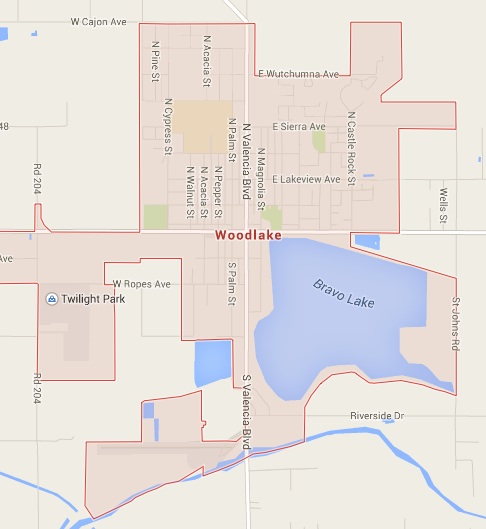
Bravo 2015-04-22 at 12.17.26 PMWoodlake is near the Sierra as well as near the Kaweah and St Johns  Rivers and depends on water wells near both those waterways and  next to privately-owned Bravo Lake.

That’s why there is concern at city hall about reports that a private land owner near Bravo Lake has had his ag pumps running 24 hours a day and is pumping that groundwater into Bravo Lake next to the city.

Bravo lake is is owned by Wutchumna Ditch Co whose stockholders are from all over Tulare County including Lindsay Strathmore Irrigation District in Lindsay Bravo lake is used as irrigation supply for its stockholders.

Woodlake city administrator Ramon Lara confirms the city’s concern that this pumping could be affecting city wells. “We have seen some drop off.”

Lara recently met with representatives of the land owner as well as Wutchumna to see if something could be worked out.

The two sides agreed Tuesday that the pumping would be turned off for 7 days starting Friday April 24 of  see if city wells respond, says Lara.

“Our wells are150 to 200 ft deep with two next to Bravo Lake and three by the St Johns” adds Lara.

Wutchumna staffer Dave Hanks plays down any dispute noting the two entities have along history of cooperation and that Bravo Lake impounding of water offers a measurable benefit to the city in terms of percolation into groundwater.

Independent water consultant Dennis Keller says he has heard about the complaints and adds he has no personal involvement.

“Groundwater use always goes with the property and if it goes off that property it is typically subject to challenge if people think their water wells are being affected.”

He says some landowners pump into a canal for use elsewhere but continue to do so because they are not challenged.

Keller says like most other waterways in the county the Kaweh River and St Johns will have a very limited flow this year with Sierra runoff on the Kaweah expected to be as little as 13% of average.

Woodlake was originally incorporated in 1940 according to a history of the community.  “After a legal battle with the Wutchumna Water Company over boundaries, the city was un-incorporated and re-incorporated in 1941 with Bravo Lake outside the city boundaries when the town officially became a city in 1941.”

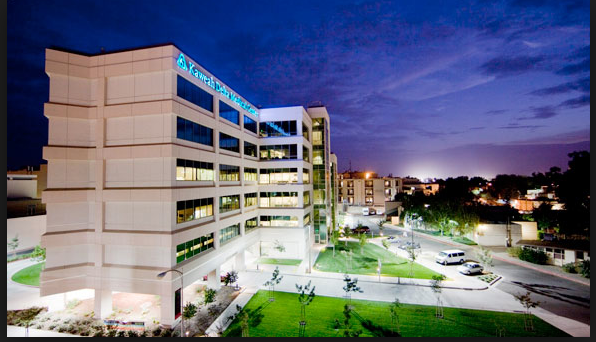
Kaweah Delta Gets Grade of ‘A’ In Patient Safety

Hanford / Tulare / Porterville Hospitals Ranked Low

April 29,205

Screen Shot 2015-02-16 at 6.32.56 PMVISALIA – Kaweah Delta Medical Center has earned an “A,” the top grade for patient safety in the latest Hospital Safety Score. The score rates how well hospitals protect patients from accidents, errors, injuries and infections.
Meanwhile in the same national ranking Tulare Regional Medical Center  earned a ‘D’ grade as did Hanford Medical Center. Porterville’s Sierra Vista got a ‘C’ grade.All three had the same grade last year.
About 40% of California hospitals received a ‘C’ grade or lower.
“This ‘A’ recognizes the dramatic improvements we’ve made in quality of care and patient safety. We’re proud of this honor, but our goal will always be to improve our performance in the future for our patients,” said Lindsay Mann, Chief Executive Officer of Kaweah Delta Health Care District.
Kaweah Delta’s performance improved from last year when it got a B rating.
Kaweah Delta is one of 31 percent of hospitals across the country who received As in Leapfrog’s Hospital Safety Score. The Visalia-based hospital raised its safety score an entire grade level from last year through a variety of initiatives that educated staff about best practices for patient safety. Clinical leadership and frontline staff implemented best practices to reduce surgical complications. Additionally, staff members have continued safe practices such as work to prevent hospital acquired infections, pressure ulcers, falls and more, said Sandra Volchko, Director of Performance Improvement and Patient Safety at Kaweah Delta.
“It’s up to us to have processes in place, and we do, to make sure that when patients come into the hospital they don’t leave with something such as an infection or injury. We wouldn’t be an ‘A’ without those,” Volchko said.
The Hospital Safety Score is the gold standard rating for patient safety, compiled under the guidance of the nation’s leading patient safety experts and administered by The Leapfrog Group (Leapfrog), an independent industry watchdog. The only hospital safety rating to be peer-reviewed in the Journal of Patient Safety, the score is free to the public and designed to give consumers information they can use to protect themselves and their families when facing a hospital stay.
Kaweah Delta’s A grade validates its achievement in preventing harm within the hospital, said Leah Binder, president and CEO of The Leapfrog Group, which administers the Hospital Safety Score. “We are proud to recognize the efforts of the care providers and staff at Kaweah Delta,” Binder said. “Patient safety requires constant vigilance, and we encourage Kaweah Delta to continue demonstrating unrelenting commitment to patients by consistently providing a safe environment for care.”
Developed under the guidance of Leapfrog’s Blue Ribbon Expert Panel, the Hospital Safety Score uses 28 measures of publicly available hospital safety data to produce a single A, B, C, D, or F score. This score represents a hospital’s overall capacity to keep patients safe from preventable harm. More than 2,500 U.S. general hospitals were assigned scores in April 2015.
The Hospital Safety Score is fully transparent, offering a full analysis of the data and methodology used in determining grades on the website. To see Kaweah Delta’s score, visit www.hospitalsafetyscore.org.

Glimmer Of Hope For Friant Water Users

Farmers Could Get 50,000 Acre Feet

April 25,2015

Tulare County farmer Tom Barcellos has heard all the talk about farmers not doing their part to save water in California and grimaces.

”We have zero allocation starring at us for a second year in a row” through the Central Valley Project.

“When you get zero water – it’s hard to promise to save more than that.”

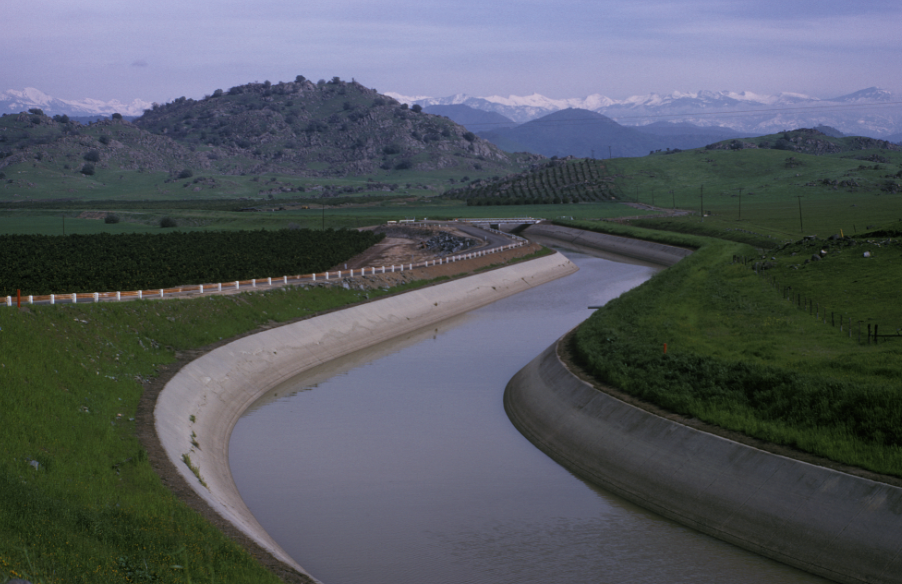
Screen Shot 2015-04-25 at 6.27.07 AMFriant Water Authority says farmers along the eastern side of the Valley including Tulare County who normally get water from the big Friant Kern Canal “can’t survive another year” without it. The canal irrigates the most productive land in the number-one ag county in the US that is also home to the state’s billion dollar citrus industry.

At a Friant board meeting held this week in Visalia with federal Bureau of Reclamation officials in the room – there appeared to be understanding of how serious the situation for local farmers has become.

“I do think they understand” says Barcellos,and “there is a glimmer of hope.”

The hope comes in a tentative plan to round up around 50,000 acre feet that could be delivered to farmers this summer along the Friant Kern Canal – water over and above about 6,000 af proposed to municipal users like the town of Lindsay.This would mean, unlike last year – water would be delivered along the 153 mile canal.

So says Friant GM Ron Jacobsma, now outgoing general manager. Jacobsma stepped down at this week’s meeting but will continue working for the group for several months.”I’ve got a lot to do if we are going to get some water.”

Jacobsma says ”the Bureau said they are going to try to work with us “ to keep what we have in reservoirs on the upper San Joaquin – perhaps 90,000 acre ft to 50,000 acre ft that we could use. ”They think its closer to 50,000 af.”

The idea would be rather than release 50,000 af down the river to the Exchange Contractors who would get just 40,000 acre ft after river percolation losses – do a separate trade or purchase of water.

Through exchanges,transfers and payments by Friant farmers hopefully 50,000 af could be obtained and offered to the San Joaquin Exchange Contractors who would add that to what they will get out of Shasta reservoir delivered by the Bureau.

Last year the Exchange Contractors who have rights to San Joaquin River water if they can not get it from Shasta – received around 300,000 af from Shasta and took 200,000af from Friant – all of their supply.

This year Friant – due to poor rainfall, has only 50,000 af available that is not committed.Some must be kept in reservoirs dead pools and about 125,000 af will go down the river to smaller contractors. In this dry year like last, there will be no release for “restoration.”

So it looks like they may be able to keep 50,000 af.

Jacobsma says 50,000 af is enough to save 50,000 acres of orange trees this summer with an acre-foot of water, keeping trees alive although not enough to produce a crop. In Tulare County alone there is over 100,000 acres of citrus – mostly on the east side, some with no ground water.

Jacobsma expects that not all Friant districts will take water this year considering it will a small amount to be divided up and some districts are more needy than others.

“Water moving in the canal will allow local exchanges.”

“In the last  dry year in 1977, we still delivered over 200,000 af of water to our contractors” adds Jacobsma. In an average year it is more like 750,000 af of surface water, even more in wet years.

Last year of course they delivered close to zero.

At issue is whether there is enough federal water stored in Shasta Dam to give the San Joaquin River Exchange Contractors their “critically dry year supply” of 650,000 acre ft this year, a move that would allow Friant Water Users to tap their own water stored above Friant Dam on the upper San Joaquin.

Compared to last year Shasta is fuller – at 70% of historical average compared to just 59% in April of 2014. There is about 300,000 af more this year.

In this, the fourth year of the drought, Ron Milligan, Reclamation’s Mid-Pacific Region Operations Manager, told Friant officials a few months ago it did not look good this year again. He said that under a continued dry scenario, “It doesn’t appear that there would be any water available for any Class 1 supply.”

Earlier this week Exchange Contractors GM Chris White said his understanding is that the issue is status quo like last year and to make the Exchange Contractors whole they would again make a call on Friant for water stored above Friant Dam to be released down the San Joaquin River for Exchange Contractor use.

But White added “there are still some negotiations going on that could help” apparently referring to this plan.This group of Los Banos-based farmers have been working with Friant and the Bureau to try to get Friant some water.

Barcellos hopes the Bureau may make some sort of announcement on the idea next week.

Jacobsma says if the plan hatches – he expects only some of the districts will take water this year while others trade to allow the most needy farmers to save their orchards

“There is just a ton of anxiety out there.”

Tough Time For Citrus

April 17,2015

ACP,HLB, Port Shutdown,Brown Rot,Red Scale & Fruit Drop …. Plus No Water

There is more than drought worrying Tulare County citrus growers in this, the number-one citrus growing county.

For starters while the county is infested with Asian citrus psyllids (ACP) there is new concern about the deadly disease these critters carry.

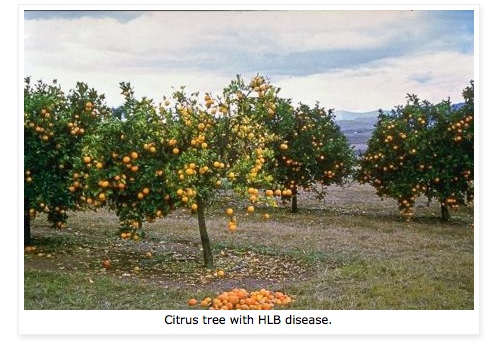
A HLB infected tree could in our midst in a backyard residence in Farmersville. The CDFA is testing the citrus tree for the presence of  HLB or citrus greening disease that has wiped out the citrus industry around the world and done $4.5 billion in damages to Florida’s citrus trees. Production in Florida is half what it was in 2005 and grower costs have skyrocketed.

HLB is spread by Asian citrus psyllids. The Farmersville home owner told officials he brought the tree from Oaxaca Mexico,a known hotbed of HLB.

HLB- USDA pic  2015-04-15 at 11.12.38 AM

“We don’t know yet if the tree has the disease but we don’t want to take any chances” says county ag commissioner Marilyn Kinoshita. Additional tests are underway through the CDFA, she adds

“Whether the tree is found to be infected, it needs to come out of the ground and be buried” says industry group Citrus Mutual spokesman Bob Blakeley.

UC Lindcove entomologist Beth Grafton Cardwell says the state of the art test we use is inadequate because symptoms may not show up for a year. “We are expecting CDFA will soon remove the tree to prevent any possible spread.”

Kinoshita says CDFA have more info soon.

Common in Florida and Texas – California has logged only one case of HLB in 2012 in a backyard in Hacienda Heights –  also involving budwood brought in illegally.

Out Of Control

In the meantime, the region’s fourth warm winter in a row is encouraging the psyllids to be flying early says Grafton Cardwell.”We would not expect this level of activity until fall.” Most of the county has been quarantined because of new finds of ACP who have set up permanent residence here.

Grafton Cardwell says the warm winters mean a host of other pests are not dying off from the cold resulting in bigger population each year. ”The red scale problem is out of control.” Left unchecked, red scale can cause trees to die back. She encourages extra treatments by growers to fight the problem.

Kinoshita says the current pest explosion includes more than bugs – squirrels chew on irrigation hoses and dig holes everywhere.

Chinese Market

Then there is the brown rot problem says Bob Blakeley. ”China just shut down all our citrus shipments from Tulare County this month” says Blakeley – due to finding a high incidence of a specific brown rot on fruit shipped into that country.

Blakeley says the brown rot – that is soil born – may have been spread by that big storm in December that splashed the spores up on the trees. Wow, what irony in this dry year!

China is the third largest export destination for our citrus crop says Blakeley, and we export about 25% of the orange crop.

To fight the brown rot problem growers are encouraged not to pick oranges from near the bottom of the tree.

Our exports are off 50% this spring” says Blakeley.

Adding to the export woes was the West Coast shutdown of the ports  that stalled more than 100 loads of oranges says Kinoshita. The upshot is  that prices went down because the domestic  market get was saturated, says Blakeley. Orange prices in 2014-15 were lower than the year before, he says.

Still more weather related problems. Fruit drop this Spring is a problem as the citrus can’t keep on the trees as long as usual and the season has been cut short.

All this and we have not touched on water which will be a big issue for this fall’s  crop if the Friant Kern Canal can’t – like last year- deliver  much water to Eastside citrus growers where more than 70% of them are.

Blakeley expects areas where there is little or no groundwater like Terra Bella, Orange Cove and Lindsay to suffer. ”We will see more orchards bulldozed.”

Farmers are looking long term as advocates encourages locals to support efforts to build more water storage.

How about some good news? This year’s citrus crop is especially good tasting most agree. Blakeley responds that he agrees as well.”But we hope we will have the opportunity to keep producing in the future.”

Endangered Sierra Nevada Bighorn Sheep Restored to Yosemite and Sequoia National Parks

April 16,2015

A multiagency operation was recently concluded that returned two herds of endangered bighorn sheep to locations in Yosemite and Sequoia National Parks. The California Department of Fish and Wildlife (CDFW), Yosemite, Sequoia, and Kings Canyon National Parks, Inyo National Forest, and the U.S. Fish and Wildlife Service, worked together on the complex operation in the Sierra Nevada.
Between March 26 and March 29, 2015, nine ewes (females) and three rams (males) were moved from the Inyo National Forest and Sequoia National Park to the Cathedral Range in Yosemite National Park. In addition, seven ewes were moved to the Laurel Creek area of Sequoia National Park; the CDFW will attempt to move an additional 3 rams to that area on March 30.


Screen Shot 2015-04-16 at 10.04.27 AM

 
The Sierra Nevada bighorn sheep is the only federally endangered mammal in Yosemite, Sequoia, and Kings Canyon. This animal was listed in 2000 after the population plunged to a low of about 100 individuals. The population has since increased to over 600, which marks an important milestone towards their recovery. Prior to the arrival of western settlers, which brought unregulated hunting and diseases in their livestock, bighorn sheep populations likely numbered in the thousands.
This latest chapter in the multi-year recovery effort involved the capture of Sierra Nevada bighorn sheep in wilderness areas on these federally managed lands. CDFW staff and volunteers, as well as veterinarians, biologists, and staff from other agencies, assessed the health and safety of the animals throughout the entire process. Each animal was fitted with a radio collar and a Global Positioning System (GPS) collar in order to track its movements over the next several years.
The newly released bighorn sheep are expected to thrive in their new homes because both of these historically occupied areas have superb summer habitat with adequate forage, are close enough to other Sierra Nevada bighorn sheep to provide the potential for connectivity among herds, and are far enough from most domestic sheep grazing areas to provide a buffer from potential disease transmission.
“This is a legacy event for Yosemite National Park and the bighorn sheep,” said Don Neubacher, Yosemite National Park Superintendent. “Additionally, this is one of the Signature Centennial projects for the National Park Service and we are ecstatic to see bighorn sheep in the Cathedral Range for the first time in more than 100 years.”
“This project would not have been possible without the leadership of the California Department of Fish and Wildlife and strong interagency cooperation with the U.S. Forest Service, and the U.S. Fish and Wildlife Service,” said Woody Smeck, Superintendent of Sequoia and Kings Canyon National Parks.
“With this week’s reintroductions, we now have bighorn distributed throughout all geographic areas identified as critical habitat in the Recovery Plan,” said Tom Stephenson, leader of the Recovery Program with CDFW.
Yosemite Conservancy funded equipment and experts to bring the new herd into Yosemite National Park, as well as the GPS collars to track the animals’ movement and location. Over the past 20 years, Yosemite Conservancy has funded nearly $630,000 to help protect bighorn sheep by supporting research, translocation efforts, radio and GPS collars. The Sierra Nevada Bighorn Sheep Foundation and the Wild Sheep Foundation funded the translocation into Sequoia National Park.
“Bighorn sheep are a true symbol of wilderness and represent the need to protect wild lands,” said Frank Dean, Yosemite Conservancy President. “With the reintroduction, visitors will experience a wilderness similar to that found in the days of John Muir, when large alpine wildlife was abundant.”
Sierra Nevada bighorn sheep are well known for their large size, strength, and ability to negotiate precipitous terrain. Adult males, called rams, stand over three feet tall at the shoulder and weigh up to 220 pounds; females, called ewes, weigh up to 155 pounds. Both rams and ewes have permanent horns; rams’ horns are massive and coiled, whereas ewes’ horns are shorter with less curvature. Bighorn sheep display a range of body coloration, from dark brown to almost white, and have a large white rump patch and a short, dark tail. Rams live to be 10 to 12 years old, and ewes live to be 12 to 17 years old. During breeding season (rut), bighorn rams compete for their right to mate with ewes. Dominance behavior includes kicking, butting, neck wrestling, and dramatic horn clashes that sound like thunder. Breeding generally takes place in November. Starting at two years old, ewes give birth to one lamb between late April and mid-June. Mothers typically wean their lambs by five months of age. The lambs become independent of their mothers when they are about one year old.
Editor’s Note: Video and still images of the reintroduction are available at ftp://ftp.dfg.ca.gov/oceo
Bighorn sheep in Sequoia and Kings Canyon:
In 2014, Sierra Nevada bighorn sheep (Ovis canadensis sierrae) occupied the Great Western Divide for the first time in over 100 years due to recent efforts by state and federal agencies. Between March 19-22, 2014, a total of 10 ewes (females) and 4 rams (males) were translocated from land in the Inyo National Forest to the Big Arroyo area of Sequoia National Park by the California Department of Fish and Wildlife, in cooperation with the National Park Service (Sequoia and Kings Canyon National Parks), U.S. Forest Service (Inyo National Forest), and the U.S. Fish and Wildlife Service.

Main Street Landmarks Change Hands In Visalia

Palace

Old Palace Hotel whose second floor has been boarded for 70 years looks like it will get a revitalization.

April 13,2015
Tulare developer Danny Freitas has bought two key Visalia landmark multi-story buildings on Main Street – just doors from each other. Freitas has purchased the 108 year old Togni building from a group of local investors as well as the 1876 constructed Palace Hotel building on the corner of Court and Main from William Martin.

The Palace Hotel has one vacancy on the ground floor while the old hotel rooms on the second floor “remain untouched from 1935” remarks Freitas.

“I looks like a time capsule up there as if someone closed the door in 1935,and reopened it in 2015.”

Freitas says he believes “with some engineering work we could do  either residential or a roof-top restaurant up there.” The building caught Freitas attention as a gem in the rough.”It’s really cool and has lots of potential.” Freitas adds he would add an elevator.

Freitas says the building constructed in 1876 was one of three Palace Hotels built around the same time including the Palace Hotel building in Porterville (1890) and one larger one in San Francisco.” They were all tied to the mining business back then.”

Palace plaque

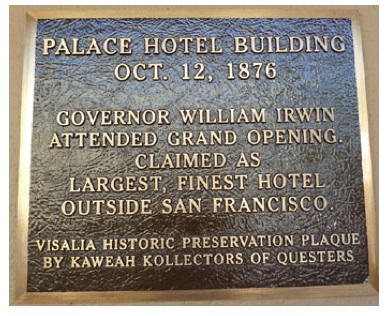
Indeed Visalia historian Terry Ommen says the state’s Governor William Irwin who attended the grand opening in 1876 described it as “the largest,finest hotel outside San Francisco.” At the time the upstairs had 45 hotel rooms and 7 larger rooms. On Main and Court the hotel had a large cafeteria. The hotel was said to be built in part for investors traveling to Mineral King during the sliver rush and was described as a proud addition to Downtown Visalia that may have been on the shabby side back then including buildings in disrepair and “rubbish and weeds.”

Ommen say Visalia’s appearance on those days was described as ” less than impressive”. According to the  the Tulare Times in 1876 the hotel was described  as “a magnificent looking building and is large and commodious…This year will lay the foundation of our stability and substantial growth.”

The building’s first owner was Visalia businessman Solomon Sweet.

Freitas has purchased the property from Martin and Martin investments of Visalia who own other buildings on Main.

Freitas has also purchased the Togni building from a group led by Harvey May.That group was honored for efforts to restore it including adding second story residential. “The building is about 90% full” says Freitas. “We have just 1500sf that could be for retail or food.”

On Main, the Palace building has the former Rio Grill space available.

“Other than our two vacancies on Main – Downtown Visalia is full.”

The Togni building was the original home of Cross Horlock Hardware and later the Togni Branch office supply store that closed in 2007. The address is 116 E Main.

Freitas is an active investor on Mooney and in the industrial park as well as in Tulare.  Freitas owns Danny Freitas Electric in Tulare.

New Brew Pub Coming To Downtown Visalia

April 11,2015

Visalia may not have much water this summer but at least it looks like we will have beer.

Brothers Matt and Mike McWilliams plan to open the town’s second brewery/restaurant combination in Downtown Visalia this September. Called Swaggers Brewery, the new pub will celebrate the craft beer explosion sweeping the country in a portion the former Surplus City building on Main St.

Swaggers 2015-04-10 at 3.37.48 PMThe micro brewery will be just down the block from pioneer beer maker Brewbakers as well as a few blocks away from the new Sequoia Brewing Co that will open for business in about a month.That new eatery will feature Fresno micro-brewed beer.

“This is a dream we’ve had for the past two years” says Mike “and Downtown Visalia seems the right place to make it happen.It’s the destination of choice.”

Mike McWilliams is the business and marketing side of the partnership and says his brother Matt has been home brewing for about 10 years.

The brewmaster has perhaps 30 full flavored recipes of beers they will make in the 6000 sf space being leased from a Visalia partnership group. The 10 ft brewing tanks as well as the kitchen will take up about half the building and the restaurant space will seat 165 customers including 40 at a big bar to be installed.

“We plan to have great food” promises Mike,gourmet burgers and pizza among the entrees.

Mike says the brewing process will be in the open as it is at Brewbakers. The partners hope to have some dining in front of the building as other Main Street eateries do.

Next door Swaggers co-tenant in the former Surplus City will be the General’s Trading Post, formerly Easley’s Gun Shop, taking about 3000 sf- roughly a third of the building.

Building co-owner Harvey May says construction on both building renovations will start this week. May had a hand in brining in Sequoia Brewing Co as well at 120 W. Main.

How popular are micro breweries? One report suggest that on average, a new brewery opens its doors every single day in the the U.S.

The Boulder Colorado  Brewers Association , the trade association representing small and independent American craft brewers, recently released 2014 data on U.S. craft brewing growth. For the first-time ever, craft brewers reached double-digit (11 percent) volume share of the marketplace.

In 2014, craft brewers produced 22.2 million barrels, and saw an 18 percent rise in volume and a 22 percent increase in retail dollar value.  Retail dollar value was estimated at $19.6 billion representing 19.3 percent market share.

“With the total beer market up only 0.5 percent in 2014, craft brewers are key in keeping the overall industry innovative and growing. This steady growth shows that craft brewing is part of a profound shift in American beer culture—a shift that will help craft brewers achieve their ambitious goal of 20 percent market share by 2020,” said Bart Watson, chief economist, Brewers Association. “Small and independent brewers are deepening their connection to local beer lovers while continuing to create excitement and attract even more appreciators.”
If craft brew is going local – the big names in beer in the past appear to be struggling to retain market share as they try to appeal to millennials.

Budweiser’s US market share fell to 8.7 percent in 2013 from 14.3 percent in 2005, according to data firm Euromonitor. With trouble in America Budweiser is looking overseas for growth. Bud’s foreign sales are 60 percent of sales.
The Visalia Bud distributor – Sequoia Beverage took the new brew pub owner of Sequoia Brewing Co to court but lost over use of the name.A local judge ruled consumers would not likely be confused. Even if their Bud sales may be down, the distributor also sells plenty of the Mexican brands through retail outlets including Modelo and Corona enjoying widespread popularity along with craft beer sales.
Mexican beer owner Constellation Brands recently announced sales were up 24% for fiscal 2015,mostly due to strong Mexican beer sales  even though wine and spirits sales increased just 1%.

Around Tulare County: Pace Of Local Car Sales Slow

March 15,2015-


Screen Shot 2015-03-16 at 3.37.12 PM


Gas prices in California are finally heading lower in the past week after ramping up about $1 since the early part of the year. They are down 6 cents in the past week says Gas Buddy and with the settling of a strike at regional refineries last week and WTI oil prices falling to $43 a barrel. In sum, look  for lower prices at the pump as we head into Spring. Visalia Costco and a few others hit $2.99 locally this week. Diesel is a few cents cheaper than regular unleaded.

Tulare County’s new car sales
were up a robust 11 percent last year. But Don Groppetti, the region’s  largest automotive dealer expects a more modest 5 to 6% increase in 2015. “The market is still positive   with good demand especially for small SUVs and full size pickups“ he says.This matches a state New Car Dealer Association prediction of 1.91 million new registrations in 2015 – up from 1.85 million last year. The Honda Accord was the state’s best selling vehicle last year.While most south Valley reservoir levels are way below normal Lake Kaweah is well above average and double what it was a year ago. Last year on March 13  the lake had just 23,000 acre/ft and as of March 13 this year it stood at 46,843AF. Corp director Phil Deffenbaugh says there has been no winter releases this year as they seek to fill the lake past last year’s  83,00AF. ”It all depends on March and April” expects Deffenbaugh who hopes they can reach 90,000AF. ”With 90 degree temps, the fuller lake is drawing big recreation crowds.” While the lake has runoff now it could be meager when the snow melts given that the snowpack is just 22% of March average.Tulare County’s Hispanic population continues to grow. The 2010 census says the county had 443,000 residents and 268,000 of them were Hispanic.That’s about 61%. By 2060 the total number of additional residents would be 336,285 says the state Dept of Finance. Of that 328,000 will be Hispanic – almost all the growth. That would take the total residents in Tulare County in 2060 to 779,000. Of that,some 596,000 will be Hispanic or about 77 percent.While immigration from Mexico and outside the US is down to 3000 from 2010 to 2014, out- migration of people leaving Tulare County was around 8000. The county’s growth will come from births, about 5000 a year. Our county will be hungry for education with the number of college age kids up 57% by 2060.

Visalia home building stayed strong in February with permits issued for 47 new homes compared to 26 in February 2014.

Self Help Enterprises continuing multiple projects around Tulare County including work on new 71 unit subdivision in Woodlake and a 36 unit multi-family project in Visalia. The non-profit is also sponsoring welding classes at a new vocational institute in the Visalia Industrial Park
.
Tulare County’s jobless rate in January was 13.9%, up from December as expected but down vs  January a year ago when it was 15.5%. The county has 3200 more jobs than a year ago including 100 more farm jobs. Construction and manufacturing are each 600 jobs stronger.

Mooney regional commercial acreage could grow by 28 acres under an application by Paloma Development to rezone land across from Target. The city planning commission gave the plan a thumbs up March 9 and it will now go the city council where most expect it will pass. The property is at the southwest of Mooney and  West Visalia Parkway.

Valley Business Bank is closing its Tipton banking center, merging its operations into its Tulare Business Banking Center, effective on June 1. The consolidation will include the relocation of all customer accounts and staff to the Tulare location. “The Tulare Business Banking Center is a more modern facility and we believe customers that desire a traditional banking experience will find that it serves their needs very well,” says Allan Stone, president and chief executive officer of the Visalia-based bank.

Pismo Beach-based Papich Construction wants to permanently erect a asphalt batch plant located at the northwest corner of Highway 198 and Road 68, about 1/2 mile west of State Route 99.They have a permit for a temporary plant now but seek full entitlement from the county.The county wants to expand the operation from 3,700 tons/day to 8,000 tons/day of asphalt.

California egg prices
have calmed down from the first of the year when Prop 2 went into effect in the state precipitating fears of egg shortages. Prices went way up for few weeks but now USDA reports large eggs are averaging $1.99 per dozen, 38 cents more than eggs sold in New York shipped in from the Midwest. Californians are going  to have to pay a few cents more per egg for the hens to stretch.

Green Energy Could Mean More Green For Tulare

March11,2015-

tulare green 2015-03-04 at 4.01.42 PMThe City of Tulare has a massive electricity bill at $1.2 million annually and a huge volume of waste gas coming from their wastewater treatment plants. Former city Public Works Director Lew Nelson recognized that and worked for years to promote green energy as a partial solution.

Now over a year after Nelson left to be an independent consultant City Manager Don Dorman appears to moving in that direction proposing more green energy projects that could save the city some real ’green.’

The city’s new public works director is Joe Carlini who is wasting no time looking to turn waste into revenue

This month Carlini is proposing to stop flaring 800,000 cubic feet of waste methane gas a day into the Valley air instead looking for a company who might take that gas and buy it or make electricity with it and sell it to the city

Instead of maintaining equipment that simply spews these emissions  skyward, the city could gain $250,000 to $500,000 a year if they sell it.  This month responses to a recent Request For Proposals will be due by end of month and some 12 firms have expressed interest.

That’s not all.

Mr Carlini is proposing several other green energy projects building on what Tulare already has in place including the existing fuel cells and a cogen plant.

Among the future plans – add another one megawatt of solar panels to be built near the WWT plant adding to the one MW farm already working.

Bringing back the idea of adding a battery storage facility for use at peak electricity times to further cut their SCE bill.

Here is the list of possible projects being discussed at the city Board of Utilities meetings March 7 & March 21.

Screen Shot 2015-03-04 at 4.06.57 PM

“We are going to maximize the use and production of energy” said Carlini in a video presentation on the city website.

Carlini says they hope to cut that big power bill by 20% with a series of green energy measures.

Carlini has had some success in turning waste into a revenue source with a project to sell their Class A solids to company who will haul it away saving the city  40% annually on $600,000 paid out last year to haul the solids away.

In the current RFP, one company is ready to buy that excess biogas – Colony Energy, who is planning on building a digester on leased land from the city. The digester will generate gas from inputs including dairy manure, food waste and other material. Colony will clean that gas to be injected into the SoCal Gas pipeline for sale, the first biomethane gas injection done by Edison statewide.

Principal Matt Schmitt says Colony’s $20 million project already has $8 million in grants due to the innovative technology in place that will cut greenhouse gas emissions – a possible model for others to follow.

“We should be under construction on the project this summer”says Schmitt who would be ready to buy Tulare’s excess biogas as well, to be sold to customers.

One option mentioned by Schmitt – city waste haulers could bring their food waste to Tulare and leave with biogas fueling their trucks in the deal. Municipalities are under the gun to cut their carbon emissions.

The city may have other takers for the gas as well with 12 firms touring the facility in the past month.

California Salmon Season Looks Good Despite Drought

March 9,2015-
In their annual preseason estimate the Pacific Fishery Management Council predicted the Sacramento River salmon run will be good with a  number of 652,000 fish, about 100,000 higher than last year. The good abundance is expected despite the the 4th year of a drought in the state. The Klamath River is expected to yield 423,800 salmon – up from 299,300 in 2014.
Commercial and sport fishermen say the outlook is good especially compared to 2008 and 2009, when low salmon numbers resulted in cancellation of the fishing season altogether.
It also good news for farmers who have been blamed in the past for low salmon numbers.

Screen Shot 2015-03-09 at 3.51.58 PM