El Nino Or La Nada? Early March Storms Look Promising

February 26,2016-

The latest computer models (GFS) show a series of storms coming into the state overcoming ‘The Blob’ of high pressure – first northern California and then central California in March after a pitifully dry February and a wet January. Forecaster John Lindsey predicts the Central Coast  could get a quarter  to half an inch March 3 – with NWS Hanford also predicting the Central Valley will get wet too. That event is  followed by stronger storms March 6 and 7 and March 11 and 12 according to less reliable long term forecasts. Northern California  will get two weak rain events this Saturday and next Monday. Pray for March Miracle.

Map: We could get a good dose March 6/7 says this NOAA model forecast about 10 days away.

Screen Shot 2016-02-26 at 6.33.08 AM

Cal Poly Helps Test Underwater Datacenter

February15,2016-

Screen Shot 2016-02-15 at 12.59.23 PM


Project Natick, aimed at developing more sustainable and efficient cloud data centers, was recently tested at the university’s Port San Luis Harbor pier
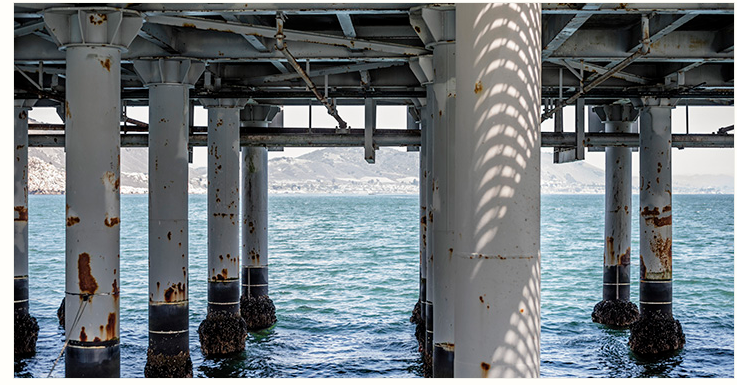
Cal Poly’s research pier is located in Port San Luis Harbor. Microsoft recently completed a 105-day trial of an underwater data center that was launched from the Cal Poly Pier.
 
SAN LUIS OBISPO — Faster, more environmentally friendly data may be coming to coastlines worldwide, and Cal Poly played a key role in early testing.
As reported by the New York Times and other national media, Microsoft recently completed a 105-day trial of a self-contained, undersea datacenter, codenamed Project Natick. The capsule spent its 15-week underwater deployment powered and instrumented at the end of the Cal Poly Pier in Port San Luis Harbor in San Luis Obispo, Calif.
Datacenters are groups of servers that essentially power the Internet. These millions of servers, otherwise known as the cloud, support billions of smartphones, tablets and computers worldwide and require a lot of energy, which generates a lot of heat. By placing datacenters in the ocean, the computing industry can use seawater as a more efficient cooling agent and greatly reduce its energy consumption and the associated carbon emissions.

Another benefit to subsea datacenters is increased Internet speeds. Half of the world’s population lives near coastlines, but many datacenters are housed much farther inland. The shorter the distance between the datacenter and the user, the faster people will receive their emails, social network updates, streaming media and search results. These new datacenters might also be more compact than the current version.
“This is a potentially disruptive technology, and we’re excited to be involved in supporting the initial testing deployment of Microsoft’s Project Natick datacenter,” said Dean Wendt, director of the Center for Coastal Marine Sciences and the university’s dean of research. “Ultimately, undersea datacenters, cooled by seawater and powered by ocean wave, ocean currents and offshore wind energy represent a more economic and low-carbon path for the expanding role that cloud computing represents.”
The limited-access Cal Poly Pier provided an ideal location for the initial datacenter deployment. The pier offers land-based infrastructure such as industrial-level electric power, internet connectivity and workspace to set up computers and instrumentation almost a kilometer out into the ocean.
“Project Natick reflects Microsoft’s ongoing quest for cloud datacenter solutions that offer rapid provisioning, lower costs, high responsiveness, and are more environmentally sustainable,” said Ben Cutler, Project Natick manager, Microsoft Research. “The Cal Poly Pier played an essential role in our ability to conduct the kind of real-world problem solving involved in testing our undersea data center project.”
The university, meanwhile, believes the recent Microsoft project illustrates how its Port San Luis Harbor facility could play a role in other groundbreaking research.
“Our leading-edge facilities and unique location offer so many opportunities for public-private partnerships,” Wendt said. “We hope to increase these kinds of collaboration with the industry, especially as it relates to developing our nation’s blue and green economy.”

Coastal Commission May Fire Exec In Morro Bay Meeting Wednesday

February 8,2016-

Screen Shot 2016-02-08 at 2.54.07 PMOn February 10, 2016, the California Coastal Commission, meeting at Morro Bay Community Center in Morro Bay beginning at 10AM – will hold a public hearing to consider whether to dismiss Dr. Charles Lester as its executive director,who has been in the position since 2011.

Counsel for the Commission has noted that “ The Coastal Act provides that the executive director “serve[s] at the pleasure” of the Commission and is exempt from civil service rules. The Commission is not required to identify any reasons for why it is considering whether to dismiss the executive director and, if it decides to dismiss him, is not required to specify the grounds for dismissal.”

A public hearing will be held and after the conclusion of the public hearing, the Commission may deliberate regarding this item in closed session. If the Commission takes any action during closed session to dismiss the Executive Director, the roll call vote will be reported publicly when the Commission reconvenes in open session.

Dr Lester in a memo to the Commission offered some accomplishments during his tenure that include:
• Maintaining the agency’s high standards for progressive, rigorous, but balanced resource
management decisions consistent with the Coastal Act;
• Unanimous Commission adoption of a long overdue
Strategic Plan with 163 specific
actions, more than 80% of which were completed or in progress after two years;
• Securing $3 million/year (25 positions) for the LCP program, and $5 million to support grants to local governments, enabling us to work faster, and more collaboratively, to certify and update Local Coastal Programs (LCPs), including our highest priority of the
Santa Monica Mountains LCP;
• Unanimous Commission adoption of comprehensive Sea Level Rise guidance, initiating adaptation planning statewide , and taking progressive actions to address sea level rise;
• Increasing public engagement and understanding, including by: hiring a Public Information Officer, launching a social media presence , implementing our new data management system, updating the website, and increasing communication with the Commission and reporting key program activities every month;
• Gaining administrative penalty authority to address access violations, and achieving early success resolving dozens of cases without issuing a single fine;
• Advancing diversity and social justice through expanded outreach and recruitment, targeted Whale Tail grants to underserved communities, and aggressive implementation of Coastal Act public
access and recreation policies;
•Strengthening our on-going interagency coordination with the Ocean Protection Council State Lands Commission, Department of Fish and Wildlife, State Parks, Coastal Conservancy, NOAA and other agencies to address shared program concerns.”

Members of many environmental groups appear to support Dr Lester as do and over 180 staff members who wrote the the Commission lauding his work. Most comments received before the public hearing support Dr Lester.

Layoffs In The Berry Patch

Santa Maria Farms Lay Off Almost 900 Workers

February 6,2016-
Screen Shot 2016-02-06 at 11.15.55 AMSome strawberry fields are not forever.
El Dorado Berry Farms, LLC – a family owned and operated farming company which has grown its own strawberries and raspberries in California for more than eight years – permanently closed down its operations in Santa Maria and Los Alamos “due to economic reasons.” says a news release.Owner Humberto Candelario says their Santa Barbara County berry operations were located on leased ranches and farmed with partner Reiter Affiliated Companies. They grow berries for Driscoll.“Recently, notices were sent under the WARN Act which indicated 653 individuals were laid off from our farming operation.  For clarity, Sixteen percent of those were to individuals laid off in November and December 2015, while the remaining
84% were employees who were laid off or who resigned at some earlier time during 2015, as part of the normal seasonal cycles.”Candelario says weather played a role in the downturn in the Santa Maria area this past year.

“El Dorado deeply regrets that the rising cost of resources has created a financial
situation in which it must close its Santa Barbara County operations. Going forward, El Dorado will focus efforts on its berry operations at its permanent locations in Ventura County.”

Meanwhile a second Santa Maria company –  Superior Farming LLC – also a partner with Reiter Affiliated Co of Oxnard has filed a state mandated layoff notice as well with the loss of 225 jobs by March 1.

Together that adds up to 878 layoffs.

Will PG&E Need An EIR For Diablo Canyon?

February 4,2016-

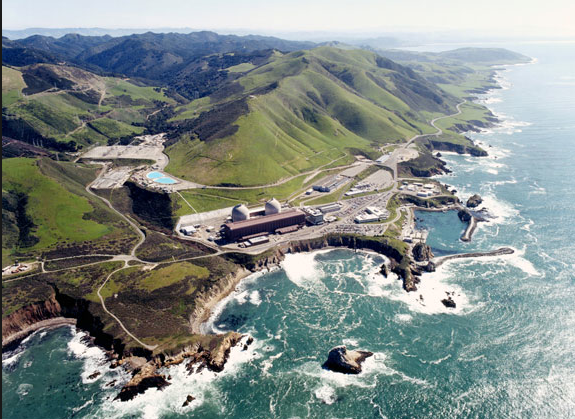
Another question mark hanging over Diablo Canyon’s future.

The three member California State Lands Commission will consider if PG&E needs to do an environmental impact report to continue to “lease” their water intake structure that feeds Diablo Canyon nuclear power plant. The meeting, scheduled for February 9th, will take up whether state law exempts PG&E from any kind of new environmental study to renew a lease that would otherwise expire in 2018.
The law states CEQA categorically exempts review of environmental impacts of “existing facilities.” PG&E asserts that the Diablo Canyon is an existing facility with no change or expansion of an existing use and that the Commission’s decision to issue a new lease would, therefore, not require CEQA review.

Screen Shot 2016-02-05 at 11.23.36 AMHowever an exception to the general categorical exemption applies where there is a “reasonable possibility that the activity will have a significant effect on the environment due to unusual circumstances.”Like what?
Newly discovered earthquake faults.To quote the commission’s staff report.“The DCPP’s nuclear fuel source and proximity to fault lines distinguish it from other power plants in California and, essential to the plant’s operation, is the DCPP cooling water system, with many components authorized under the CSLC leases. The DCPP is the only active nuclear power plant in California, supplying approximately 18,000 gigawatt-hours of electricity annually (nearly 10% of California’s electricity generation1). Power plants in the State with comparable production use natural gas fuel sources.

Seismologists discovered some of the fault lines after PG&E designed and constructed the DCPP. For example, a geologist from the United States Geological Survey (USGS) discovered the Shoreline fault in 2008, decades after PG&E constructed the plant. To date, there is substantial disagreement between the USGS and PG&E regarding the risks associated with the proximate faults.
According to PG&E, the DCPP can withstand earthquakes up to a magnitude of 7.5 and the faults do not pose significant threats to the DCPP’s integrity, but a USGS seismologist believes that a joint seismic event of the Hosgri and Shoreline faults could exceed DCPP’s design capacity for safe operation, possibly reaching a magnitude of 7.7.”

The Commission also has the obligation to consider Diablo Canyon’s effect on public trust lands says the staff report also pointing to the state water board requirement that the state’s only nuclear power plant stop using once through cooling water by 2024. An informational item on once-through cooling,originally scheduled for January 2016, was rescheduled and may be heard by the Water Board in Spring 2016.

With just three members it will take at least two votes to order the new EIR with member Gavin Newsom appearing to favor the idea. Another member, Michael Cohen, is Brown’s appointee who may reveal if the Governor wants to make it harder to keep the power plant open or may favor its key role in providing low carbon energy to the state for some years to come.

PG&E has advised Commission staff that a formal decision regarding whether to continue to seek DCPP NRC license renewal has not yet been made.It expires in 2024.

Multi Million Dollar Cambria Restaurant Closes- Staff Laid Off

January 28,2016-

Screen Shot 2016-01-27 at 6.24.01 AMCentrally Grown Inc., a multi-million dollar startup restaurant on the north end of Cambria has a great view, but as of now – nobody to enjoy it.That’s because after the first of the new year the place has been locked up tight. The company’s Facebook page says they plan to reopen January 21 – but a week later nothing is stirring.

Meanwhile Centrally Grown’s 800 telephone number has been disconnected with customers complaining that posting on their Facebook site is the only way to seek info.

Also this week the company flied a state required WARN notice that says Centrally Grown will be laying off 16 employees as of January 22.
The eatery has not updated its website or Facebook page leaving the enterprise without a workforce and a future very much in doubt.

One irritated customer vented on their Facebook page yesterday as follows. “I just received word that you guys will not be reopening. I booked my wedding with you back in July, paid my deposit & haven’t been able to successfully get ahold of anyone since. With no other way to get in touch (phone shut off, no response with emails) I have no choice but to post on here. I NEED MY DEPOSIT BACK! I am almost 4 months from my wedding date & now have to start from scratch. Beyond bad business…This shows a lack of human compassion. SHAME ON YOU!!”

The specialty market, casual café and bar, catering service and garden nursery owned by Dave Robertson, has been open about a year but has had startup troubles to say the least. Robertson paid nearly $2.5 million for the 3 acre property that overlooks the ocean along Highway 1. A year long construction period followed before it opened in Feb 2015.

In the interim the place’s food offerings has been at best a works in progress as seen in a number social media critiques.Lately more troubles surfaced.

The SLO Tribune detailed staff turnover in December, talk that has had the Cambria community buzzing.
“Robertson said some Centrally Grown employees were let go in a shift of priorities for the restaurant/bar/bakery/market and other retail departments. Other employees were downsized or fired, reducing the staff from a peak of more than 70, although many of those had not been working there full time.
Other employees apparently quit or walked off the job, as happened Saturday, Dec. 12.”

Water Watch: Reason For Hope

January 27,2016

Screen Shot 2016-01-27 at 4.16.44 PMAs we come into the what is typically the wettest time of the year in California here are a few bullet point to to offer reason for hope after 4 years of drought.

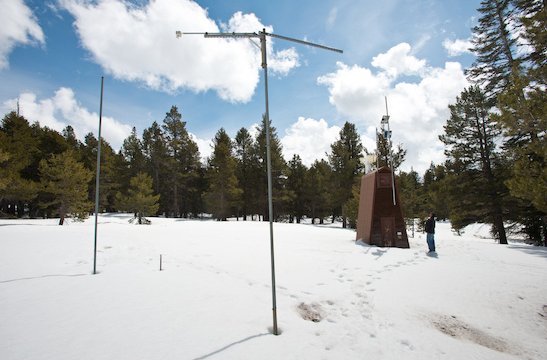
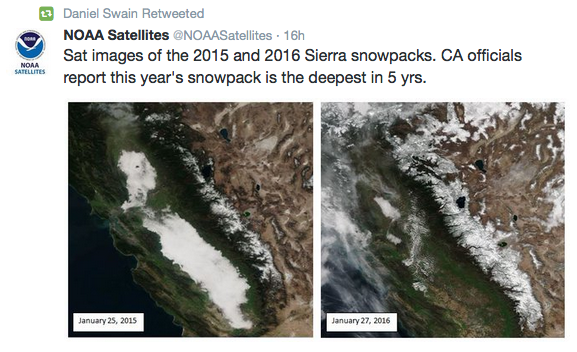
-Latest snow pack stats show the North is 129% normal, Central 118%, South 117%. Best since 2011 for the date.

-Good News On The Kings River: Pine Flat Dam has seen nearly 13 inches of rain this season compared to 12 inches for all of 2014 and 8.5 in for all of 2013. Storage is 190,000acre ft- ahead of storage for this same date for the past two years with the snowpack building at higher elevations. February 1 average for snowpack is 99%

-On the upper San Joaquin River Huntington Lake snowpack is 74% of April 1 average and for the whole basin it is 61%. February 1 average is 96%. December San Joaquin stations precip was 142% of average.

–Santa Margarita Reservoir has seen 15 inches of rain so far this year, ahead of the total for all of 2014 water year, and ahead of this date in 2015. The reservoir is an important source for SLO County.Rain total at the lake doubled since the turn of the year. Storage this month at another big SLO County reservoir, Nacimiento Lake has jumped from 17% to 22 % in the past few weeks on heavy rain.

–Lake Shasta: Rainfall at Shasta Dam has more than doubled in January from 15in to more than 36 inches as of January 27.  The state’s most important reservoir has gone from 1.42mil af or 31%of capacity as of Jan 1 compared to 2.17mil af or 48% of capacity. Today’s storage that stands at 2.17mil af compares to 1.65mil af for Jan 27, 2014 and 1.98mil af for the same date in 2015.

-State water system’s most important reservoir – Lake Oroville  is looking better as well having reached 1.38mil af as of today compared to just 1mil af of storage as of Jan1,2016. The dam received 17.50 in of rain so far this water year compared to just 20 in for all of 2014 and  26.5 in for all of 2015. Now it just has to keep raining.

Screen Shot 2016-01-28 at 6.28.27 AM


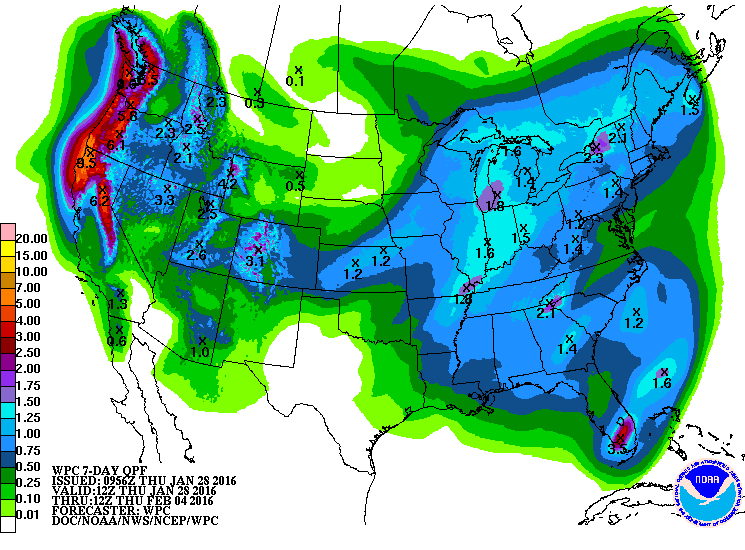
Here is a look at precipitation totals for the week ahead.Pretty impressive! Reservoirs will feel the love.

Screen Shot 2016-01-28 at 6.33.34 AM


Monarchs’ Wings May Reveal If They Are From Pismo

January 26,2016-
Screen Shot 2016-01-26 at 9.46.30 AMButterflies may shout out their birthplace on their wings like high school boys wear their school colors on their coats. It turns out the butterflies may boast of being from Pismo Beach where they overwinter.
A newly published study of California’s overwintering monarch butterflies confirmed many previous migratory studies. But the findings also showed some unexpected and surprising patterns of movement, reports a research team led by the University of California, Davis.
The study, published in the early online version of the print journal Ecography, examined the natal origins, or “birthplaces,” of butterflies at four California overwintering sites.
“We hope that this paper improves our understanding of where monarch butterflies grow up in western North America,” said lead researcher Louie Yang, a community ecologist in the UC Davis Department of Entomology and Nematology.
“Building a clearer understanding of where they come from could help us better understand many aspects of their ecology,” Yang said.
The monarch butterfly (Danaus plexippus) of North America overwinters along the California coast and in the central mountains of Mexico. Previous studies have indicated that the western monarchs — those that originate west of the Rocky Mountains — overwinter along the California coast, while the monarchs that develop east of the Rockies overwinter in central Mexico.
The new study
Yang and colleagues looked in more depth at the western monarch population. The researchers collected butterflies from the trees where they had gathered in four California overwintering sites in early December.
Those locations included two northern sites — Lighthouse Field State Beach and Moran Lake, both in Santa Cruz County — and two southern overwintering sites — Pismo State Beach in San Luis Obispo County and the Coronado Butterfly Preserve in Santa Barbara County.
The researchers examined the butterflies’ wings for shape, structure and telltale hydrogen isotopes. The different isotopes, known to be associated with precipitation in various regions in the United States, allowed the researchers to correlate the wing size and shape with how far the butterflies had migrated from their birthplaces.
Of the 114 overwintering butterflies sampled, they found that 30 percent developed in California’s southern coastal range, 12 percent in the northern coast and inland range, 16 percent in the central range, and 40 percent in the northern inland range.
Across all four overwintering sites, they found butterflies from a wide range of locations, although most were from the southern coast of California and the more distant northern inland U.S. But there were marked differences between the northern and southern overwintering sites. Most of the butterflies collected from the study’s two most northern overwintering sites originated in the southern coastal range, while most of the butterflies collected in the two most southern overwintering sites originated in the northern inland range (Idaho, Montana, Wyoming, eastern Oregon and Washington).
Collaborators and funding
Collaborating with Yang on this study were Dmitry Ostrovsky of the University of Colorado, Denver; and Matthew Rogers and Jeffery Welker, both of the University of Alaska.
The project was funded in part by a National Science Foundation Early Career Development Program grant and an NSF Major Research Instrumentation Program grant.

Proposed Chumash Heritage National Marine Sanctuary, Public Information Session

December 29,2015
Screen Shot 2014-11-30 at 4.11.53 PMNOAA will be hosting a Public Information Session in Morro Bay on Wednesday, January 6, 2016, 6:00 p.m. to 9:00 p.m. The topics will include National Marine Sanctuaries in general, and the status of the proposed Chumash Heritage NMS nomination and study. Superintendents and staff from Monterey Bay and Channel Islands National Marine Sanctuaries, among others, will be in attendance to address questions. The session will be held at the Veteran’s Memorial Hall, 209 Surf Street, Morro Bay. This meeting is not a hearing to receive testimony or take action on the Chumash Heritage National Marine Sanctuary nomination.

Around SLO County: Strong Job Growth/ New Los Osos Eateries

December 18,2015-

Strong Job Growth In SLO

The unemployment rate in the San Luis Obispo County was 4.4 percent in November 2015, up from a revised 4.3 percent in October 2015, and below the year-ago estimate of 5.4 percent.The county saw 400 more nonfarm jobs than the month before but lost 500 farm jobs due to the end  the harvest season. Nonfarm jobs are up a strong 4300 from a year earlier lead by 1100 more construction jobs.

The jobless rate in SLO compares with an unadjusted unemployment rate of 5.7 percent for California and 4.8 percent for the nation during the same period.

Los Osos Eatery News

Screen Shot 2015-12-18 at 11.52.10 AMMartin’s of Cayucos will open a second location in Los Osos perhaps by April says owner Martin Escobar. The popular eatery offers breakfast,lunch and dinner serving both Mexican and Italian food.The Cayucos restaurant has been a fixture there for 16 years.
Martin’s (pronounced Marteens) will occupy a space at 905 LOVR sharing a building with Hong Kong Chinese food in the back. Both spaces will be remodeled over the next few months by the property owner.

Developer Bill Lee has purchased the restaurant building next to his inn at 1365 2nd St in Baywood. Mr Lee had been leasing the space since June and has done a major remodel of the old Maya Restaurant space. Before he could open he found himself in a legal tangle with the property owner that his purchase of it settled. Now Lee says a new dinner house will open in March.

More To Come? Over at the Ralphs grocery building a new yogurt shop has applied for tenant  improvements at 1240 LOVR #4. Also a brewery is eyeing space in the former Haggen shopping center. Starbucks has received its remodel  permit for their  improvements like the drive-thru around their new coffee place at the old B of A building.