Around SLO County: Merrimaker sold

-August 27,2019-

Farmers getting more for their strawberries

California strawberry farms are not producing as many flats of the juicy berries as they did a year ago but they are getting more for every flat they sell. The National Berry Report says California has harvested 118.4 million flats of strawberries so far this year through Aug 18,2019 compared to 132.5 million flats as of the same time in 2018. But they are getting $10 a flat this year vs just $7 a flat last year. Even more impressive is the fact that organic strawberries fetched $8 a flat last year but have doubled that price this year – to $16 a flat.

Oceano Dunes getting 23 ft-tall lifeguard tower

tower 2019-08-23 at 6.56.49 AMGrover Beach will get a new 23 ft lifeguard tower built by the state in the next few years. Permitting for the project has begun. The tower is to be built on top of the existing restroom at the Grand Ave entrance, the first time there will be a permanent lifeguard station along this stretch of the popular beach. Kevin Pearce, District Superintendent Oceano Dunes District now anticipates construction to start in 2021 perhaps open for the summer 2021 season.The existing restroom below the lifeguard tower will be renovated for accessibility. The tower will be built without disturbing nearby habitat. Pearce says the station should” improve public safety at the beach”.Using binoculars lifeguards can see far down the beach, he says. The observation tower will service Oceano Dunes SVRA, Pismo State Beach, and adjacent beach operated by the city of Pismo Beach on a year-round basis.

Los Osos ‘Dive Bar’ Merrimaker changing hands
Baywood’s First Street battle finally over
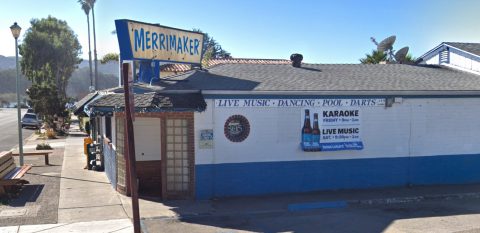
Merrimaker 2019-08-21 at 1.44.31 PM

Developer and Los Osos resident Bill Lee is purchasing the famed Baywood Park ‘dive bar’ the Merrimaker Tavern in a deal set to close at the end of September. Meanwhile Lee and a group of Baywood neighbors are ending a nearly three-year dispute over landscaping Lee carried out along Baywood’s First Street (yellow box in picture) . A compromise was found after the county Planning Commission required Lee to remove some shrubbery in the county right-of-way.Under an agreement he will work to replant trees and shrubs per a plan as well as put in a boardwalk to connect to the Bay. The dispute started after Mr Lee was accused of doing the landscaping without a permit launching several years of heated community meetings and legislative hearings.Look for work on First Street later this year.
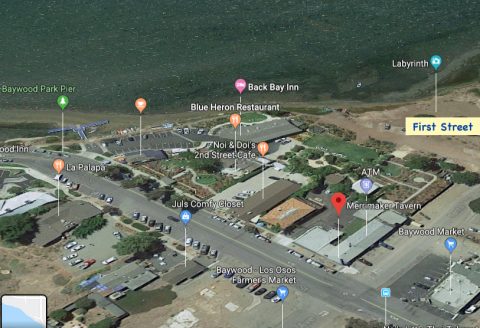
Baywood from the air2019-08-21 at 1.42.40 PM

A retired southern California commercial real estate company owner, Lee owns much of block in this part of town including the upscale Blue Heron restaurant, the Back Bay Inn cafe and the Back Bay Inn hotel that he wants expand. Asked what plans he has for the Merrimaker, Lee says the place is in need of repair and renovation but he wants to “make it a wonderful neighborhood bar.”

What that means for the character of the dive bar isn’t clear. Obviously Lee will strive to keep that friendly atmosphere the place is famous for. Look up the definition of a Dive Bar on Wikipedia and you will see there is photo of the Merrimaker!

One definition is a “rare place where high and low rub elbows—bums and poets, thieves and slumming celebrities. It’s a place that wears its history proudly.”

Lee’s Orange County firm,Lee & Associates was started in 1979 offering a broad array of real estate services including commercial real estate brokerage, property management, valuation, asset management and finance.The company claims to be the largest firm of its kind in North America. The company’s reach extends across the US, British Columbia and, most recently, to Europe through a strategic alliance with Gerald Eve.Mr Lee settled in quiet Los Osos rather than continue managing the company.Their real estate signs are seen across the US West.

Mr Lee has both supporters who cite his generosity and critics who complain he tries to throw his weight around. But all acknowledge he has changed the face of sleepy Baywood, bringing visitors to the area, donating a community garden and offering regular free concerts along the Bay that locals flock to.

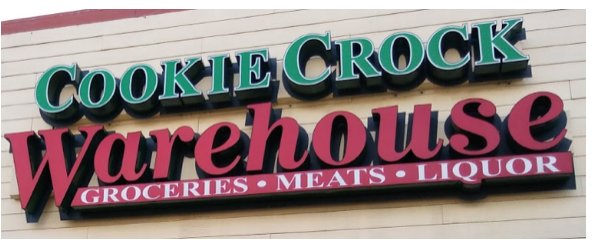
Twin dollar stores may fill Morro Bay’s Cookie Crock

-July 28,2019-

Cookie Crock logo 2019-07-24 at 9.17.16 AMMorro Bay and Los Osos residents sounded out on the popular but chatty social media website Next Door in recent weeks that they were looking forward to  welcoming a trendy Aldi grocery or perhaps a Trader Joe’s to the vacant Cookie Crock grocery store space on Quintana.

But, excuse the punch line, that’s not the way the cookie crumbles

Instead of one of those retailers – the darlings of the boomer class moving into town, Morro Bay will get a double dose of dollar stores – favorite of working folks.

Morro Bay Community Development Director Scot Graham says Dollar Tree has taken out a permit to demise the existing 20,000sf store into two side-by-side dollar stores, one a Dollar Tree and the other a Family Dollar. Both brands are owned by the nation’s largest discount variety retailer – Dollar Tree with nearly $6 billion in sales. Between the two brands they have some 15,000 stores across the US.

And one in Morro Bay, just down the block. Graham says he has been told that Dollar Tree will be relocating to the new site later this summer where they will get a bigger store, about double what they have today (5000sf) with lots more parking than they  have now.

In recent weeks the Cookie Crock owners have been busy clearing the space out and disposing of the fixtures telling this reporter that indeed a dollar store is moving in and they want to clean the place out by the end of July. The store closed in May.

At the Morro Bay Dollar Tree staff said they have heard the rumors but had no firm information from their managers that it was true.

The success of dollar stores appears to be in part their willingness to go to smaller towns in rural America with no Walmart near by to sell a line of everyday discount products. As the retail recession has prompted more storefront vacancies, it has been the dollar stores who have been willing to move in.

“Trader Joe’s told us there just wasn’t enough traffic here to warrant them coming to Morro Bay” remarks city planner Scot Graham.

Still the unusual thing about this plan is that the company would consider putting in two side-by-side dollar stores, at least that is what they show in their plans, says Graham.

Dollar Tree bought the Family Dollar chain more than 3 years ago but even today they are siting new Family Dollar stores as well more Dollar Tree location.On the other hand Dollar Tree announced recently that it was closing as many as 390 Family Dollar stores in 2019 with 85 closings in the fourth quarter of 2018. In its most recent quarterly report same-store sales at Dollar Tree were up 3.2%while Family Dollar saw an increase of 1.4%.One source says Family Dollar stores, unlike Dollar Tree, sell the majority of its products for more than $1 and there is a wider selection of of well-known brands. Family Dollar often has a selection of  fresh food that includes milk, eggs, and cheese but no fruit or vegetables.

All the discount dollar stores in the chain along the Central Coast are Dollar Trees while in the San Joaquin Valley most of the company stores are Family Dollar locations.

Salmon season strong

-July 24,2019-

Screen Shot 2019-07-24 at 11.22.09 AMHeavy rainfall in 2018-19 has resulted in the best salmon fishing season in decades along the California coast when the three-month season opened in May 2019. Some 400,000 Chinook salmon are expected to return to the Sacramento River in 2019, still down from the 1.5 million salmon returning in 2003.This year’s big supply has pushed price per pound down for a change.

Back in February the officials forecast was for 379,632 adult Sacramento Valley salmon now in the ocean off the West Coast, compared to 229,400 a year ago at this time. This suggested a return to relatively plentiful salmon fishing in 2019 would be likely.

None other than the Wall Street Journal recently featured  Giovanni’s  Fish Market in Morro Bay talking about the ample supply of salmon this sumner.

Coastal Commission OKs Morro Bay sewer plant

-July 13,2019-

Screen Shot 2019-07-13 at 7.53.55 AMThe California Coastal Commission approved the proposed new Morro Bay sewer plant this week in a 10 to 0 vote. Meeting in San Luis Obispo the Commission heard that while the facility would displace some ag grazing land the benefit of relocating  the plant away from its present location on the oceanfront far outweighs the negative.

The staff report summarized that the proposed project meets Coastal Act consistency on many fronts—for the protection and enhancement of coastal resources, for providing essential public services to Morro Bay residents and visitors, and for providing adaptation and resiliency in an era of increased hazards exacerbated by climate change.

The Commission directed the City to propose a project of this type back in 2013, finding that a project that perpetuated the City’s water and wastewater status quo was not appropriate or consistent with the Coastal Act. The City responded to the Commission’s directive, and the proposed project is the end result that addresses the Coastal Act concerns previously raised by the Commission in a way that provides a more sustainable wastewater and water supply future for the City. As conditioned, the proposed project is consistent with the Coastal Act, and staff recommends approval of the CDP.

The project includes construction of a new one million gallon per day advanced treatment facility on South Bay Boulevard north of Highway 1, two new lift stations, approximately 3.5 miles of pipelines and wells to inject the purified water into the groundwater aquifer, which can be extracted for reuse through the City’s existing infrastructure. The current schedule includes construction beginning in 2019 and project completion by 2023.

Los Osos neighbors win appeal of vacation rental

Los Osos group campaign photo highlights the neighborhood

630 sign petition supporting Los Osos vacation rental regulation

-July 11,2019-

The San Luis Obispo County Board of Supervisors voted 3 to 2 Tuesday to deny an application for a new vacation rental (VR) permit on a large waterfront home in Baywood / Los Osos. The supervisors appeared to be swayed by an outpouring of concern from the community at this week’s meeting that the VR would be located right next door to an existing permitted vacation rental.

An organized group, Neighbors for Los Osos, had circulated a petition signed by 630 locals supporting density regulations on the number of short-term rentals allowed in a given neighborhood.

These proposed regulations are supported by the Los Osos Community Advisory Council but not considered official because the town’s Community Plan has yet to be adopted by the supervisors. That could come late this year, but many Los Osos residents don’t want to wait.

The supervisors got an earful from over 30 speakers who showed up to appeal both a hearing officer’s approval last March and now staff support for the VR application at 670 Santa Lucia Drive in Los Osos.

“I know Los Osos wants a set-back between vacation rentals of 500 feet” said swing-vote Supervisor John Peschong of Templeton and “ and that may be too much.But if this permit were to be approved there would “only be 3 feet “between the two short-term rentals, he reasoned.

“They would be right on top of each other “Peschong remarked as he announced he would vote with Los Osos district supervisor Bruce Gibson as well as Adam Hill to override the staff opinion.

Long time Los Osos residents came out in force this day worried that more vacation rentals would change the character of Los Osos for the worse.One resident said the clustering of vacation rentals was “akin to horizontal hotels and hotels do not belong in a residential neighborhood.”

Another remarked “we loose full time residents to visitors who do no have a stake in the community.”

Robin McPeak said “When too many vacation rentals are allowed in close proximity to one another, and in this case next-door, the character of a neighborhood changes. This steady stream of strangers displace permanent residents.”

Los Osos resident Sue Morgenthaler noted” no other community with vacation rental regulations allows side-by-side short term rentals” and all have some kind of spacing between VR permits. Despite strong community opinion on this – the county hearing officer and county staff ”completely disregarded all this” she complained.

“If you approve this it will set a precedent and you have to wonder – where will it stop” she argued.

One Baywood resident says he lives on Santa Maria St and” its a “walking street” where he often meets his neighbors and looks forward to the camaraderie. “It’s a quality of life issue” he says.

Another resident, Judy Green summed it up this way.”We want neighbors – not weekenders.”

Permit applicant Amy Thoman argued that she understood community concerns but that those density rules they talk about have not been adopted. She said her rental “would not be party place” and would be overseen by a property manager.
.
“This is an upscale $2 million house and we will not be renting it” to someone who causes trouble, she maintained.

Thoman pointed to a staff estimate that there are just 35 vacation rentals out of a housing stock of 6200 in Los Osos.

Supervisors Debbie Arnold and Lynn Compton pointed to this small number of units in town that should minimize the negative impacts some were worried about.

Compton noted that the applicant should not be told no after they purchased the house and a denial might amount to a “property taking”. The applicant “got ambushed” by the strong reaction from the neighborhood, she remarked.

But supervisor Adam Hill appeared to get a positive opinion from county counsel at the meeting to support the idea that supervisors were not taking away any right and that they have “discretion” to approve or disapprove the request.

Debbie Arnold remarked that many beach houses were originally purchased as vacation units and now property owners might need to rent their units out to afford to fix them up.

But supporters of VR regulation say their proliferation is driving up both home an rental prices – a subject Gibson promises to the talk about at a Coastal Commission workshop on VRs later this week.

SLO crop value up 12% in 2018

-July 19,2019-

Screen Shot 2019-07-10 at 6.18.37 AMThe San Luis Obispo County Department of Agriculture/Weights and Measures announces the release of the 2018 production statistics for the local agricultural industry. The overall value of agricultural production hit a milestone record of $1,035,499,000 in 2018. This represents an increase of 12 percent over the value reported in 2017

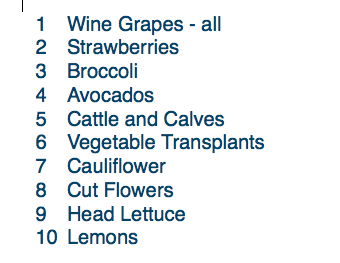
The top ten commodities by value in 2018 were

Screen Shot 2019-07-10 at 7.11.11 AM

Ag Commissioner Martin Settevendemie says “Despite an extended summer heat wave, wine grape producers enjoyed a good growing season with an 8% increase in production and a modest overall price increase of 3%. The total wine grape value hit a record high of $276 million.” Ten years before in 2008, the value was $124 million.

Cabernet Sauvignon remains the top wine grape variety in 2018 at $129.6 million on 18,354 acres. In 2008  we grew just 11,000 acres with a value of $27 million – a five hold increase.

In 2018 fresh and processed strawberry production skyrocketed due to increased acreage and the planting of higher yielding varieties. Prices plummeted early in the season due to an oversupply of strawberries following a statewide freeze that prevented growing regions from the typical phasing in of product. Despite this price drop, the overall strawberry value was up 18% to more than $268 million on 4165 acres.

Tonnage of strawberries in 2018 was 202 thousand tons.In 2008 SLO County grew 1500 acres valued at $65 million yielding 45,000 tons, again five fold increase.

Vegetable acreage in 2018 has rebounded to come back in line with historical levels. The rebound was attributed to increased rain over the last couple of years, a more stable labor market and favorable growing conditions for vegetable crops.

The animal category increased by 1% compared to 2017, valued at just over $48.5 million. The number of cattle and calves sold during 2018 increased by 4% to 44,900. Cattle prices dropped 5% averaging $131 per CWT. Since 2016, the cattle industry appears to have stabilized relative to the prolonged drought experienced in recent years.

SLO’s cattle herd has been cut in half since 2008 from 91,000 head in 2008 to 45,000 head in 2018.

Cannabis transition

The nursery industry is in a state of transition with indoor cannabis production beginning to replace nursery stock. Local greenhouse facilities are being leased or purchased for cannabis production, resulting in decreased indoor decorative and ornamental plant production during 2018. Ironically, the cut flower market stabilized because of less competition from neighboring counties where some cut flower production areas have been converted to cannabis.  Despite the conversion of some local growing area to cannabis, the nursery stock industry remained relatively stable with the overall value declining just 2% to $81.2 million. In 2008 the nursery crop in SLO County was valued at $101 million.

Avocado production has jumped to 19,000 tons in 2018 from 5300 tons in 2008. Back then the crop was valued at $11 million and in 2018 it reached $46 million.

Overall  the fruit and nut category has grown in value from $229 million in 2008 to $657 million  in 2018.

“Local agricultural producers amplified their economic contributions to the local and statewide economies in 2018 with an increased overall value of agricultural commodities of $1,035,499,000, a milestone in San Luis Obispo County”, according to Martin Settevendemie, Agricultural Commissioner/Sealer.

Statistics for the local agricultural industry featured in the Department’s Annual Crop Reports for 1928 through 2017 can be viewed in the Crop Report Library.

Congress blocks plan for offshore oil drilling here

-June 30,2019-

Screen Shot 2019-06-30 at 1.52.29 PMPresident Trump’s plan to open California waters for offshore oil drilling has been blocked in Congress this past week under a bill championed by Central Coast congressman Salud Carbajal and others. Trump says he wants to open more than 90 percent of American waters to oil and gas development, including along the California coastline.

In a key vote the House voted June 21 to adopt several amendments to the Department of Interior budget for next year that ban the agency from spending any money for new offshore oil and gas drilling in federal waters off the Atlantic and Pacific coasts, more than 3 miles off the coast. According to the Bay Area News Group. “Without funding, the Trump administration cannot hold public hearings, perform the legal work, complete required studies and oversee lease sales to oil companies.”

The report quotes one expert. “Congress is saying you can’t have the money to drill here,” said veteran coastal activist Richard Charter of Bodega Bay, a senior fellow with the Ocean Foundation. “I think Trump’s offshore drilling plan is dead in the water for now.”

The Natural Resources Defense Council, Oceana, The Sierra Club, Surfrider, The National Parks Conservation Association, and Native Movement offered the following statement in response:
“Our federal budget reflects our values as a nation. This decisive action by the House of Representatives to block funding to advance offshore drilling activities supports healthy communities, oceans, national parks, climate and marine life. We cannot allow the oil and gas industry to boost its profits while our environment and coastal economies suffer the consequences of devastating oil spills.”

Three amendments adopted to a spending bill, H.R. 3052, by Rep. Pallone (D-NJ), Rep. Carbajal (D-CA), and Rep. Wasserman-Schultz (D-FL) (#88, #26, and #95 respectively) bar the use of Department of the Interior funds for offshore drilling off the Atlantic and Pacific coasts and Florida’s Atlantic and Gulf Coast respectively. Additionally, an adopted amendment by Rep. Cunningham (D-SC) (#18) bars the use of Bureau of Ocean Energy Management (BOEM) funds to allow seismic airgun blasting.

The House will hold a final vote on the spending bills this week. The bills go then to the GOP controlled Senate.The Senate is not considered likely to block the House actions, however, because several Republicans representing coastal states, such as Florida, Georgia and the Carolinas, where business leaders and GOP governors have come out against new drilling, quietly oppose it.

The votes on these amendments were the first time the 116th Congress voted on legislation to block offshore drilling and exploration and follows a decades long tradition of offshore moratoriums in the Interior-Environment Appropriations funding bill. A coalition of bipartisan stakeholders support blocking the expansion of offshore exploration and drilling, including every East and West Coast governor and more than 2,200 elected officials says the NRDC.

Landmark Baywood eatery’s last day

-June 29,2019-
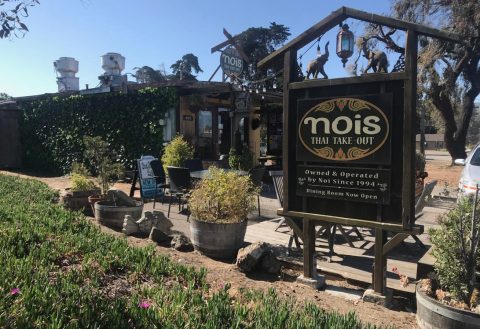
Noi's 2019-06-28 at 9.57.45 AMLos Osos /Baywood favorite Noi’s Thai Take-Out closed their doors Friday, June 28 after being in business since 1994.The good news – Noi and Doi’s Second Street Cafe will remain open just down the street offering the same familiar cooked-from-scratch Thai dishes.

Noi’s husband Ron Miner remembers “When we opened here twenty five years ago in this little town the Tribune “wondered if we could make it” – joking that “maybe you have been sitting too long at the Merrymaker” the well worn dive-bar across the street.

Even today with Baywood well “ discovered” Ron says “I am looking down the street right now and there isn’t one car moving” adding that this Back-Bay berg is still pretty quiet, except for the weekends.

“Running two restaurants offering the same food was both splitting our customers and taxing our overhead” he explains. Add to that the fact the Noi is battling cancer and Ron is eager to decrease the stress in their life.”She doing OK right now” he adds.

Ron, a contractor by trade, hopes to increase the size of the Second St Cafe kitchen to get food out the door a little faster.Some people don’t mind if they have to wait an hour for the food is ready.” It’s OK – we will wait” many say.

Over the years people have commented on Noi’s food. One writer remarked that CalPoly students “are obsessed” with the place.

Word got out that Noi’s would close a few days ago and there have been lines stretching out the door as customers want one more taste of what some say is the best Thai in the area. But no worries – just head down the block.

Ron says they will retain the iconic but tiny Noi’s Take-Out building for catering jobs as well as the dining room

Grocery workers vote

– June 24,2019-

Screen Shot 2019-06-24 at 4.45.41 PMGrocery workers in the UFCW are voting today  whether to authorize a strike at Albertsons, Vons and Ralphs stores in Southern and Central California.  The grocery companies and union have been negotiating for months on a new contract. Word on potential strike could come Tuesday or Wednesday. UFWV Local 770  covers both Los Angeles County and the Central Coast.

Latest China increase boosts tariff to 91% on U.S. wine

-May 15,2019-

What’s the trade war doing to California wine sales? It’s not good.

Screen Shot 2019-05-15 at 2.49.52 PMThe Wine Institute reported this week that the Chinese government announced that it would be increasing the tariff on U.S. wines in response to the ongoing trade dispute between the U.S. and China. The increase is good news for our competitors.

Effective June 1, China will add another 15% tariff on U.S. wine imports to their country. That takes the total tax and tariff on US wines  shipped to China to 91% since they ratcheted up several times starting April 2018.

“This is the third Chinese tariff increase on U.S. wine in the past 14 months, and with each additional round, it becomes more and more difficult to compete in the fastest-growing wine market in the world,” said Robert P. “Bobby” Koch, President and CEO of California-based Wine Institute.

Sales of US wine to China were already off 25% in 2018.Most of that was from California.

 “It is imperative to resolve this dispute as soon as possible, so that our wineries do not suffer long-term market loss. Despite these challenges, the California wine brand remains strong with Chinese consumers and we are committed to doing everything we can to ensure this does not change ” added Koch.

China is one of the fastest growing wine markets in the world and will soon be second only to the U.S. in the total value of wine sales. U.S. wine exports to China and Hong Kong have grown 450% in the past decade. U.S. wine exports to all markets abroad, more than 90% from California, reached $1.47 billion in winery revenues and 375 million liters (41.7 million cases) in 2018.

US competitors in the world market include number one producer France, then Italy and Spain followed by the US in fourth place. Smaller upstarts like Argentina, Australia, South Africa and Chile are growing faster than the US.

When the Chinese consumer shops for wine in 2019 US made wine will cost them more than wine from Chile or France.