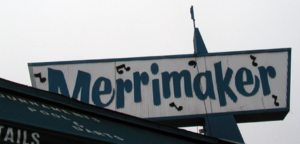
Baywood’s famed ‘dive bar’ the Merrimaker, has a new owner with a new plan to open a beer garden venue to add to its friendly neighborhood bar atmosphere inside.
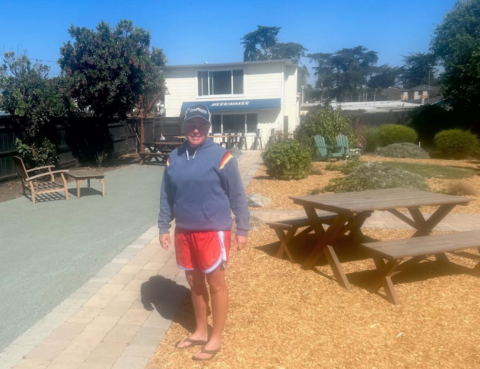
Jennifer Dorn in the beer garden
The owner is a familiar name in these parts. Jennifer Dorn has purchased the landmark corner bar and about an acre of land with it from the Lee family and opened the doors quietly on August 19. The property extends along Santa Maria from 2nd St to 1st St.
Trained in the culinary arts with a degree, Jennifer suggests we might expect there will be food being made here once a full kitchen is added, now underway in the two-story apartment building in the back. No doubt, fish, synonymous with the Dorn family name, will be on the menu.
Make Merry inside or out
For now the big change at the Merrimaker is the addition of a sprawling fully-landscaped beer garden with an outdoor entrance behind the bar that will be available once the liquor license is fully in place. This will add to the trend in this little village to feature outdoor hangouts for food and drink customers that draw crowds in laid-back Baywood.
And music will be part of the scene too including this Labor Day Saturday when Beverage Control will allow Jennifer to hold a special event in the beer garden including a band starting this Saturday at 3 PM.
The Dorn family is well known with flagship restaurant Dorn’s Breakers seafood in Morro Bay run by Jennifer’s brother Chris as well as Ducky’s in Morro Bay and Mersea’s in Port San Luis.
Already completed from the old days is the remodel of the bar itself, both the exterior and interior carried out by former owner Bill Lee. Lee purchased the tavern in 2019 but passed away in 2021. He also landscaped the big yard in back and fenced it off, setting the table now for Jennifer to offer merriment both inside and out.
The new hours at Merrimaker are Monday 2-10, closed Tuesday, Wednesday Thursday Friday 4-11, Saturday Sunday 10am-11pm.The place is located 1301 2nd St. Los Osos, CA 93402 in the village of Baywood.
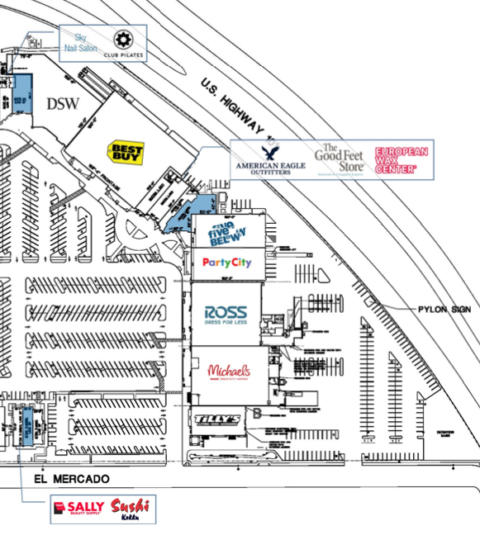
Madonna Plaza is recovering from the retail shakeout that Covid 19 wrought nationwide and in San Luis Obispo. A few years ago Sears left the center making room for new retail spaces and attracting both Ross and Michaels – relocated from other parts of town and now open. The latest news is that teen retailer Tilly’s is filling the last space that used to be part of Sears next to Michaels with construction of a new 6500 sf store. Commercial realtor Phillip Kyle confirmed that Tilly’s will open here but the timetable is not known.The Tilly’s logo is all on Kyle’s company website site plan next to Michael’s. This addition follows the backfilling of the Petco building that was vacated by the pet store with tenant improvements by Party City and Five Below well underway. Both are new to town.
Also new in the center – Dave’s Hot Chicken is open where the pandemic prompted Panera Bread to close their doors last year. All these new tenants including Tilly’s target SLOs younger shoppers.
Tilly’s is a publicly-traded specialty retailer of casual apparel, footwear and accessories for young men, young women, boys and girls with an extensive assortment of branded merchandise. The California -based company is headquartered in Irvine They currently operate 244 total stores across 33 states.The closest Tilly’s is in Santa Maria.
The company started out as World of Jeans and Tops in 1982.The first retail store was in Los Alamitos, Calif. Selling jeans to distributors T Hezy Shaked co-founded the store. According to the website Business News Bill in 1992 they opened their first clothing store named Tilly’s, ironically in San Luis Obispo that later closed.
Rendering shows marketing piece for storefront next to Michaels
Site plan of center shows Tilly’s store location next to Michaels
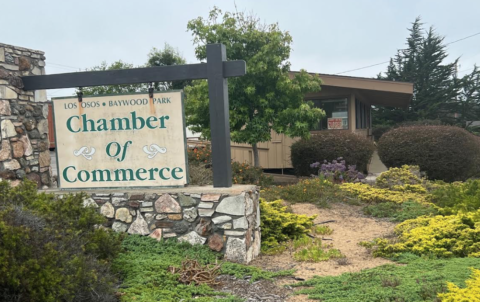
Los Osos Chamber of Commerce closed their doors as of July 1 after their landlord passed away and their modest office and visitor center on Los Osos Valley Rd was sold.
According to past president Jim Stanfill, the volunteer agency has no plans to reopen elsewhere in town unless they can find a benefactor.
The civic group was formed in 1955.
Stanfill says the group will maintain its website and offer service to members to advertise events in town.”Our board still meets on Zoom” says Stanfill. But tourists won’t be able to drop by to pick up local info anymore. The building was on the way to popular Montana De Oro State Park.
Board secretary for the group Lynette Tornatzky told members recently that “Your Chamber is Going Virtual” like many businesses have across the country. The chamber is refreshing its business model but continuing to hold special events like this fall’s Octoberfest the last Sunday in October.
The group can still be reached at (805) 528-4884 or email them at info@lobpchamber.org. In addition the group will continue to offer their newsletter to keep up with local activities and highlight the benefits of membership says Tornatzky.
“Whether it’s updating your listing on the website directory, adding an article to the newsletter, featuring your event on our Facebook page, or hosting a ribbon cutting, we are excited to support your business.”
The unemployment rate in San Luis Obispo County was 2.1 percent in May 2022 says the EDD, the lowest rate ever recorded for the county. The next lowest rate recorded was 2.4% in April of this year and in a few months of 2018 and 2019, prior to the pandemic.
Figures have been collected since 1990, says Andri Moskalyk EDD spokesperson. The very low jobless rate here reflects the economic recovery since Covid 19 hit the US in 2020 boosting unemployment in SLO County to 12.7% in May 2020.
Moskalyk notes that using figures from a separate jobs report covering households, the county has seen an increase in the labor force year -over-year of 3300. But the total is still down 2800 from May 2019- before the pandemic hit. The latest labor force number is 137,700 in May 2022 compared to 140,500 available for work that were in the labor force in May 2019.
”We’re not sure what happened to those people and whether some of them listed back then will still return to the SLO market to look for a job.”
Clearly some have moved away facing poor job prospects and high cost of living impacts during that time. The jobs are back but the high costs are still there.
There is the prospect that the downturn in the economy led by sky high oil prices in recent weeks could drive the jobless rate back up going forward. If we are seeing the lowest unemployment rate we are looking at the highest gas prices here at the same time.Just this Friday oil futures saw a big drop based on the Fed raising the interest rates the day before.
Still the lowest jobless rate ever, better than half what it was a year ago at 5.2% is a significant improvement although still with a ways to go. This is reflected in California numbers for May showing California has now regained 93 percent (2,565,100) of the 2,758,900 nonfarm jobs lost during March and April of 2020 due to the COVID-19 pandemic.
EDD analysis shows:
• Of the 390,000 U.S. nonfarm jobs gained in May, California accounted for 11 percent of them.
• At 869,300 jobs, California had the largest absolute year-over seasonally-adjusted job increase in the nation in May 2022.
• California has enjoyed month-over gains in nonfarm jobs in 15 of the past 16 months totaling a 1,481,800 job gain over that time period.
• Eight of California’s 11 industry sectors gained jobs in May with Information (+8,800) posting the largest increase. The sector’s growth was due in part to increases in the Motion Picture and Sound Recording industries.
• Leisure & Hospitality (+8,800), which suffered some of the largest losses in the pandemic, showed strong growth yet again and has now gained 816,900 jobs since April 2020 after losing nearly one million jobs due to the COVID-19 pandemic.
• Trade, Transportation, and Utilities suffered the largest month-over job loss (-3,700) due to reductions in Retail Trade (specifically General Merchandise Stores).
The EDD industry jobs report shows 2800 more jobs in SLO County than a year earlier with 1000 more of those in the Leisure and Hospitality sector.
“The low unemployment rate in the state shows that worker supply remains the primary obstacle to job growth in California,”said Taner Osman, Research Manager at Beacon Economics and the UCR Center for Economic Forecasting. “Moreover, a clear dichotomy has emerged, whereby labor markets in the state’s central communities have outperformed the coastal communities; the coast is routed in high cost and housing supply constraints and continues to experience labor market shortages.”
The California Association of Realtors reports that the Central Coast region continued to have the biggest decline of all the state’s regions, with home sales dropping 21.8 percent from a year ago. San Luis Obispo recored that exact decline, slightly better off than Sant Barbara who had a 29% drop in sales.Still, the median price of an SLO home was $931,000 – up from $890,000 in April.
Feinstein: Keep Diablo Canyon open
In a open letter from Diane Feinstein the US Senator lays out the case to keep the nuclear plant operating for now.
California has some of the most ambitious clean-energy goals in the world, including decreasing carbon emissions to 40% below 1990 levels by 2030 and achieving 100% clean electricity by 2045. That will require energy alternatives that can provide power around the clock in addition to solar and wind. Shutting down the state’s single largest power producer under these circumstances would make little sense. Closing Diablo Canyon would remove 18,000 gigawatt-hours from the grid, nearly 10% of the state’s electricity generation. This is an extraordinary amount of power for a grid facing reliability concerns amid heat waves and wildfires. When the power goes out, lives are endangered. Moreover, the plant generates 15% of the state’s carbon-free electricity. At least in the short term, that would have to be replaced with fossil fuel generation. I continue to advocate for renewable energy. It is clearly the future for not only California but also the country and the world. But while California is leading the way on renewables, we aren’t there yet.
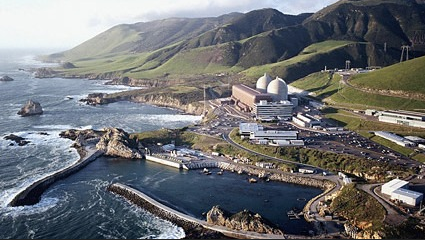
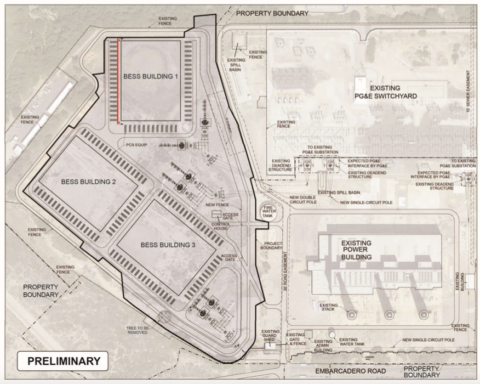
On June 3 the City of Morro Bay launched their Notice of Preparation for the formal EIR covering construction of the proposed Vistra Battery Energy StorageSystems (BESS) facility.The plan says the24 acre portion of the site will consist of three two-story buildings with a total building area of 91,000 sq ft.
The City of Morro Bay is moving forward with an agreement with Vistra Energy, which promised last year to convert the old power plant yard into the world’s largest battery storage facility. Vistra’s $500 million proposed project would also cover the cost of taking down the stacks and removing the power plant’s existing turbine, both built using hazardous materials. City Community Development Director Scot Graham says he expects the stacks could fall as soon as 2023 but Vistra now says it might wait until the BESS is completed . It could 2 years to do the demo. The battery storage is located away from the power building and stacks on the former oil tank yard that was cleared a few year ago. The distance means the stacksand building do not have to come down to construct the battery storage units. Total acreage for the procjt is 95 acres.The Morro Bay Power Plant was operational on the parcel since the 1950s but has been idle since its retirement in 2014.
Construction of the BESS is anticipated to take 36 to 48 months.
Battery storage is used to store energy during off-peak hours when energy usage/demand is lower and dispatch stored energy on an as-needed basis during peak demand hours. This technology reduces the amount of fossil fuels consumed during peak hours and maximizes usage of energy from renewable sources such as wind and solar facilities that may not be able to produce energy during times of peak demand.The batteries are anticipated to have a 20-year life.
Regards the demolition work the document says asbestos containing materials have been identified by a Pre-Demolition Asbestos Containing Materials Survey completed in September 2019. Negative pressure containment tents would be erected inside the power building to make sure all asbestos materials can be contained and not expose areas outside to contamination. Asbestos abatement of the main structure would be performed by dividing the building into segments and would take approximately 9 to 12 months to complete. Demolition would not begin until the area has been abated for all asbestos and other hazardous materials. Work crews would consist of 50-75 workers and appropriate supervision and safety oversight. The Contractor and all employees would meet all California and Federal training requirements and have appropriate licenses/certifications. Required air monitoring would be completed by a Vistra-employed qualified contractor.
The contractor would provide on-site decontamination facilities for all workers and inspectors.
Demolition of the three450 -ft stacks would occur following abatement of any regulated materials and demolition of any connecting ductwork. The stacks would be removed by conventional means without using explosives, one stack at a time. Screening would be used around the perimeter of the stack at the levels where concrete cutting is taking place to minimize airborne dust.
Demo and recycle of materialsuse could take 3500 trick trips says the notice.
Entrance to MB expected to attract new retail/restaurant
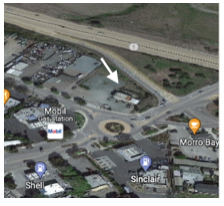
Just north the existing Morro Bay roundabout the City has been using an old gas station site for staging the construction of the wastewater treatment plant and its connecting pipelines.Most recently the site was used by alocal U-Haul dealer ,now relocated. As the pipeline project nears an end City CommunityDevelopment Director Scot Graham says he expects the site could be targetedby the owner to lease out to a tenant who would like like the highly visible and accessible site at theentrance to the this city. There are already three gas stations adjacent the roundabout making it likely a restaurant who might need a drive thruwould be a candidate for this spot right off Highway 1.
Developer wants multi-family north of Highway 1 at South Bay Blvd
You may have noticed the 5-acre lot off Highway 1 near South Bay Blvd where vacant single-family parcels have been laid out but where year after yea r-nothing is built.The site is next to an Assisted Living facility.
Now owner and developer John Hinchey of Steiner Development wants to change the zoning on the plots to multi-family and looks to build up to 70 units north of the highway not far from the new WWT plantain the other side of the hill.
They call it Sea Shell Cove even though its not near the ocean and has nice of view – not of water but Back Hill to the south.
The project site includes ten existing parcels (ranging in size from 0.32 acres to 0.61 acres for a total project site size of 4.7 acres (gross). The land use and zoning designation changes would increase the allowable density of the project site from up to 4 dwelling units per acre to up to 27 dwelling units per acre.
The project has come in under the radar but Morro Bay residents seem to have awakened to the scale of the development.
One commentator- Carol Truesdale wrote the Planning Commission this week suggesting that “The increase from one home per lot (10 lots) to the following density of 7 homes per lot (total of 70 homes) is a huge jump: “Given these restrictions, the project site’s existing net buildable area for purposes of calculating density is 1.5 acres, or what would be 41 units under a high-density land use designation. The request to change the land use designation to high density is to facilitate a future multi-family residential project of up to 70 units.”
Four local reservoir ‘pumped storage’ projects proposed
The expected launch of a huge offshore wind project off the Central Coast with government leases coming this fall, is spurring a boom of onshore energy projects locally and inland in the mid-state. Changes are already underway where the offshore energy cable will make land in Morro Bay with Vistra Energy planning to demolish yesteryear’s technology including the famous stacks and old fossil fuel power plant next year and construction of a $500 million 600MW lithium battery storage facility at the same time.
The state PUC has required utilities to add more energy storage to help smooth out the grid and keep the lights on in the face of rapid climate change and wildfires.
But apparently there is plenty of energy storage still needed to accommodate 3000 to 6000 megawatts(MW) of power expected to come ashore at both Morro Bay and Diablo Canyon as can be seen in four recent permit requests filed for San Luis Obispo reservoirs. They happen to be located along transmission lines from the Coast to the rest of the state.
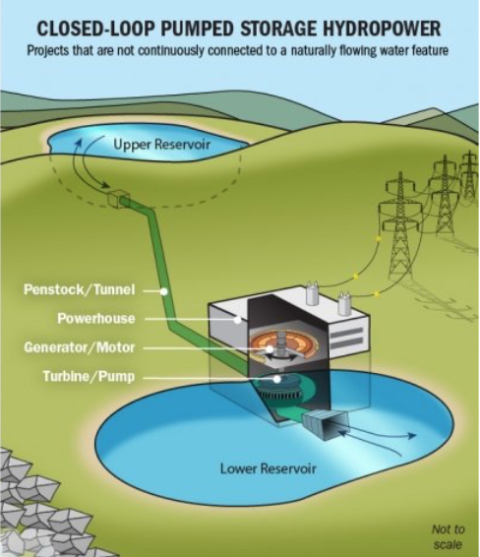
One experienced developer,Victor Rojas of Walnut California, has recently filed permit requests under the name Premium Energy to build four similar pumped storage hydroelectric projects that each would generate at least 600MW. The pumped storage reservoirs would act like giant batteries over a long duration.The idea is based on pumping water from a low elevation to an upper reservoir that Premium Energy would construct. Then when the grid needs power, the water would be put to work, toward falling quickly through a pipeline when demand is greatest.
The new pumped storage projects being proposed to the Federal Energy Regulatory Commission (FERC) this spring are all in or next to San Luis Obispo County – one near Cayucos at Whale Rock, one at Lake Nacimiento, one at Margarita Lake and the last at Twitchell Reservoir between Nipomo and Santa Maria.
All feature publicly-owned reservoirs surrounded by high elevation hills, mostly in private lands. The uphill nearby offers a chance to capture hydropower that will drop through a pressurized pipeline called penstock that can be turned open in a hurry when needed.
All the projects will operate in a closed loop system, says the applications, noting they will reuse the water in a cyclic manner with no more significant amount of water diverted from Lake Nacimiento for example, once the upper reservoir filling is completed.
Santa Margarita-Lopez connection
In the case of Santa Margarita Lake – for the upper reservoir, the existing Santa Margarita Lake will be used, the Salinas Dam, and for the lower reservoir Lopez Lake will be used, at Lopez Dam.An eight mile pipeline would connect the two.A hydraulic head of 740 ft would exist between the upper and lower reservoir, which would be exploited for hydro power generation.The Santa Margarita PSH would be interconnected with Pacific Gas and Electric (“PG&E”) system to the 500 KV line that interconnects Diablo Substation and Midway Substations, which runs close to Lopez Lake; a short interconnecting transmission line would be needed to tap into the existing line. In generating operation mode, the project would deliver 600 MW to the utility power grid.
Rojas is asking FERC to allow a 4-year study period after which they would grant a construction permit to the company.He says the study period will cost $5 million for each project. To build the projects, they will require both public and private investment.
The applications make clear the tie-in to the planned offshore wind bonanza. “The project is proposed to store renewable energy, mainly wind from the upcoming offshore projects in the Morro Bay and Diablo Canyon Call Areas, and facilitate the goal of supplying firm, low-priced, clean power to the grid during extended hours of storage operation (up to 48 hours).”
As for the lithium battery storage plant in Morro Bay, Premium Energy says their pumped storage facilities will complement each other.
Besides these Central Coast pumped storage projects,Rojas previously filed for projects in the Sierra at Lake Isabella and several along the eastern range including Walker Lake and Pyramid Lake.
Although lithium battery storage technology has become top-of-the-mind for the public recently, the utility industry has bought into hydropower-based pumped storage for decades as their go-to choice to store power.
Another new technology uses compressed air storage as a battery with at least one project being proposed locally by a Canadian-based company – Hydrostor,who announced last November plans to build a 400MW long-duration energy storage facility near Morro Bay called the Pecho Energy Storage Center.
The project faces controversy since it is being proposed in a pristine valley. Already the Coastal Commission recently found that the Chorro Valley—where Hydrostor wants to build their plant—has unique scenic resources that make it “unsuitable” for a power plant.
Castaic pumped storage
FERC says Pumped Storage Hydropower (PSH) contributes 93% of grid storage in the United States and it is growing nearly as fast as all other storage technologies combined.The industry has seen a big pickup of new project filings across the US.
Diablo connection
You might be familiar with the role Diablo Canyon nuclear power plays in pushing water uphill in the Sierra at Helms above Frersno. Here, water falls from an upper lake to a lower reservoir dropping 1600ft. A report some years back said Helms generators can produce a total of 1,212 megawatts of electricity or enough to power the cities of Fresno and Oakland. Nearly four miles of 28-foot diameter tunnels connect the powerhouse and two reservoirs, said to be the largest electrical storage battery in the world.
The PG&E hydroelectric project was intended to provide spurts of power when it is needed most: hot summer evenings when people flock home from work, turn on air conditioners and run pumps to water gardens.
Diablo Canyon’s night time power feeds Helms when it is cheap to pump water back up the hill.Then the water can rush downhill again when a burst of power is needed.
California has the most pumped storage capacity, with 3.9 GW, or 17% of the national totals, says FERC. One of the most famous is at Castaic Lake, north of LA.
Now Premium Energy wants to build these 4 clustered SLO projects – some with a hydraulic head nearly as great as Helms.Their Cayucos project would feature a drop of 1588 ft -almost the same as Helms.The upper reservoir would be 6 miles north of Whale Rock Other local projects will be designed to drop 700 to 1000 ft, still enough to generate that 600MW.
At Twitchell, the difference between the upper and lower reservoir would be 1200ft in one alternative design.
The application says the project envisions procurement of four new pump-turbine generator-motor sets with units rated at 150 MW each.
The Twitchill project would reuse the water in a cyclic manner and no more significant amount of water will be diverted once the reservoir’s filling is completed. The project’s proposed reservoirs will provide enough water storage capacity for the minimum capacity of 600 MW continuous output for a minimum of 8 hours.
The project is scalable and depending on the market demands for larger capacity and extended hours storage, could be uprated up to 1500 MW or larger, with storage duration of up to 48 hours to support grid power restoration after a major grid black out” says their application.
These are longer duration times than lithium battery storage can muster.
Each of the local projects will require transmission line upgrades that will cost multi-millions not just based on the pumped storage projects but the huge amount of energy expected to be generated by the offshore wind floating turbines. All these land projects are located not just on hills above existing reservoirs but along existing transmission pathways that connect the Coast to the Central Valley’s grid that in turn carries power up and down the state.
The key transmission infrastructure is already there or nearby. As they say, location, location, location.
The state infrastructure czar, CAISO has already suggested major upgrades to connecting power lines and substations will be needed in middle California to insure residents can keep the lights on long term in the face of climate change.
-May 23,2022- The U.S. Department of Energy last week announced that it has extended the deadline for nuclear power plants to apply for federal funding to July 5. PG&E owns and operates Diablo Canyon nuclear power plant and would be the entity to apply for this funding.
The U.S. Department of Energy extended the deadline for applications and sealed bid submissions under the $6 billion Civil Nuclear Credit (CNC) Program. The CNC program supports the continued operation of U.S. nuclear reactors, the nation’s largest source of clean, emissions-free electricity.
Owners or operators of nuclear reactors most at risk of premature closure due to economic hardship have 47 more days to submit applications for certification and sealed bids for credits. The deadline for the first CNC award cycle is now 11:59 p.m. Mountain Time on July 5, 2022.
“The Civil Nuclear Credit program will help the United States meet our climate goals while protecting jobs and the communities that depend on these plants,” said Assistant Secretary for Nuclear Energy, Dr. Kathryn Huff. “We received a request to extend the application period, which could keep at-risk reactors online, delivering much needed clean energy to the grid.”
Back in California ,a spokesperson for the Governor’s Office suggested Gov Newsom wanted to close the plant long term but for now wanted to keep options open.
“The Governor supports keeping all options on the table as we build out our plan to ensure reliable energy this summer and beyond. This includes considering the possibility of a limited term extension to Diablo Canyon, which continues to be an important resource as we transition to clean energy. The grant program’s extended deadline is helpful in that context.
In the long term, the Governor continues to support the closure of Diablo Canyon as we transition to clean energy while ensuring the reliability of our energy grid.”
Between primary season 2020 and the same time in 2022, San Luis Obispo County recorded that Democrat registration increased by 5503 voters while the GOP added 1345 new voters, better than a three to one increase. Declined to State over the same period actually fell by 2437.
In 2020 there were 64,100 Democrats and 61,587 Republicans. Two years later, in April 2022 there are 69,663 Dems and 62,931 Republicans. There are now 36,224 declined to state voters.
Tesla will build a new 31,000 square foot car dealership on Calle Joaquin in San Luis Obispo, a project given the green light by the city Architectural Review Commission this week.
The dealership that would face Highway 101, is being proposed by San Pedro-based Rich Development on 2.8 acres of vacant land. The site, at 1381 Calle Joaquin, is near the new Town Place Suites by Marriott hotel that recently opened and in-line with two other dealerships just north Los Osos Valley Road.
Today the closest Tesla dealership is in Santa Barbara.The top selling electric car maker would offer their line of cars to the San Luis Obispo market that has been beset by some of the highest prices in the state.Today SLO County’s ’s average price for fuel is at a Southern California high of $6.25 a gallon, according to AAA.
Tesla is now one of the world’s most valuable companies as well as the most valuable automaker with a market capitalization above $900 billion. The company has a market high lead of 23% of the battery-electric (purely electric) market and 16% of the plug-in market (which includes plug-in hybrids) in 2020.
The company’s name honors inventor and electrical engineer Nikola Tesla. In 2004, as a result of a $6.5 million investment, Elon Musk became the largest shareholder. Musk has been CEO since 2008.The first model rolled off the line in 2008.
Today Tesla’s sales revenue has been growing at a rapid pace with $16.9 billion in sales in the first quarter of this year – an 87 percent increase year over year. But unlike most car makers, Tesla has not spread their brick and mortar dealerships beyond major cities. For example, there are none in the Central Valley. A Tesla dealership here is likely to spur local and regional sales, a boost for city sales tax revenue.

 The Dorn family is well known with flagship restaurant Dorn’s Breakers seafood in Morro Bay run by Jennifer’s brother Chris as well as Ducky’s in Morro Bay and Mersea’s in Port San Luis.
 Madonna Plaza is recovering from the retail shakeout that Covid 19 wrought nationwide and in San Luis Obispo. A few years ago Sears left the center making room for new retail spaces and attracting both Ross and Michaels – relocated from other parts of town and now open. The latest news is that teen retailer Tilly’s is filling the last space that used to be part of Sears next to Michaels with construction of a new 6500 sf store. Commercial realtor Phillip Kyle confirmed that Tilly’s will open here but the timetable is not known.The Tilly’s logo is all on Kyle’s company website site plan next to Michael’s. This addition follows the backfilling of the Petco building that was vacated by the pet store with tenant improvements by Party City and Five Below well underway. Both are new to town.
 According to past president Jim Stanfill, the volunteer agency has no plans to reopen elsewhere in town unless they can find a benefactor.
 The unemployment rate in San Luis Obispo County was 2.1 percent in May 2022 says the EDD, the lowest rate ever recorded for the county. The next lowest rate recorded was 2.4% in April of this year and in a few months of 2018 and 2019, prior to the pandemic.



 On June 3 the City of Morro Bay launched their Notice of Preparation for the formal EIR covering construction of the proposed Vistra Battery Energy StorageSystems (BESS) facility.The plan says the
 Demolition of the three
 Just north the existing Morro Bay roundabout the City has been using an old gas station site for staging the construction of the wastewater treatment plant and its connecting pipelines.Most recently the site was used by a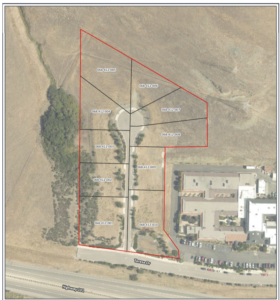

 The expected launch of a huge offshore wind project off the Central Coast with government leases coming this fall, is spurring a boom of onshore energy projects locally and inland in the mid-state. Changes are already underway where the offshore energy cable will make land in Morro Bay with Vistra Energy planning to demolish yesteryear’s technology including the famous stacks and old fossil fuel power plant next year and construction of a $500 million 600MW lithium battery storage facility at the same time.
 In the case of Santa Margarita Lake – for the upper reservoir, the existing Santa Margarita Lake will be used, the Salinas Dam, and for the lower reservoir Lopez Lake will be used, at Lopez Dam.An eight mile pipeline would connect the two.A hydraulic head of 740 ft would exist between the upper and lower reservoir, which would be exploited for hydro power generation.The Santa Margarita PSH would be interconnected with Pacific Gas and Electric (“PG&E”) system to the 500 KV line that interconnects Diablo Substation and Midway Substations, which runs close to Lopez Lake; a short interconnecting transmission line would be needed to tap into the existing line. In generating operation mode, the project would deliver 600 MW to the utility power grid.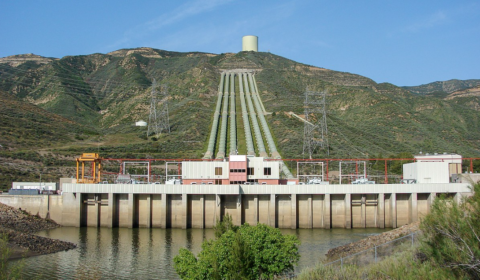

 The U.S. Department of Energy last week announced that it has extended the deadline for nuclear power plants to apply for federal funding to July 5. PG&E owns and operates Diablo Canyon nuclear power plant and would be the entity to apply for this funding.
 Between primary season 2020 and the same time in 2022, San Luis Obispo County recorded that Democrat registration increased by 5503 voters while the GOP added 1345 new voters, better than a three to one increase. Declined to State over the same period actually fell by 2437.
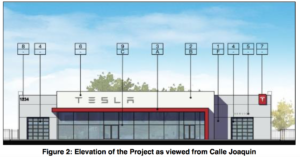 Tesla will build a new 31,000 square foot car dealership on Calle Joaquin in San Luis Obispo, a project given the green light by the city Architectural Review Commission this week.