
Uphill battle:
Four local reservoir ‘pumped storage’ projects proposed
 The expected launch of a huge offshore wind project off the Central Coast with government leases coming this fall, is spurring a boom of onshore energy projects locally and inland in the mid-state. Changes are already underway where the offshore energy cable will make land in Morro Bay with Vistra Energy planning to demolish yesteryear’s technology including the famous stacks and old fossil fuel power plant next year and construction of a $500 million 600MW lithium battery storage facility at the same time.
The state PUC has required utilities to add more energy storage to help smooth out the grid and keep the lights on in the face of rapid climate change and wildfires.
But apparently there is plenty of energy storage still needed to accommodate 3000 to 6000 megawatts(MW) of power expected to come ashore at both Morro Bay and Diablo Canyon as can be seen in four recent permit requests filed for San Luis Obispo reservoirs. They happen to be located along transmission lines from the Coast to the rest of the state.
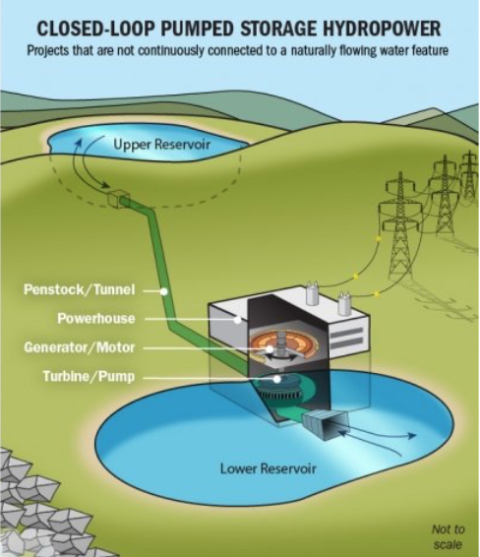
One experienced developer,Victor Rojas of Walnut California, has recently filed permit requests under the name Premium Energy to build four similar pumped storage hydroelectric projects that each would generate at least 600MW. The pumped storage reservoirs would act like giant batteries over a long duration.The idea is based on pumping water from a low elevation to an upper reservoir that Premium Energy would construct. Then when the grid needs power, the water would be put to work, toward falling quickly through a pipeline when demand is greatest.
The new pumped storage projects being proposed to the Federal Energy Regulatory Commission (FERC) this spring are all in or next to San Luis Obispo County – one near Cayucos at Whale Rock, one at Lake Nacimiento, one at Margarita Lake and the last at Twitchell Reservoir between Nipomo and Santa Maria.
All feature publicly-owned reservoirs surrounded by high elevation hills, mostly in private lands. The uphill nearby offers a chance to capture hydropower that will drop through a pressurized pipeline called penstock that can be turned open in a hurry when needed.
All the projects will operate in a closed loop system, says the applications, noting they will reuse the water in a cyclic manner with no more significant amount of water diverted from Lake Nacimiento for example, once the upper reservoir filling is completed.
Santa Margarita-Lopez connection
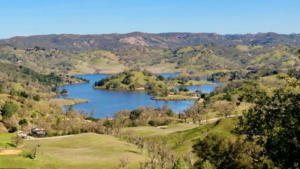 In the case of Santa Margarita Lake – for the upper reservoir, the existing Santa Margarita Lake will be used, the Salinas Dam, and for the lower reservoir Lopez Lake will be used, at Lopez Dam.An eight mile pipeline would connect the two.A hydraulic head of 740 ft would exist between the upper and lower reservoir, which would be exploited for hydro power generation.The Santa Margarita PSH would be interconnected with Pacific Gas and Electric (“PG&E”) system to the 500 KV line that interconnects Diablo Substation and Midway Substations, which runs close to Lopez Lake; a short interconnecting transmission line would be needed to tap into the existing line. In generating operation mode, the project would deliver 600 MW to the utility power grid.
Rojas is asking FERC to allow a 4-year study period after which they would grant a construction permit to the company.He says the study period will cost $5 million for each project. To build the projects, they will require both public and private investment.
The applications make clear the tie-in to the planned offshore wind bonanza. “The project is proposed to store renewable energy, mainly wind from the upcoming offshore projects in the Morro Bay and Diablo Canyon Call Areas, and facilitate the goal of supplying firm, low-priced, clean power to the grid during extended hours of storage operation (up to 48 hours).”
As for the lithium battery storage plant in Morro Bay, Premium Energy says their pumped storage facilities will complement each other.
Besides these Central Coast pumped storage projects,Rojas previously filed for projects in the Sierra at Lake Isabella and several along the eastern range including Walker Lake and Pyramid Lake.
Although lithium battery storage technology has become top-of-the-mind for the public recently, the utility industry has bought into hydropower-based pumped storage for decades as their go-to choice to store power.
Another new technology uses compressed air storage as a battery with at least one project being proposed locally by a Canadian-based company – Hydrostor,who announced last November plans to build a 400MW long-duration energy storage facility near Morro Bay called the Pecho Energy Storage Center.
The project faces controversy since it is being proposed in a pristine valley. Already the Coastal Commission recently found that the Chorro Valley—where Hydrostor wants to build their plant—has unique scenic resources that make it “unsuitable” for a power plant.
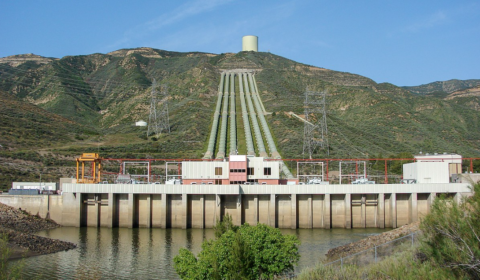
FERC says Pumped Storage Hydropower (PSH) contributes 93% of grid storage in the United States and it is growing nearly as fast as all other storage technologies combined.The industry has seen a big pickup of new project filings across the US.
Diablo connection
You might be familiar with the role Diablo Canyon nuclear power plays in pushing water uphill in the Sierra at Helms above Frersno. Here, water falls from an upper lake to a lower reservoir dropping 1600ft. A report some years back said Helms generators can produce a total of 1,212 megawatts of electricity or enough to power the cities of Fresno and Oakland. Nearly four miles of 28-foot diameter tunnels connect the powerhouse and two reservoirs, said to be the largest electrical storage battery in the world.
The PG&E hydroelectric project was intended to provide spurts of power when it is needed most: hot summer evenings when people flock home from work, turn on air conditioners and run pumps to water gardens.
Diablo Canyon’s night time power feeds Helms when it is cheap to pump water back up the hill.Then the water can rush downhill again when a burst of power is needed.
California has the most pumped storage capacity, with 3.9 GW, or 17% of the national totals, says FERC. One of the most famous is at Castaic Lake, north of LA.
Now Premium Energy wants to build these 4 clustered SLO projects – some with a hydraulic head nearly as great as Helms.Their Cayucos project would feature a drop of 1588 ft -almost the same as Helms.The upper reservoir would be 6 miles north of Whale Rock Other local projects will be designed to drop 700 to 1000 ft, still enough to generate that 600MW.
At Twitchell, the difference between the upper and lower reservoir would be 1200ft in one alternative design.
The application says the project envisions procurement of four new pump-turbine generator-motor sets with units rated at 150 MW each.
The Twitchill project would reuse the water in a cyclic manner and no more significant amount of water will be diverted once the reservoir’s filling is completed. The project’s proposed reservoirs will provide enough water storage capacity for the minimum capacity of 600 MW continuous output for a minimum of 8 hours.
The project is scalable and depending on the market demands for larger capacity and extended hours storage, could be uprated up to 1500 MW or larger, with storage duration of up to 48 hours to support grid power restoration after a major grid black out” says their application.
These are longer duration times than lithium battery storage can muster.
Each of the local projects will require transmission line upgrades that will cost multi-millions not just based on the pumped storage projects but the huge amount of energy expected to be generated by the offshore wind floating turbines. All these land projects are located not just on hills above existing reservoirs but along existing transmission pathways that connect the Coast to the Central Valley’s grid that in turn carries power up and down the state.
The key transmission infrastructure is already there or nearby. As they say, location, location, location.
The state infrastructure czar, CAISO has already suggested major upgrades to connecting power lines and substations will be needed in middle California to insure residents can keep the lights on long term in the face of climate change.