Sriracha back on the grocery shelf

New farms harvest jalapeños

CFB News

After parting ways with its longtime jalapeño supplier, Sriracha Sauce maker Huy Fong Foods struggled to find a steady supply of fresh peppers. Recently, following two years of shortages, the popular condiment began reappearing in stores.

Over the past several months, a vegetable farmer in the Imperial Valley pulled off an improbable feat that may help solve an urgent supply shortage—at least for those who crave some extra heat in their rice, soup, noodles or stir-fry.

Shoppers who set out to buy a bottle of Huy Fong Foods’ Sriracha sauce in recent years likely went home empty-handed. That’s because in 2022, after churning out the sauce for decades, the company in Los Angeles County ran out of its key ingredient—red jalapeños—and shut down its processing plant.

For 28 years, Huy Fong sourced all of its peppers from Ventura County farmer Craig Underwood of Underwood Ranches. But in 2017, the partnership collapsed after a payment dispute that led to a jury awarding $23 million to the farmer.

Since then, Huy Fong, while secretive about its suppliers, has reportedly sourced jalapeños from farmers in Mexico and the southwestern U.S., but with mixed results. A couple years ago, the company announced a lack of inventory had left it “unable to produce any of our products.”

The “severe shortage” persisted for more than a year, leaving restaurants and hot sauce aficionados in dire straits. Last summer, third-party retailers were selling the iconic green-capped bottles, previously worth about $5, for as much as $150.

Huy Fong blamed its supply issues on drought-related crop disasters across multiple growing seasons, though other hot sauce brands that use jalapeños did not experience the same challenges.

A key reason for Huy Fong’s shortage, growers and pepper experts said, was that the company evidently failed to rebuild a supply network with enough farmers. For a pepper processor, “that is just absolutely critical,” said Stephanie Walker, co-director of the Chile Pepper Institute at New Mexico State University.

Jalapeños are difficult to grow because of their long growing season—typically about 80 days for transplanted crops. “When they’re in the ground longer, they’re going to be exposed to more risks,” such as pests, diseases and extreme weather, Walker said.

Red jalapeños, which are picked after the pepper turns from green to red—with a growing season of about 120 days—and must then be harvested within a short window, can be especially challenging.

“We learned over 28 years how to grow and harvest jalapeños,” Underwood said. At its peak, he grew 2,000 acres of jalapeños for Huy Fong, planting multiple crops each year. The farm even designed its own mechanical harvester and hauled the peppers from the field to Huy Fong’s facilities.

“What we did for them was rather complicated,” said Underwood, whose company still grows jalapeños and makes its own brand of Sriracha sauce.

Before Huy Fong’s inventory dried up, its Sriracha was the top-selling hot sauce in 31 states, according to consumer data from Instacart. Since then, Huy Fong lost market share as competitors and newcomers filled the void. A Huy Fong representative said no one from the company was available to comment.

To get back in business, Huy Fong needed peppers. But “finding really good pepper growers is challenging,” Walker said. In addition to pest and weather risks, labor costs caused many U.S. growers to abandon the crop. Where could Huy Fong go?

According to California pepper growers, last summer, a man described variously as “a broker,” “a gentleman” and “a guy in Coachella” sounded out farmers to grow large amounts of red jalapeños for an undisclosed processor.

“He was trying to put together a very quick, very large jalapeño program,” said Alex Jack of Jack Brothers, Inc., who farms in the Imperial Valley and received a call from the man in July.

When he got the call, the jalapeño seedlings were already growing in a greenhouse in Northern California, Jack said. The broker needed farmers to sign contracts and plant the peppers within a few weeks before they were too late to transplant.

It was an unusual approach. “Unless they have a grower or growers already lined up,” Walker said, “I’d consider it very risky to start a large number of transplants. My guess is that they were quite sure that they’d be able to get growers on board.”

It was mid-July, and the man wanted to know if Jack could plant 500 acres, using drip irrigation, by Aug. 15.

“They were doing things unconventionally,” Jack said, possibly “because they were in a predicament where they had to just get things rolling and hope it all worked out.”

The Jack family has farmed in the Imperial Valley for more than a century, and Jack has farmed there since 1989, but he had never grown jalapeños. Planting so many so fast “would be like a new NFL franchise winning the Super Bowl in its first season,” Jack said. “It’s crazy.”

To start with, at the height of the Imperial Valley’s sweltering summer, much of his team was away on vacation.

Jack called up his ranch manager and irrigation specialists, and hired more workers through a farm labor contractor. “We brought everyone back and we got it all planted,” he said. “It was a Herculean effort.”

Setting up the irrigation system in time was only possible, Jack added, with knowledge his family gained through generations of farming. “It’s a lot of years of experience from Jack Brothers doing drip irrigation that helped us put this whole program together,” he said.

High-value crops such as chili peppers are almost always grown on drip irrigation, Jack said, because the system, while expensive, enables farmers to “fine-tune the growing of the crop” by administering precise amounts of water and fertilizer.

The jalapeños benefited from underground piping for drip irrigation Jack already had on some of his fields. “We did about half the jalapeños on our permanent drip field, and we did half on portable systems,” he said. He estimated it took 25 people working full time for a month to plant the crop, finishing in late September.

Then came a massive storm from the Gulf of Mexico, followed by multiple days of triple-digit heat. “I thought we were in trouble, but the peppers came through with flying colors,” Jack said.

A fleet of mechanical harvesters, purchased by the client for this year’s crop, began harvesting the jalapeños just after Christmas. “Considering everything we went through and how little time we had to plan for it, the crop looks really good,” Jack said.

Growing the crop successfully has made him the confidential processor’s largest supplier, he said. With harvest wrapping up, Jack is preparing to plant 210 acres of jalapeños for the spring season. They should be ready to harvest in June.

Beyond that, Jack isn’t sure what the future holds. He does not have a long-term contract to continue growing peppers.

In November, Huy Fong said it had resumed production, noting in a statement, “We continue to have a limited supply that continues to affect product availability.”

In recent weeks, consumers began reporting lower prices for Sriracha and wider availability. Jack said he still doesn’t know with certainty where all his red jalapeños are going, though growers familiar with the scale and urgency of the program said it may be no great mystery.

Fuel Prices drop

California diesel price drops 70 cents since November

The price of diesel fuel has dropped $.70 since November says the federal Energy Information Agency.West Coast Pad 5 price that includes California was selling for $5.34 as of October 30 and as of January 15 it is selling for $4.58, more than a 70 cent drop.In June 2023 the average price in the state was $6.13 a gallon.

Oil analyst Tom Kloza in a “ Disinflation Update” offers this price comparison for average price of fuels nationwide.

Fuel Current Price Year Ago % Change
Gasoline $3.08/gal $3.39/gal – 9.1%
Diesel $3.92/gal $4.61/gal -15.0%
Jet fuel $2.66/gal $3.92/gal -32.1%

Kings County dairy switching production to Jersey cows

-January 20,2024-

Screenshot 2024-01-20 at 7.35.05 AM Screenshot 2024-01-20 at 7.34.46 AMThe Anthony and Bob Brazil Dairy is holding a complete herd dispersal on January 17 at the A&M Livestock yard in Hanford.But the long time dairy is not going out of business says auctioneer Richard Martella.He explains that the dairy is selling their 300 familiar black and white Holstein cows to replace them with brown Jersey cows and continue their Hanford area operation which is already been in business for 87 years.
Jersey cows have become in-favor recently in the San Joaquin Valley based in part on the assertion that they need less feed to put out the milk volume. This factor is key for Central Valley dairies, who are under the gun to reduce their groundwater pumping under SGMA (Sustainable Groundwater Management Agency) as they plant feed crops like corn and alfalfa nearby for their cows.

One Jersey cow website boasts that ” Although smaller, Jerseys cows are incredibly efficient feed converters compared with other breeds. They have the unique biological ability to utilize the energy in feed for milk production, rather than expelling it as waste.

Jerseys deliver a quality product that you get paid for. Compared to average pooled milk, a glass of Jersey milk has 18% more protein, 29% more milkfat and 20% more calcium. It is also especially rich in vitamins.”

The formula is said to be good for cheese making. Jersey is a British breed of small dairy cattle from Jersey, in the British Channel Islands. The Holstein breed was exported from the Netherlands.

Martella points out that the cull value of a Holstein animal is far higher than a Jersey.

The US Holstein Association advocates just as vigorously for their breed pointing out “Holstein dairy cattle dominate this country’s milk production industry. The reason for their popularity is clear: unexcelled production, greater income over feed costs, unequaled genetic merit, and adaptability to a wide range of environmental conditions. Added up, this means more profit for the dairy producer who milks Holsteins. This point becomes even clearer when you consider that nine of every 10 dairy producers currently milk Holsteins.”

Certainly if you drive around Central Valley, you’ll see a lot more Holstein cows than Jerseys.

Jersey cows  are brown and Holsteins are black and white

Port of LA reports 19% increase in cargo volume in November

-December 14,2023-

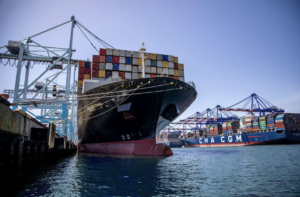
Screenshot 2023-12-14 at 7.34.08 AMSAN PEDRO, Calif. — The Port of Los Angeles saw cargo volume increase for the fourth consecutive month in November, when it rose 19% compared to the same time last year, officials said Wednesday.

The port processed a total of 763,262 twenty-foot equivalent units in November. Loaded imports landed at 384,629 TEUs, an increase of 25% compared to 2022.

Loaded exports came in at 111,755 TEUs, an increase of 24% compared to November 2022. Empty containers totaled 266,888 TEUs, a 10% increase compared to last year.

“Our year-end growth reflects the strength of the U.S. economy powered by the American consumer,” Port of Los Angeles Executive Director Gene Seroka said during a media briefing. “Black Friday and Cyber Monday sales were strong, and the forecast for overall holiday sales is 3 to 4% above last year, another high mark.”

He added, “Thanks to the outstanding efforts of our dockworkers and other stakeholders, we’ve gained market share in recent months.”

Seroka believes the positive growth will continue into 2024 as the port works toward maximizing operational efficiencies and decarbonizing the port complex.

At the briefing, Kristin Morency Goldman of The Toy Association shared the latest consumer trends in the industry, including the popularity of educational toys. She noted research indicated nearly 90% of adults will buy games or toys for other adults, a phenomenon she described as purchasing for “kidults.”

Interest rates & fuel costs decline / Funding for twin rail projects / Water to be extended to Jackson Ranch

-December 7,2023-

10-year note drop to 4 percent should mean mortgage rates should see 6.6 percent

Screenshot 2023-12-06 at 10.06.02 AMAs of December 6, Wall Street is cheering up Main Street with a decline in the 10-year note of around 20% from 5 percent in mid October to near 4 percent today. Who cares? Kings County residents will care when they see their cost of living go down. Today interest rates, gas prices and grocery prices are all heading south.

Mortgage rates were close to 8% only weeks ago but now some lenders are offering rates below 7%

Redfin Chief Economist Daryl Fairweather says the housing market may have some relief on the horizon. “In the most likely scenario, we expect rates to come down to around 6.5-6% by the end of the year, which isn’t a huge relief but it’s enough to make hundreds of dollars of a difference for a potential homebuyer,” Fairweather says.

With inflation largely under control, the Federal Reserve will likely cut rates two or three times starting in the summer, which is why mortgage rates will decline as the year goes on, says Redfin.

Fuel costs down too

Fuel costs including gas and diesel are down with wholesale gasoline prices at a year long low. WTI oil prices at our deadline are down to $69 per barrel from a high of $ 91 in late September with US oil production at record levels but demand falling.This is happening despite Mideast turmoil. Reports say US crude exports raised worries about increased global supply and as traders continued to doubt the impact of OPEC cuts.

Kings county average gas prices are $4.47 gallon says AAA – 50 cents lower than year ago and a high $6.26 in the summer of 2022. Several local stations are selling well below four dollars a gallon with the lowest at $3.75. Diesel is selling for $5.74 compared to $6.95 in summer of 2022. The Energy Information Administration (EIA) predicts a 1% decline in US gasoline consumption by 2024, reaching the lowest per capita level in two decades.Additionally, new data from the Energy Information Administration showed total domestic gasoline stocks increased by 5.421 million bbl last week, the most since late September and surpassing expectations of 1.027 million.

Food inflation

USDA reports that food inflation is projected to slow to about 3% in 2024, compared to 5.8% in 2023. 2024 grocery food prices will increase by 1.6% but Restaurant food prices are predicted to increase by 4.3%.

Deflation?

WSJ reports this week that after a historic run-up in inflation, Americans are now starting to see something they haven’t in three years: deflation. However “ deflation – falling prices- is largely confined to appliances, furniture, used cars and other goods.”

Connect to Las Vegas?

Rail funding: The US Department of Transportation has awarded the California High-Speed Rail Authority nearly $3.1 billion in grant funding this week for continued progress on the country’s first electrified 220-mph high-speed rail system through Kings County, made possible by President Biden’s Infrastructure Investment and Jobs Act.

The money will:
-Fund six electric trains for testing and use
-Fund design of train facilities
-Fund design and construction of the Fresno station
-Fund final design and early works, including right-of-way acquisition and utility relocation on the extensions to Merced to Bakersfield.

Screenshot 2023-12-05 at 4.00.58 PMThis week Biden also funded $3 billion for a private high-speed train project that would connect Los Angeles to Las Vegas. Brightline West aims to start construction in the upcoming year, with the goal of having trains between Las Vegas and Rancho Cucamonga running by summer 2028 just in time for the Olympics.
This 218-mile, all-electric high-speed rail service in SoCal will include additional stations in Apple Valley, Hesperia, and Rancho Cucamonga connecting on to Union Station in Downtown LA.
Significantly, the California Speed Rail system would in the future connect to the Las Vegas train line along the 54-mile High Desert Corridor line from Palmdale to Apple Valley. California high-speed rail will have a station in Palmdale. This would allow visitors from the San Joaquin Valley and the Bay Area to travel by high speed train to Las Vegas in a matter of hours. This planned connection will depend on funding for the Palmdale to Apple Valley line.

Water to be extended to Highway 5 development

Screenshot 2023-12-06 at 9.23.56 AM
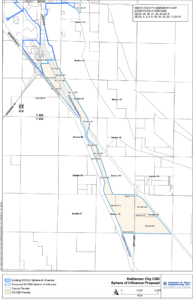
This week Kings County LAFCO approved a plan to extend water service outside Kettleman City CSD’s jurisdictional boundaries to serve the highway commercial development of Jackson Ranch, some 4 miles south on I-5. Infrastructure at the big development is under construction.

The Jackson Ranch Specific Plan development currently does not have a surface water treatment plant to treat the water for safe drinking. The Kettleman City CSD already treats surface waters from the California Aqueduct and is the closest water purveyor. With the extension of service approved by LAFCo the Kettleman City CSD will provide the Jackson Ranch Specific Plan area with a consistent supply of water for health and safety purposes.

At full buildout of the Jackson Ranch development it is anticipated that the total water demand for the entire development will be 60 Acre Feet of water per year . The water supply assessment for the Jackson Ranch project concludes that there is a sufficient water capacity to provide water not just to this project but also to provide potentially additional water to be available to the Kettleman City Community Service District during years of drought, says a staff report.

An agreement is in place ensures that the Jackson Ranch developer will provide the Kettleman City Community Service District with sufficient water allocations from the California Aqueduct to meet all of the needs of the Jackson Ranch development and that the Jackson Ranch developer will also provide sufficient funds to pay for the treatment of water and conveyance of the water to the Jackson Ranch Specific Plan area so that the Kettleman City Community Service District is kept whole.

McCarthy won’t run again

News that Kevin McCarthy will not run for a new term in Congress will not will not likely result in an opportunity for Democrats to gain a seat in the Bakersfield area since the congressional district carved out by the legislature has a strong Republican majority.

Moving cargo

-November 23,2023-

Shipping up/Costs down

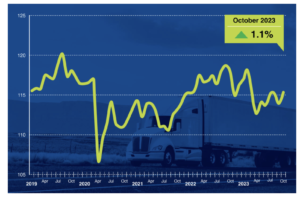
America Trucking Association says truck tonnage increased 1% in October supported by a decline in fuel prices. Last Thanksgiving retail diesel was more than a dollar higher than it is today. The US Energy Information Agency says the average California diesel price is now $5.64 down from $6.29 in October 2023. Lower diesel price will make it cheaper to ship and deliver goods as well as plow fields across America and help in the fight against inflation.AAA says diesel prices in Visalia are down 54 cents from a month ago.(Chart shows volume of tonnage)Screenshot 2023-11-22 at 11.50.36 AM

West Coast port activity up 

Long Beach

Screenshot 2023-11-22 at 11.48.34 AM
Cargo moving through the Port of Long Beach in October rose for a second consecutive month amid preparations for the upcoming holiday shopping season and ongoing efforts to recapture market share.

Dockworkers and terminal operators moved 755,150 twenty-foot equivalent units (TEUs) last month, up 14.7% from October 2022. Imports increased 23.6% to 363,300 TEUs and exports decreased 24.8% to 90,073 TEUs. Empty containers moved through the Port grew 23.3% to 301,777 TEUs.

“Cargo is rebounding and we are continuing to collaborate with our industry partners to recapture market share and invest in infrastructure that will position us for future growth,” said Port of Long Beach CEO Mario Cordero. “We are anticipating moderate growth through the rest of the year as retailers continue to stock shelves for the winter holidays.”

Oakland

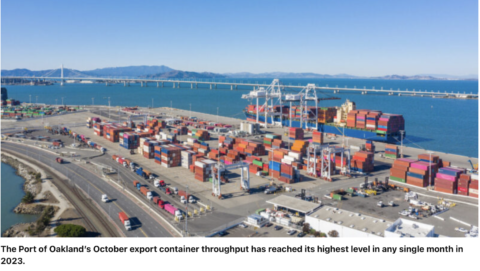
At the busy Port of Oakland full export TEU increased 4 per cent in October 2023 compared to October 2022, reaching 68,974 TEU.

The fading of supply chain congestion caused by pandemic-related disruptions continues to bring exporters back, said the port in its latest statement.

Port of Oakland Maritime Director Bryan Brandes, said: “Our port remains the preferred export gateway for fruits, nuts, meats, and grains since we are the closest to agricultural areas in the Central Valley.

“We also offer the fastest transit times to Asia since we are the last port of call in the US before ships go back across the Pacific.”
READ: Port of Oakland, Japanese trade officials team up to reduce shipping emissions

Screenshot 2023-11-23 at 5.50.15 AM
The Port of Oakland’s full imports are down 8 per cent in October 2023 against October 2022. Import levels appear to have levelled off at roughly 70,000 TEU per month.

According to the port, nationwide consumer spending has slowed, however, consumer spending in Northern California reportedly remains high. Nevertheless, it has dipped slightly from its peak during the pandemic.

“Import growth is expected to remain flat as traffic continues to stabilize after the significant spikes we saw during the pandemic years,” added Brandes.

“Shipping rates remain low and carriers are signalling that will remain well into 2024.”

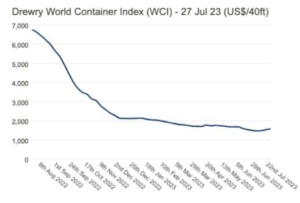
Worldwide, cargo price indexes are way down from a year ago when high shipping costs helped create shortages at the retail level.

Disinflation watch

-Novmber 18,2023-

OIL PATCH ‘GUSHER’

Turns out they did “drill-baby- drill”

Kern County's oil patch
Kern County’s oil patch

U.S. oil drillers have not been restrained in 2023  as some feared. Reuters reports that for the first three quarters of 2023, U.S. oil production has averaged a record 12.8 million barrels per day. The previous annual record — set in 2019 just before the Covid-19 pandemic impacted production —was 12.3 million bpd.

If you’re driving to grandmas house this week stop at Hanford Costco station where they’re selling regular for $3.89.

Wall St Journal -Disinflation

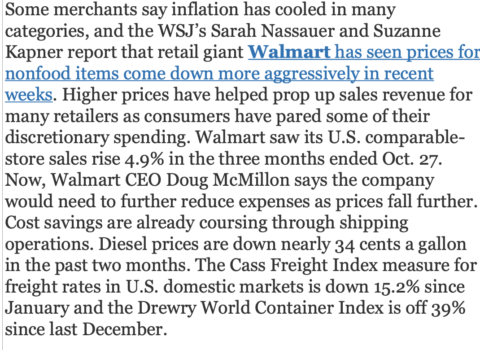
Shoppers Are Finally Getting a Break on Prices

In some cases, Walmart and other retailers are offering better deals on food and clothes than a few months agoScreenshot 2023-11-18 at 5.39.36 AM

Screenshot 2023-11-18 at 6.11.18 AM

Thanksgiving dinner cheaper for a change

-November 16,2023-

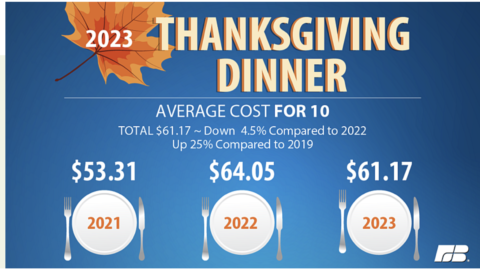
Screenshot 2023-11-15 at 7.13.53 AMGathering around the table for a Thanksgiving dinner won’t take as much of a toll on your pocketbook this year compared to 2022, but the meal still reflects historically high costs. The American Farm Bureau Federation’s 38th annual survey provides a snapshot of the average cost of this year’s classic holiday feast for 10, which is $61.17 or less than $6.20 per person.
That is a 4.5% decrease from last year’s record-high average of $64.05, but a Thanksgiving meal is still 25% higher than it was in 2019, which highlights the impact high supply costs and inflation have had on food prices since before the pandemic.

The centerpiece on most Thanksgiving tables – the turkey – helped bring down the overall cost of dinner. The average price for a 16-pound turkey is $27.35. That is $1.71 per pound, down 5.6% from last year.

“Turkey prices have fallen thanks to a sharp reduction in cases of avian influenza, which have allowed production to increase in time for the holiday”says a Farm Bureau spokesperson.Last year, supply concerns and record turkey and egg prices during the 2022 holiday season caused problems for consumers and farmers. Egg prices are way down this year as well.

Almost everything on the Thanksgiving menu is lower – prices for cranberries have dropped 18%- 2 frozen pie crusts are $3.50 (down 4.9%) and a half pint of whipping cream is $1.73 (down 22.8%).

Might as well wait on mortgage rates for better deal tomorrow

-November 16,2023-

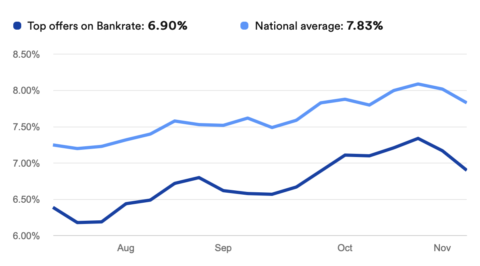
Screenshot 2023-11-16 at 7.21.00 AMMortgage rates should trend down in the next week, according to the majority of rate watchers polled by Bankrate this week.

Of those polled, 78 percent of respondents believe mortgage rates will decrease in the upcoming week and 22 percent believe rates will stay the same. None predict that rates will rise.

The average 30-year fixed rate dropped to 7.66 percent as of Nov. 15, according to Bankrate’s national survey of large lenders, down from 7.69 percent the previous week.

 Prediction on rates by Jeff Lazerson,President, MortgageGrader “Way down. A roller coaster ride down! Thank you CPI.”

By the way -might as well wait to fill that gas tank as well as oil and gasoline prices plunge too. There has been a

 “a sharp rise in U.S. crude inventories over the past two weeks” say analysts.

Energy Information Administration states it anticipates a 1% decline in US gasoline consumption in 2024, which would mark the lowest per capita gasoline consumption in 20 years, driven by factors like remote work, improved fuel efficiency, high gasoline prices, and persistent inflation.


Happy Thanksgiving

U.S. crude oil exports reached a record high in first half of 2023

-October 19,2023-

Data source: U.S. Energy Information Administration, Petroleum Supply Monthly

Exports help oil companies but not US motorists

Lights out at Santa Maria oil refinery2020-08-12 at 1.22.55 PMU.S. crude oil exports in the first half of 2023 averaged 3.99 million barrels per day (b/d), which is a record high for the first half of a year since 2015, when the U.S. ban on most crude oil exports from the United States was repealed. In the first half of 2023, crude oil exports were up 650,000 b/d (19%) compared with the first half of 2022.

Europe was the largest regional destination for U.S. crude oil exports by volume, at 1.75 million b/d, led by exports to the Netherlands and UK. Asia was the regional destination with the next-highest volume, at 1.68 million b/d, led by exports to China and South Korea. The United States also exported significantly smaller volumes of crude oil to Canada, Africa, and Central America and South America.

Although exports increased in the first half of 2023, the United States still imports more crude oil than it exports, meaning it remains a net crude oil importer. The United States continues to import crude oil despite rising domestic crude oil production in part because many U.S. refineries are configured to process heavy, sour crude oil (with a low API gravity and high sulfur content) rather than the light, sweet crude oil (with a high API gravity and low sulfur content) typically produced in the United States.

U.S. crude oil imports come primarily from historical trading partners such as Mexico and Canada. Heavy, sour grades of crude oil are often discounted compared with light, sweet grades of crude oil because they require more complex refinery units to produce profitable yields of refined products such as motor gasoline, diesel, and jet fuel. Most U.S. crude oil imports take place when it is more profitable for U.S. refiners to process discounted heavier grades because those refineries have already invested in the additional complexity required to refine them.

Lower fertilizer costs helping farms break even

Commodity prices are forecast to fall in 2024 but so will crop production expenses, said agricultural economist Michael Langemeier of Purdue University. “Moderation in input prices, particularly fertilizer prices, is likely to result in lower breakeven prices in 2024.”

Farm production expenses were forecast by the USDA at a record $458 billion this year, up nearly 7% from 2022, when expenses surged by 15%. Fertilizer and fuel costs soared in 2022 and were a sore point in farm country. Fuel prices would decline and fertilizer prices would hold steady this year, according to an August USDA estimate.

To offset high production costs, farm groups have called for higher reference prices, which would make crop subsidy payments more likely in the new farm bill. A 10% increase in reference prices could boost crop subsidies by $20 billion, according to one analyst. Lawmakers have not agreed on how to offset the expense and stay within spending limits. The farm bill is on the legislative back burner while the House selects a new speaker and Congress works on government funding bills.

“Breakeven prices for corn and soybeans are expected to decline from 5 to 10% in 2024 after increasing sharply in 2022 and 2023,” wrote Langemeier, after comparing changes in farm input costs with the overall U.S. inflation rate. Fertilizer, diesel fuel, and ag chemical prices have fallen steeply in the past year — nearly 50% for anhydrous ammonia, a nitrogen fertilizer.