Immigrant Docs Help Ease California’s Primary Care Shortage

Dr. Jose Chavez Gonzalez examines Graciela Jauregui at Riverside County Regional Medical Center (Photo by Jenny Gold/KHN).

RIVERSIDE, Calif. — When Jose Chavez Gonzalez moved to the United States from El Salvador, he took any job he could get — stocking warehouses, construction, cleaning houses and working in a meat processing plant.
But unlike most of the other immigrants he worked alongside, Chavez, 38, was a doctor with eight years of medical training. He came to the U.S. in the mid-1990’s to be with his family, but like all doctors from other countries, he still had to pass the U.S. medical boards and go through at least three years of residency in order to practice here. The process can be both expensive and time consuming, so during the day he worked various menial jobs and at night he studied for the boards.
“I had to do it. And I wouldn’t complain,” says Chavez. “It was OK to me. I mean, of course medicine is my passion, but since I didn’t have a license here, I couldn’t practice it.”
A quarter of U.S. doctors are foreign-born, mostly from countries like India that focus on training ­­medical students to work in the U.S.  Many other immigrant physicians never become American doctors, particularly those who come from Latin American countries like Chavez.
But a program at the University of California is seeking to change that, while at the same time helping to address the shortage of primary care doctors in the state. The UCLA International Medical Graduate Program offers Latino doctors a stipend along with board preparation classes, mentorship and references to help them find a good residency slot in primary care. In return, the doctors pledge to work in an underserved area of California for two or three years.
The program at UCLA was founded by Dr. Patrick Dowling and Dr. Michelle Bholat to help address the shortage of primary care doctors in the state, and a particular shortage of doctors of Latin American heritage. Though about 40 percent of the state’s population is Hispanic, only 5 percent of its doctors are.
Nearly half of the estimated 5 million Californians expected to be newly eligible for health insurance under the Affordable Care Act are Latino, and Dowling says it’s key that patients see a doctor who understands their language and culture.
“You can either do total body cat scans on everybody or you can sit down and try to understand what the patient is saying and why and what’s going on in their life,” says Dowling.
The program is small. But slowly, it’s making a dent.  Chavez was able to pass his medical exams in two years. Today, he’s hard at work as a first-year resident at the Riverside County Regional Medical Center. Most of his patients are Hispanic, and many are immigrants like him.
Graciela Jauregui came to the clinic with severe pain in her knee. She was born in Mexico but has lived in the U.S. for 17 years, working as a housekeeper. She’s 62 and doesn’t speak English. She says she always prefers to see a doctor who can actually understand her.
Speaking through an interpreter, Jauregui says, “All doctors are good people, but when they speak Spanish it’s better.”
Chavez’s fluency in Spanish is prized by his boss, Riverside’s chief of family medicine Dr. Geoffrey Leung. Leung says the clinic employs translators, but they are often in short supply. And even with a translator, important details can be lost.

Program founders Dr. Michelle Bholat and Dr. Patrick Dowling (Photo by Jenny Gold/KHN)
“No matter how good of a translator you have, your concern is that you may lose some part of the integrity of the message,” Leung says.
So far, the UCLA program has placed 54 Hispanic doctors into family medicine training programs – Dowling says that’s almost as many as came from all 10 California medical schools put together.
Dowling says hundreds and maybe thousands of immigrant doctors from Latin America could be practicing, but are instead working other – often menial – jobs. And that’s a wasted resource.
“I was just reviewing an applicant this morning who’s currently working in McDonalds,” Dowling says. “And I thought of the irony: She’s serving people Big Macs right now and what she could be doing is explaining to people that isn’t what you want you want to be eating.”
Chavez, for his part, is happy to be treating patients again: “[It] gave me the opportunity to stop working and focus full-time on studying. Without the program, I would still be working on construction.”
Kaiser Health News

Valley Economic Indicator Rises To Highest Level In Three Years

click to enlarge

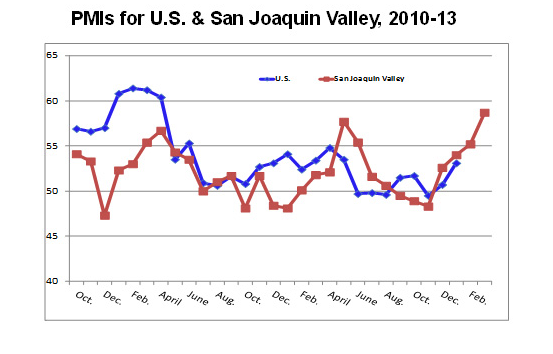
Fresno State’s Craig School of Business San Joaquin Valley Business Conditions Index advanced for a fourth consecutive month. During March the overall index expanded to 58.7 from 55.6 in February. An index of greater than 50 indicates an expansionary economy over the course of the next three to six months.
“The overall index jumped to its highest level in three years pushed higher primarily by construction and manufacturing expansion,” said Dr. Ernie Goss, a research associate from the Craig School who produces the index.
The index is a leading economic indicator from a survey of individuals making company purchasing decisions in the counties of Fresno, Madera, Kings and Tulare. The index uses the same methodology as that of the national Institute for Supply Management.
Survey results indicated that federal spending sequestration is having little impact on local business confidence. “This month we asked companies how the federal spending sequestration was affecting their company. Approximately 90 percent indicated that the cuts were having no impact on their company. The remaining 10 percent reported only modest impacts. None of the businesses reported significant impacts,” said Goss.
Other survey findings:
Employment moved above the growth neutral threshold for a fifth straight month. The job index climbed to 57.7 from February’s 51.1. While hiring has increased, most gains are among temporary and hourly workers. Giving the overall upward economic trend nationally, Goss expects to see healthy increases in the hiring of permanent works in the months ahead.
Wholesale prices declined to 60.4 from 66 in February according to the prices-paid index, which tracks the cost of raw materials and supplies. This month survey participants were asked how much they expected prices for their company’s products and services to increase in comparison to last year. On average, supply managers expect prices to grow by one percent for 2013, or less than the current rate of growth in the U.S. consumer price index.
Inventories expanded for businesses in March. The inventory index grew to 51.9 from 51.3 in February. Goss says the sluggish growth this is an indicator of weak business confidence.
Trade strengthened for March with a reading of 51.7, up from February’s 44.2. March imports expanded for the month with an import index of 56.3, up significantly from 51.9 in March.
Other components of the March Business Conditions Index were new orders at 62, up from 58.1 in February; production or sales at 63.5, up from February’s 55.6; and delivery lead-time at 58.4, down from 59.6 in February.

Some Locations See Home Construction Double

Central Valley Home Building Up

Central Valley home builders pulled permits for 587 new homes during the first  three months of 2013 compared to 425 for the same period a year earlier. The figures come from Construction Monitor for Madera,Fresno,Kings and Tulare Counties.

Lennar Homes continues to lead the pack of home builders permitting 117 new homes in the region in the first quarter of the year compared to 74 for the first three months of 2012 when they were also the top builder.

Visalia new home building permits numbered 75 so far this year says the city compared just 34 for the first three months of 2012,showing the pace more than doubled. The city total building valuation is up 67% so far this year at $33.2 million compared to $19.8 million for the first quarter of 2012.

CENTRA COAST HOME PERMITS DOUBLE LAST YEAR’S PACE

Led by San Luis Obispo County the Central Coast saw new home building permits more than double in the first three months of 2013, Construction Monitor reports.

In the SLO/Santa Barbara two-county region contractors received 182 new home permits compared to 91 for the same period in 2012.

Of that, SLO County has been busier. For  the first quarter of 2013 SLO County builders got permits for 123 new sf homes vs 66 for the same period in 2012. Shea Homes is the busiest builder with 32 units.

Builders also got permits for 156 units of multi-family so far this year compared to just 21 units in the first three months of 2012.

California Labor Market Stronger Than Believed

After slowing sharply over the past few months California’s labor market surged forward in February, adding over 40,000 jobs as the unemployment rate dropped by 2 tenths of one percent to 9.6%. The overall gain over the past year has been just under 300,000 jobs, a growth rate of 2% (seasonally adjusted). The sectors enjoying the biggest job gains included Professional and Business Services (+9,400), Leisure and Hospitality (+15,700), and surprisingly, Government (+11,200). While services were solid, the goods oriented part of the economy contracted—with jobs in Manufacturing (-3,300) down as well as in Trade and Transportation (-7,000).

Tulare County: The unemployment rate in the Tulare County was 15.9 percent in February 2013, down from a revised 16.8 percent in January 2013, and below the year-ago estimate of 17.6 percent,EDD reported .Total nonfarm jobs are up 3000 year over year.

SLO County: saw the unemployment rate fall to 7% – best in years.

Regionally, job growth was mixed. The Orange County (+7,000), San Diego (+6,500) and San Jose (+2,300) metropolitan areas boosted state nonfarm growth, but major metropolitan areas in the northern and southern parts of the state showed declines for the month: Los Angeles County (-4,800), San Francisco MD (-2,900) and Oakland MD (-2,600).
This week the EDD also released revised 2011 labor force data for California, reaffirming what their annual industry employment revisions showed – that California’s labor market has recovered at a faster pace than originally reported. The 2011 labor force data was revised upward to reflect an additional 18,500 entrants into the labor force. Last week, the 2012 labor force revisions showed an additional 65,900 entrants into the labor force.
The industries showing the largest upward revisions for 2012 in last week’s release include the Professional and Business Services (+25,700), Other Services (+22,900), and Leisure and Hospitality (+20,900) sectors. The Construction industry posted one of the largest percent changes showing an additional 16,200 jobs in 2012, a 2.8% difference from what was originally reported and reflecting a much improved housing sector in the Golden State.
Last week’s annual revisions also showed that the additional nonfarm job growth in 2012 was broad based regionally. The greater Los Angeles area and most of the San Francisco Bay Area were found to have stronger nonfarm job growth than originally reported. The San Francisco MD led the upward revisions with an additional 20,300 payroll positions, followed closely by Los Angeles County (+18,400) and Oakland MD (+16,800).

Around California: Fish,F-35s,Fuel & Freight

click to enlarge

More Salmon

Cold Pacific water temps may not be good for rainfall across the Golden State this winter but they seem to to be a key beneficial factor in expected salmon returns up Northern California rivers this fall. A recent report noted “Changes in ocean temperatures, which switch from cooler to warmer every decade, can affect salmon survival in the Pacific Ocean.” The cold water has improved conditions for ocean salmon survival in the past few years as more in fish come back to spawn.

California fall Chinook salmon runs are are expected to be up again this year according to the preliminary analysis from the Pacific Fishery Management Council (PFMC). The Council’s preseason report, released in late February said more than 834,000 fall Chinook are forecast for the Sacramento River system compared to  618,000 in 2012 and lows  a few year s back of only 41,000 fish in 2009. PFMC expects the Klamath River ocean abundance for age 4 fish is 331,000  – highest since 1986.

High Hopes For F-35 Deployment in Lemoore
Concerns that the Navy’s F-35  basing in Lemoore in coming years could be in trouble due to  the feds budget were eased last week with a Bloomberg story that said the military was committed to buying more of the jets. The story says the Pentagon wants more planes despite its soaring cost.
“ Buying 29 F-35s next year, the same number Congress approved for the current year, would mean stability after reductions from planned purchases for three consecutive years.” says the article.
“Over the past three years, the Pentagon deferred planned purchases of 425 F-35s until after 2017.
The F-35 funding to be proposed for fiscal 2014 “will help calm any anxieties amongst the partner nations” buying the jets, Douglas Barrie, senior fellow for military aerospace with the London-based International Institute for Strategic Studies, said in an interview.”

Bringing the F-35s to Lemoore will mean replacing seven FA-18 Hornet squadrons with F-35C stealth fighters starting in 2015 say Capt  Eric Venema. A new 40 aircraft training squadron would be added to the  base. Adding it up Venema says an additional 750 military personnel and contractors would come to Lemoore, along with 1,600 military dependents. The basing would mean some $242 million in new construction projects as well.
Earlier this year the Navy announced they had selected Lemoore over El Centro to be the west coast home for the squadrons. That decision will be finalized late this year.

Too Much Ethanol Fuels Red Ink
A surplus of ethanol nationwide has helped idle scores of Midwest ethanol plants. In California Pacific Ethanol just reported a loss in the latest quarter but said margins were improving now.Corn prices are easing this week. Net sales were $197.0 million for the fourth quarter of 2012, compared to $241.8 million for the fourth quarter of 2011.“Both as a step toward qualifying for advanced biofuel and to take advantage of favorable pricing, we purchased sorghum as feedstock for producing ethanol from local, Midwest and international markets,” CEO Neil Koehler said in the company’s fourth quarter earning release

Truck/Train Freight Activity Higher
The American Trucking Associations’ advanced seasonally adjusted (SA) For-Hire Truck Tonnage Index rose 0.6% in February after increasing 1% in January. (The 1% gain in January was revised down from a 2.4% increase ATA reported on February 19, 2013.) Tonnage has now increased for four straight months, which hasn’t happened since late 2011

. Over the last four months, tonnage gained a total of 7.7%. In February, the SA index equaled 123.6 (2000=100) versus 123.0 in January. The highest level on record was December 2011 at 124.3. Compared with February 2012, the SA index was up a solid 4.2%, just below January’s 4.6% year-over-year gain. Year-to-date, compared with the same period in 2012, the tonnage index is up 4.4%. In 2012, tonnage increased 2.3% from 2011.

American freight railroads are shipping more carloads in the latest industry report with less coal but 57% more oil moving by rail than a year earlier. That could help spell relief for California motorists says recent LA Times story.

“In 2008, BNSF, a railroad that serves the West Coast, moved 1.3 million barrels of oil. In 2012, it moved 100 million barrels. Most of BNSF’s oil originates in North Dakota.

“You could say that ‘there’s a train a-coming,'” said Tom Kloza, chief oil analyst for the Oil Price Information Service, “and its carrying oil.”
Patrick DeHaan, senior energy analyst for GasBuddy.com, said that access to cheaper domestic crude should mean that California gasoline prices will be cheaper in the long run.”

Biz Beat / More Jobs in Tulare County / Hanford Power Plant To Be Scrapped

Tulare County Jobless Rate Improved

Tulare County’s jobless rate in January 2013 was 16.8%,up from 15.9 % in December 2012 but down from 17.7% in January 2012. Almost 2000 fewer people were unemployed in January 2013 compared to a year earlier. The uptick in January vs December 2012 is largely due to a 4000 person increase in the labor pool meaning more were looking for work. There were some 2700 more non-farm jobs in Jan 2013 compared to Jan 2012 led by 1000 more in manufacturing and 1400 more in trade and transportation.The hospitality industry added 400 more jobs year over year.

More Hotel Rooms Sold

February saw a nice uptick in in hotel room occupancy in both Tulare and Fresno Counties,but not Kern. Fresno hotel occupancy rose to 54.9% from 51.6% in Jan 2012. Tulare County recorded a 54.9% occupancy – up from 49.9% a year earlier.Bakersfield hotel occupancy fell year over year to 59.5% from 63.1%. Rooms sold in Fresno were up 7%,Tulare County up 9.9% but Bako was down 4.6%. Tulare County’s nearly 10% improvement was the best in the state according to Smith Travel.

Badger Fire Station

Badger will get a new fire station according to  a public notice The new  facility would sit on 2.3 acres at Wildhog Canyon and Hwy 245.

Ag Land Values

The Ranch Co’s annual statistic report shows ag land prices excluding rangeland way up to an average of $12,162 an an acre in 2012,a 68% increase over 2011. Owner John Grimmius notes some walnut orchards are going for as high as $36,000 an acre.

Gas Prices Down In March
California gas prices have fallen more than 20 cents this month to around $4 a gallon. Several stations  in Tulare are selling at $3.79  a gallon this week.

Power Plants To Be Scrapped

The mothballed solid fuel power plants owned by GWF Energy in California have been sold at a March 20 auction and according to one source sold for scrap including the idle plant in Hanford. The auction company for the old coke fired power facilities has requested bids to demolish several of the plants including Hanford. that closed in 2011.The demo will require a permit from the Valley Air Board over any asbestos issues. GWF Energy has six mothballed coke plants in the state – out of favor due to their greenhouse gas emissions. As of December GWF is now owned by Highstar Capital with ownership of a 334 MW combined cycle power plant in Tracy and the 2 ‘peaker plants’ in Kings County,one in Hanford and one near NAS Lemoore.(Henrietta). All three nat gas plants have agreements with PG&E through 2022.

BIZ TRENDS / Rain / Gas / Interest Rates

Rain Next Week: Forecaster John Lindsey says Central California will get a few days of rainy weather from March 20 – 23. For March 11 the southern Sierra is only 52% of April 1 average. Temps in the 80s this week will likely cause some snowmelt in March,what little is there. Big storm would indeed be a ‘March Miracle.’

Gasoline prices are down nearly 10 cents from their high in late February says Gas Buddy. Latest numbers show an average price of $4.14 a gallon.Cheapest in Tulare is $3.83, Fresno $3.82 and in SLO the Costco is selling for $4.14.Gasoline futures in NY are down about 20 cents after rising steadily this New Year.  Back in California, diesel prices have fallen about 15 cents from late February.

interest rates spike up

Rising Interest Rates Curtail Mortgage Activity: Applications for mortgages decreased as mortgage interest rates rose to recent highs during the week ended March 8.  The Mortgage Bankers Association’s (MBA) Market Composite Index, a measure of application volume, was down 4.7 percent on a seasonally adjusted basis from the previous week and 4.0 percent on an unadjusted basis.
The Refinance Index was down 5 percent compared to the week ended March 1 and the refinance share of mortgage activity decreased to 76 percent of total applications from 77 percent, the lowest share of refinancing applications since May 2012.
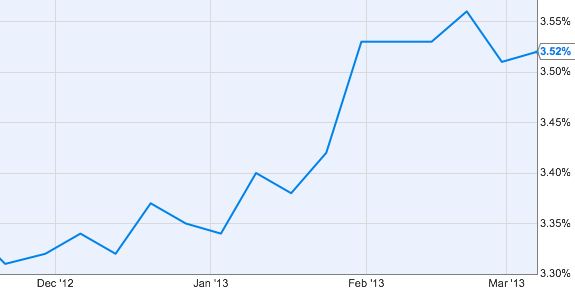
Freddie Mac’s March 7 survey found 30-year fixed-rate mortgage (FRM) averaged 3.52 percent with an average 0.7 point for the week ending March 7, 2013, up from last week when it averaged 3.51 percent. Last year at this time, the 30-year FRM averaged 3.88 percent.

California Gas Prices Finally Falling

California gasoline prices fell for the first time this year – down about 3 cents from Feb 28 says Gas Buddy. The average selling price is now $4.20 – up from $3.95 a month ago and $3.45 as of Jan 1. Prices today are still lower than a year ago by a few cents.

AAA fuel report week offers the following.

“The national average increased for 36 consecutive days from Jan. 17-Feb. 22. During this streak retail prices surged 49 cents per gallon from $3.29 to $3.78, which was just below the year-to-date high of $3.79 on Feb. 27. Since this recent peak, the national average has dropped for five straight days and declined a total of four cents.

Motorists in every state are paying more at the pump than one month ago, however many drivers are beginning to feel some welcome relief. 27 states have an average price that is cheaper than one year ago and 38 states and Washington D.C. are paying less than one week ago. With “spot” gasoline prices (gasoline sold for immediate payment and delivery) dropping dramatically across the country it is likely that retail prices will continue to fall in the coming days.”
Oil analysts seem to agree.

“The savings could widen out to 20 cents to 25 cents per gallon this month,” said OPIS analyst Tom Kloza. “The expanding gap should come as much cheaper wholesale prices work their way downstream and are compared with very steep increases that were characteristic of March 2012.”

The WTI oil price is near $90 a barrel this week,down from near $98 a month ago.
In January the US Energy Agency(EIA) predicted lower crude and gas prices this year.”EIA expects that falling crude prices will contribute to a decline in the national annual average regular gasoline retail price from $3.63 per gallon in 2012 to $3.55 per gallon in 2013 and $3.39 per gallon in 2014, about 11 cents per gallon and 4 cents per gallon higher than forecast in last month’s STEO, respectively. Diesel fuel retail prices averaged $3.97 per gallon during 2012 and are forecast to fall to $3.92 per gallon in 2013 and to $3.82 per gallon in 2014.”

Box Maker To Add 200 Jobs In Kingsburg

Sacramento Container Corp, manufacturer of corrugated boxes for the food and beverage industry in Northern California, has announced that they will open their second manufacturing and warehousing facility at a building formerly owned by Del Monte and used as a warehouse for their nearby cannery. The vacant 100,000 sf warehouse was sold to Sacramento Container last week.
Company president  Joseph LeRoy says they chose the Kingsburg facility due to its location to current major customers, such as Sun-Maid.  “Initially, there will be approximately 25 employees working at the facility. Over the next 24 to 36 months SCC plans to increase the number of jobs to 200.”
According to Kingsburg Mayor Chet Reilly, “I was excited to hear about Sacramento Container’s plans to expand into Kingsburg and bring with them a significant number of new jobs.  This comes on the heels of other recent announcements of new businesses opening in Kingsburg.   The location of new businesses in Kingsburg is not the result of mere luck but a concentrated effort to let companies know that Kingsburg is open for business.”
Kingsburg lost a major employer last year when Del Monte’s big peach cannery closed  along with the nearby warehouse. The plant itself on 50 acres recently sold to Grace Church of the Valley. The cannery operation used to employ over a thousand workers in peak fruit season.
Nearby, the former Silgan can making plant,also empty – has significant interest by parties, says city manager Don Pauley. Silgan’s closure laid off an additional 60 workers last year.
Now Kingsburg looks to regain some of those jobs.
Sacramento Container Corporation was founded in 1992 by Joseph LeRoy who continues to operate the company. SCC’s current operation is in Northern California at the McClellan Air Force Base with 320,000 square feet of manufacturing and warehouse space.  The expansion into Kingsburg allows SCC to better serve their current and future customers in the Fresno and Bakersfield markets.  SCC plans on manufacturing corrugated boxes in the new facility beginning approximately April 15, 2013.
According to LeRoy, “We’re the largest by volume independent corrugated manufacturer in Northern California.  What differentiates us from our competitors is our adoption of a culture that is focused on a unique approach to service our customers.  For example, our standard lead time is three working days, and we warehouse and just-in-time deliver for the majority of our customers.  We are excited   In 2012, SCC sold 1 billion 130 million square feet of corrugated boxes.  To put that into perspective, one could take a sheet of corrugated 1 foot wide and wrap it around the equator 8 times to equal the amount of corrugated the company manufactured last year.  LeRoy plans on eventually manufacturing that much corrugated in Kingsburg .
“It’s been a joy doing business in Kingsburg.  Everyone, including City Manager Don Pauley, that we’ve dealt with has been extremely helpful and made the transition relatively easy for a new business to move into the market.”  LeRoy said.

When the Going Gets Better…We Better Go On Vacation

Whats a good barometer for how the economy is doing? How about Hawaii travel stats dependent on visitors’ own local economies to sustain its own. So how is the global economy?  Well for starters there was a 21% increase in visitors to Hawaii from developing markets around the world.

The numbers are in for 2012 and Hawaii total visitor spending was $14.3 billion and visitor arrivals the highest of any year. Growth in total visitor expenditures and arrivals in every month of the year elevated annual 2012 total visitor expenditures to a record $14.3 billion, according to preliminary statistics released by the Hawai‘i Tourism Authority.

A record 7,998,815 total visitors (+9.6%) came to the state in 2012, exceeding the previous high of 7,628,118 visitors in 2006.
For the month of December 2012, total visitor expenditures rose 14.9 percent (or +$184.6 million) to $1.4 billion, boosted by higher daily spending (+9.4% to $194 per person) and a 6.3 percent growth in total arrivals (to 733,709 visitors).

Annual 2012 Show US West Coast Travel Spending Up 12%

There were strong increases in total visitor expenditures from U.S. West (+12.2% to $4.6 billion), U.S. East (+9.9% to $3.4 billion), Japan (+21.7% to $2.6 billion), Canada (+9.8% to $995 million) and All Other markets (+50.7% to $2.6 billion).
Arrivals among the top visitor markets exceeded 2011: U.S. West (+6.7% to 3,194,975), U.S. East (+3.5% to 1,699,124), Japan (+17% to 1,452,563) and Canada (+4.3% to 498,241).
A total of 992,291 visitors arrived from developing markets, up 21.3 percent from 2011.
Total visitor expenditures and arrivals by air for the four larger Hawaiian Islands increased from 2011: O‘ahu (+18.7% to $7.4 billion; +11.1% to 4,891,540); Maui (+18.8% to $3.6 billion; +5.9% to 2,295,867); Hawai‘i Island (+17.7% to $1.7 billion; +8.8% to 1,434,271); and Kaua‘i (+20.1% to $1.4 billion; +7.3% to 1,084,868).
A total of 283,293 visitors came by cruise ship or by air to board cruise ships, up 16.1 percent compared to 2011. Visitor days for all cruise ship visitors rose 7.5 percent from the previous year.

Disney Theme Parks

California’s Disneyland attracted more visitors in 2012 as well.For the latest quarter Disney reported their parks and resorts business enjoyed the highest revenue growth at the company, rising 9% to $3.4 billion. Operating income climbed 18% to $497 million. Disney dumped $1 billion into its lagging California Adventure Park and it has paid off  in higher attendance.