
Holy Cow! 4X More Milk & 77% Less Feed !
Tighter Motoring of Groundwater At Dairies
As a result of litigation all Central Valley dairies must sample and monitor their wastewater and keep adequate records through the Central Valley Regional Water Quality Control Board .Some 20% of the farmer’s fields have to be sampled each year.
Tulare County Gets New Dairy Advisor
Dr Alex Souza has been appointed dairy farm advis0r with the University of California Cooperative Extension .He received his degree from the University of Wisconsin and worked with World Wide Sires.
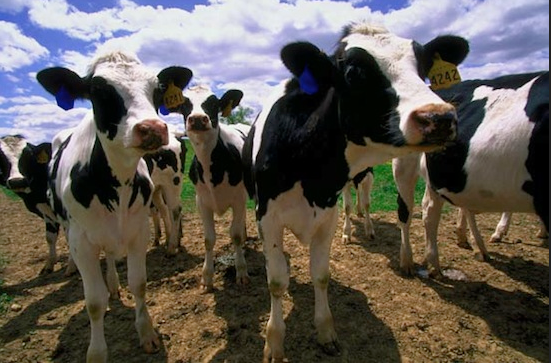 Holy Cow! 4X More Milk & 77% Less Feed
The Journal of Dairy Science published a recent article about the sustainability of the dairy industry.Here are some facts.
“Advances in genetics, nutrition, and herd management have resulted in more than a four fold increase in milk yield and an associated reduction in numbers of both farms and cows. In 1940,
there were approximately 21 million cows on almost 4.7 million dairy farms in the United States, but by 1980, farm and cow numbers decreased 93% and 48%, respectively, to 334,180 farms with just under 11 million cows. Farm numbers decreased to approximately 53,000 licensed dairies in 2012 and cow numbers have decreased a further 16%. Milk yield averaged 5,194 lb./cow in 1950 compared with 21,340 lb./cow in 2011.
As a result of this evolution, today’s dairy industry produces 59% more milk with 64% fewer cows, consuming 77% less feed and 65% less water per CWT of milk produced compared with dairy production in 1944.”
Tulare’s Saputo Plant Adding New Whey Silo
Saputo now owns the former Morningstar plant in Tulare on J St.The company has applied to build a new 60ft whey silo at the facility says the city.
Cali Cheese Has Until January 14 To Buy Tulare Land For Plant
Tulare officials say start-up company – Cali Cheese says they are on track to build a cheese plant in Tulare and has until January 14 to buy city-owned land for the plant as agreed to earlier this year.
Chinese Milk Demand Is Good News
Excerpts from Milkweed November 2014
“China’s dairy consumption is growing. China is looking to diversify its suppliers of dairy products and commodities, following the botulism scare from New Zealand in August 2013. The U.S. is the only major alternate source of available, perceived high- quality dairy products and commodities. Chinese consumers prefer to buy quality foreign dairy products – particularly infant formula-type products. “Made in the U.S.A.” carries special marketing clout on packages of dairy products in China. We wonder how soon it will be before Chinese buyers “pull a Smithfield” (Foods): buying major U.S. dairy processing assets to have greater control.
Meanwhile, global demand for U.S. dairy proteins, butter and high-milk fat products is draining U.S. inventories. USDA data show U.S. nonfat dry milk production very low at 76.4 million lbs. for September. Meanwhile, Skim Milk Powder (for export) climbed to 54.2 million lbs. U.S. dairy processors and food processors are facing tight, expensive supplies of nonfat dry milk.
Butter inventories – troublingly close to 300 million lbs. in early summer – are being pulled down nicely. U.S. butter plants are producing more unsalted, 82-score (82% milk fat) for export buyers. U.S. butter inventories dropped about 30 million lbs. in both August and September 2013 – according to USDA’s Cold Storage report.
Export demand should only increase. The world is coming to the U.S. for dairy products and commodities. Our nation’s challenge is to produce dairy commodities that fit into the specifications of export buyers – and to put a good price on those products.”