Citrus mutual names new CEO
Exeter-based California Citrus Mutual announced the selection of Tom Danowski as its new Chief Executive Officer following an extensive search conducted by the CCM Board of Directors.
Danowski brings more than three decades of executive leadership experience spanning agriculture, advocacy, trade association management, and marketing. Most recently, he served for 13 years as President and CEO of the Oregon Wine Board and Oregon Winegrowers Association. During his tenure, he helped drive the Oregon wine industry’s total annual economic impact from $2.7 billion to $8 billion through industry collaboration, strategic advocacy, and public policy work.
Prior to leading Oregon’s wine industry, Danowski held senior executive positions with several nationally recognized consumer brands, including Chateau Ste. Michelle Wine Estates, Starbucks, and Coca-Cola. His background combines strategic marketing expertise, operational leadership, and extensive experience working with both agricultural producers and policymakers.
Danowsoki replaces Casey Creamer who left the trade group in mid-February 2026, after which day-to-day operations have been handled by the existing staff.
Mexico lettuce contamination exposes weak regulation says farm publication
The Packer farm newspaper this month pointed to weak regulation of mounting imports of lettuce and other produce from Mexico as a problem citing increases of foodborne illness -Cyclospora in the US.
Salinas-based Taylor Farms has been linked to iceberg lettuce imports from Central Mexico caused by fecal matter contamination of irrigation water and Jalapeno peppers linked to salmonella.
The newspaper pointed to a decline in oversight by the FDA.
“Food and Drug Administration’s ability to oversee imported food, experts say. FDA’s employment fell by 22% in 2026 compared to 2024, according to agency data, in part due to workforce cuts since Donald Trump returned to the White House. Foreign food-facility inspections by FDA fell by nearly 13% in fiscal 2025, while imports have continued to rise.”
The news has hit the US fresh produce industry hard as consumers have balked on purchase of salad makings at their local store. No California grown produce has been linked to any illness.
NBC reports that lettuce prices have recently plunged 16% as the cyclosporiasis outbreak has rattled consumers.
It’s very likely due to the cyclospora outbreak and consumers just not wanting to buy lettuce right now,” said Jeremy Horpedahl, an associate economics professor at the University of Central Arkansas. The “consumer is just wanting to stay away from this product.”
Paraquat out in California
The California Department of Pesticide Regulation (DPR) announced in recent days that all manufacturers of pesticide products containing the active ingredient paraquat-dichloride (paraquat) have voluntarily cancelled their product registrations, beginning the phase-out of the use of paraquat in California.
Exposure to the pesticide has been tied to potential thyroid issues and birth defects in humans, according to reports from the state pesticide regulation agency.
Almond crop sales diverge – exports up, domestic down
Chinese sales shrink again
The Almond Board of California has released its final position paper for the 25/26 crop year and it shows export sales continued strong, up 3% over 24/25 but domestic sales were off 11.3%.
While exports overall were strong to Turkey, Pakistan , Morocco,Spain and Italy – sales to a former top customer China /Hong Kong dropped 34%.
Trade war impacts
U.S. almond sales to China have fallen sharply due to high retaliatory tariffs, allowing Australia to overtake the United States as China’s leading supplier. Shipments to China reached 144 million pounds in the 2022/23 marketing year (August–July), but fell by nearly 50% to 51 million pounds in 2024/25.Now as of July 2026 they are down to 33 million pounds for the crop year. That is a drop of 77% from 2022/23.
According to industry reports from the survey company Land IQ, bearing acreage sits at approximately 1.38 million acres, indicating a slight downward trend driven by orchard removals and stricter groundwater regulation
Tractor sales continue downward trend
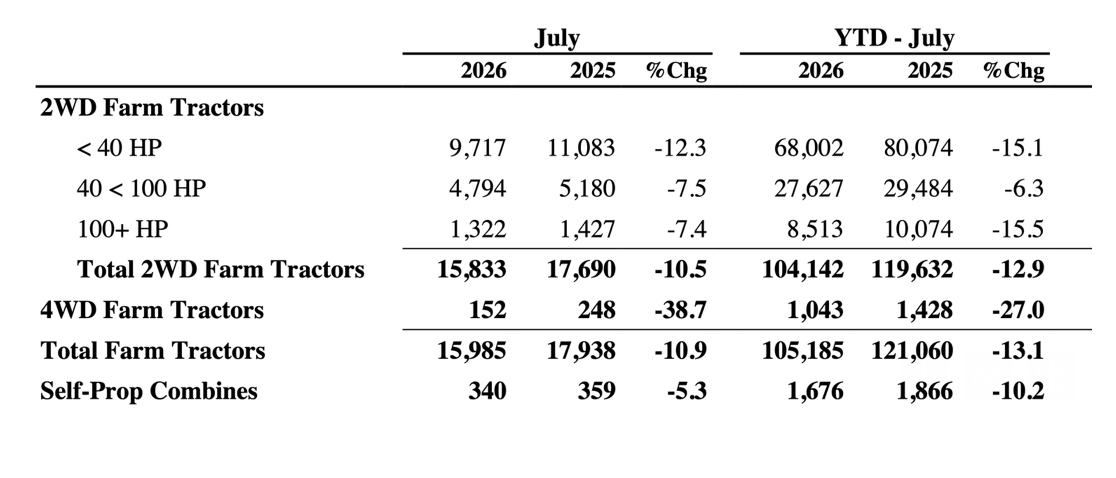
Both 2-wheel and 4-wheel tractor sales were down in July compared to the same month in 2025, says an industry monitor, the Association of Equipment Manufacturers. 4-wheel tractor sales declined 39% and 2-wheels were down 10.5%. and 12.9% on a year to date basis as farmers face uncertainty over the future.