
– May11, 2019 –
California almond crop expected to grow almost 10%
USDA says the initial subjective forecast for the 2019 California almond production is 2.50 billion pounds. Forecasted production is 9.6 percent above last year’s production of 2.28 billion pounds. Forecasted bearing acreage for 2019 is a record high of 1,170,000. Forecasted yield is 2,140 pounds per acre, 2.4 percent higher than the 2018 yield of 2,090 pounds per acre. The subjective production forecast is based on a telephone survey conducted from April 19 to May 4 from a sample of almond growers.
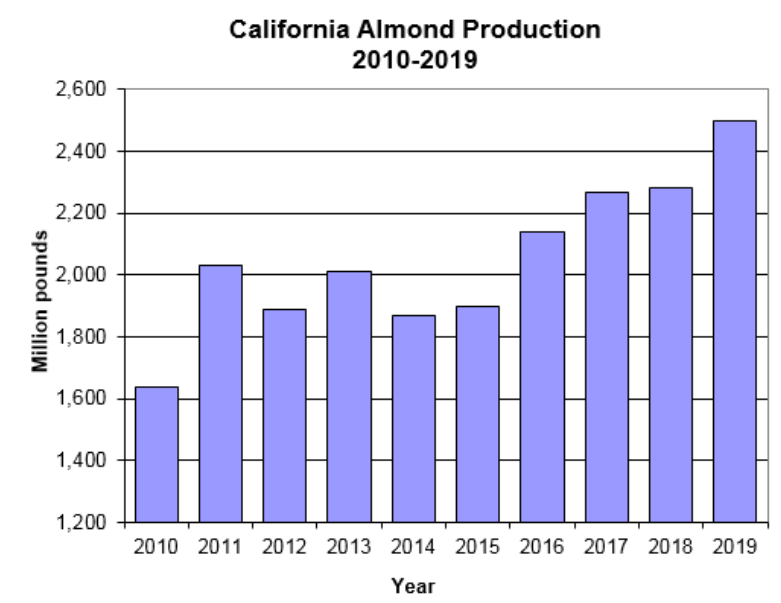
The 2019 almond crop experienced unusual weather in the early part of the season. Significant rainfall during the bloom hindered pollination. However, an extended bloom period provided the opportunity to compensate for disruptions and allowed for more overlap between blooming varieties. Instances of rain continued into spring, bringing cooler temperatures that minimized pest and disease pressure, but there were reported occurrences of bacterial blast and jacket rot in some parts of the state. Strong winds in mid-April damaged trees and knocked off some nuts. As temperatures began to rise in the second part of April, orchards dried out enough to allow field work to begin. With the crop developing at a good pace, irrigation and fertilization are in full swing. Growers are optimistic as nuts appear to be sizing well.
86% of farmers raised worker wages last year
In efforts to attract qualified farm labor, California farmers and ranchers have increased their wages due to the chronic employee shortages. In the recent Adapting to Farm Worker Scarcity Survey for 2919 conducted by the California Farm Bureau Federation and UC Davis, data showed there was an increase in farm labor shortage despite more farmers were offering higher pay. The study found that 86 percent of all respondents raised their wages in 2018, with roughly 30 percent starting those increases back in 2014.
CFB
California will ban Chlorpyrifos
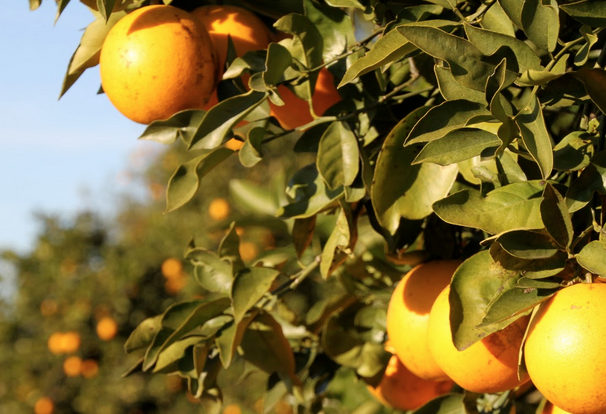
Tulare Co orange growers have been largest users countywide
California will ban the pesticide chlorpyrifos, linked to neurological damage in children.
The California Environmental Protection Agency says that use of the pesticide dropped more than 50 percent from 2 million pounds in 2005 to just over 900,000 pounds in 2016.
“California’s action to cancel the registration of chlorpyrifos is needed to prevent the significant harm this pesticide causes children, farm workers and vulnerable communities,” said CalEPA Secretary Jared Blumenfeld.
The delisting will take effect in two years as the state funds a search for safer alternatives.
The organophosphate pesticide has been used in citrus production including to control the Asian citrus psyllid – the vector of the bacteria that causes citrus greening.
The California Citrus Mutual group criticized the state move.“The citrus industry is fighting feverishly to protect itself from the deadly citrus disease, Huanglongbing,” stated CCM presswint Casey Creamer. “In order to do so, we must have the necessary tools in the toolbox for an effective Integrated Pest Management program.”
“The once mighty citrus producing state of Florida has lost 70% of its production due to this disease, which is expanding exponentially in residential citrus trees in Southern California at this very moment. While our commercial growers will remain vigilant, it is vital that our policy makers recognize the seriousness of the threat and ensure sound scientific procedures are followed.”
“California Citrus Mutual will continue to be actively engaged in the regulatory processes around the cancellation decision and will continue to explore all potential remedies to allow the safe and effective use of Chlorpyrifos.”
Chlorpyrifos is used in more than 90 countries. Most household uses of the chemical ended in 2000, but it has remained popular in farming. California already lists chlorpyrifos as a “toxic air contaminant” and has developed permanent restrictions on its use.
DPR figures show that insecticide use on oranges increased in 2016 and has increased 50 percent in the last 5 years.
Chlorpyrifos is a broad-spectrum insecticide used primarily for citricola scale management. However, chlorpyrifos resistance in citricola scale has been documented and imidacloprid is increasingly being used to suppress these resistant populations. Imidacloprid is also used in the required treatment of glassy-winged sharpshooter
DPR futures show that in2016 Tulare County farmers applied 81,000 lbs of the chemical and half of that was on oranges.
Body mass bigger in the countryside
Obesity rises faster in rural areas
from NPR
A new paper in the May 8 journal Nature has shattered the preconceived notions of urban versus rural body types. More than 1,000 researchers representing the Non-Communicable Disease Coalition analyzed 2,009 studies of more than 112 million adults from 200 countries. In the most comprehensive analysis of urban/rural weight gain to date, they assessed changes in body mass index, a measure of body fat based on height and weight, between 1985 and 2017.
A healthy BMI for both male and female adults is 18.5 to 24.9. Overweight is a BMI of 25 to 29.9. And obesity is a BMI of 30 and above. The study found that global averages are creeping up for everyone — but faster for rural residents. The global average BMI for women rose in the past three decades by 2.09 in rural women compared to 1.35 to in urban women; in that same period, it rose by 2.10 in rural men compared to 1.59 in urban men.