
200MW battery storage facility slated for mothballed power plant
From offshore wind storage to keeping the lights on in emergencies, batteries my be the answer
-November 27,2019-
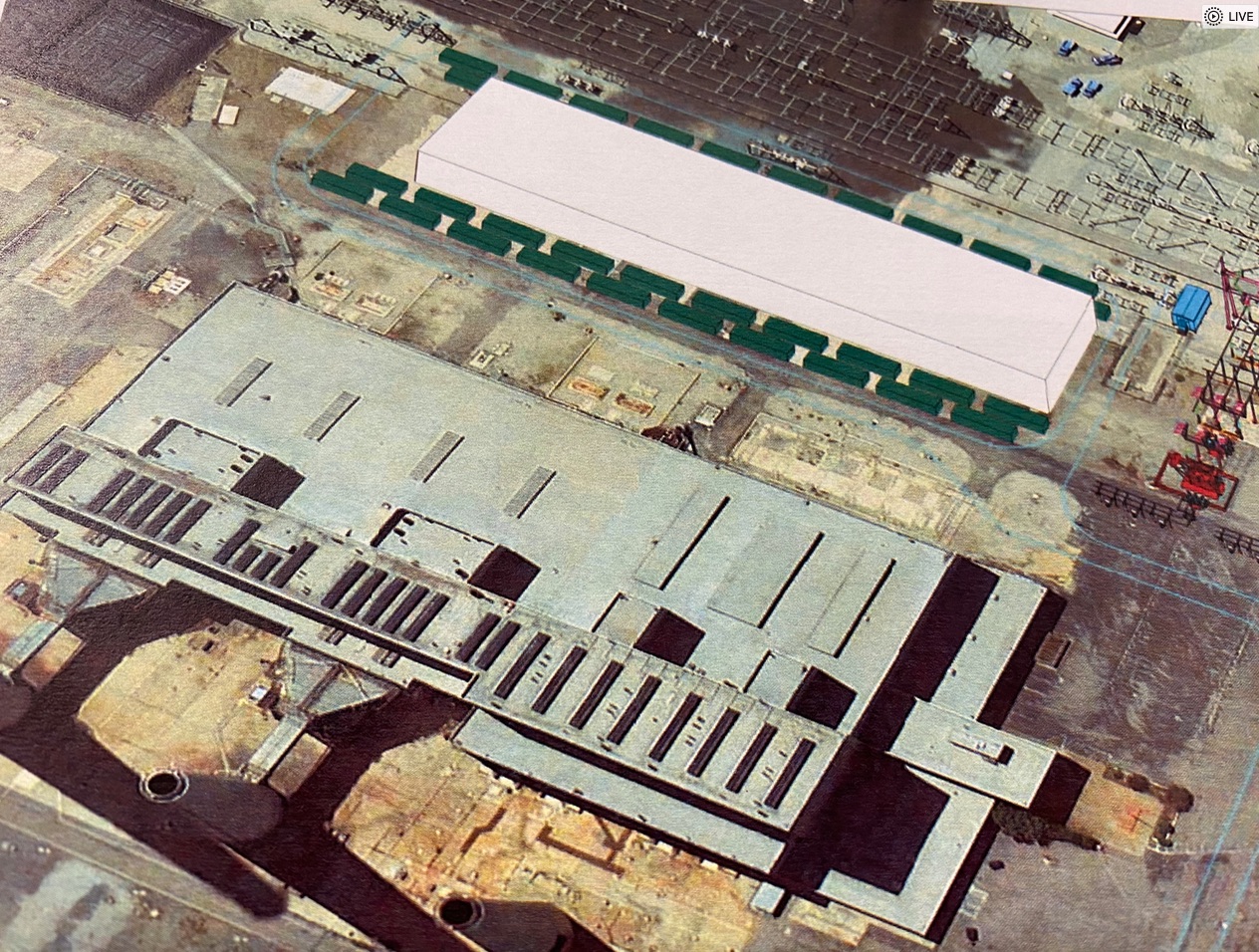 Irving Texas-based Vistra Energy has filed a plan November 12 to build a 4-acre, 200 megawatt battery storage facility just behind their mothball power plant and next to the big PG&E substation there. City Community Development Director Scot Graham says the Vistra proposal follows similar storage projects the company is building at their power plants in Moss Landing and in Oakland.
Vistra rendering of site for proposed 200MW battery plant building(in white) behind mothballed Morro Bay power plant and next to PG&E substation.Morro Bay visitors will probably not even see it
The Morro Bay application says the company wants to build a new 90,000sf building to house some 60,000 battery modules using lithium-ion technology. They also plan to build a new substation to connect to the PG&E station that connects by high voltage transmission lines to the rest of California.
The application says the company expects to be under construction by 2023 after all approvals are met including permits from the City, SLO County, Costal Commission and the California Independent System Operator (CAISO) who manages the state’s grid. In Morro Bay, community meetings on the project are several months away.
Eric Cherniss, Senior Director, Corporate Development and Strategy for Vistra Energy, says the decision to site the energy project here allows the battery units to connect to both the existing grid and by transmission lines to those big renewable energy projects to the east including those in the Central Valley as well as to the west – where offshore wind power could come online in the future including the big 1000MW Trident Winds project off of Morro Bay.
“We have multiple options to receive, store and distribute power and provide reliability for the grid as well” says Cherniss.
 One scenario- batteries can absorb solar energy when rates are low and sunshine is plentiful. Then from 4 p.m. to 9 p.m.batteries can be activated so customers do not have to pay for the high-priced electricity.
Battery energy projects can help extend renewable power by storing solar energy generated in daylight hours and deliver that energy back to the grid after the sun goes down and the need for power is great. That is where CAISO grid management comes in.
More plans in works?
Cherniss says the decision to build a new large energy storage building for the battery units allows Vistra some flexibility to make plans to develop the existing vacant power plant into some kind off mixed-use facility in the future, apparently the subject of some discussion.He hints that the height of the building might be attractive to some developers.
To that end Cherniss says they have applied to the County for a lot line adjustment that could allow the battery project to be separated from the rest of the 107 acre Vistra property that includes those iconic 450 ft tall stacks.
The Vistra Moss Landing battery project at 300MW/1,200-MWh is said to be the largest of its kind in the world as California is demanding more storage of solar power. Unlike here, the Moss Landing plant still operates. The big project is under construction now and should be operating a year from today.Also in the works at the same site is a Tesla battery storage facility not owned by Vistra.
The Morro Bay power plant was commissioned in 1953 and decommissioned in 2014. It has not generated electricity since but could. But there are no plans to do so. It will not be connected to this new battery facility.
Retiring fossil fuel plants
Since its $1.7 billion merger with Dynegy in April 2018, Vistra has been backpedaling on fossil fuel generation including coal and toward renewables. Since 2010, Vistra brags that they and its predecessor companies have retired, or announced plans to retire nearly 13 GW of fossil generation, including 14 coal generation plants and 3 natural gas generation plants while opening multiple solar and battery energy projects.
In California they are retiring so called gas-fired peaker plants that have provided standby emergency power needs but are considered a dirty source.
Recently Vistra signed an agreement with East Bay Community Energy, a community energy provider for Alameda County. It will replace a jet-fuel peaker in downtown Oakland with a 20-megawatt, 4-hour-duration lithium-ion battery plant. Unlike solar and wind this energy source can dispatch on-command.
California is demanding more battery energy for the grid requiring the state’s three investor-owned utilities to buy 1,325 MW of storage by the end of 2020.And it’s not just the investor utilities but the community-based aggregators like Monterey Bay Community Power that demands more as long as it is carbon free. The 11 agency member group includes the town of Morro Bay.
As of September, Monterey Bay Community Power (MBCP) is looking to acquire 10 megawatts to 100 MW of front of the meter battery storage capacity and discharged energy over a two-hour to eight-hour period.
Ina news release MBCP noted in a Sept. 13 request for offers that the storage capacity and discharged energy is being sought in order to satisfy a projected long-term need for capacity and energy delivery beginning in 2021. This Vistra project is expected to start up after that date.
Adding to the potential demand are more calls for back up systems after millions of Californians underwent days-long black outs this fall under the fire-prevention power outage plan of bankrupt utility Pacific Gas & Electric. Only now ,at the end of November is California’s brutal fire season ended.
Tom Habashi, the CEO of Monterey Bay Community Power says storage will help with the state’s renewable energy problem.
“The bottom line is, if we are to further reduce our carbon emissions in a significant way, we must reduce our need for natural gas and other fossil fuels during the hours that renewables are not producing electricity through storage.”
Batteries have the potential to capture energy as it’s being produced and discharge it whenever consumer demand is high enough.
One analysis point out that “Critical community facilities—from schools to hospitals and fire stations—could also begin to rely on solar and battery storage systems to keep running when the grid goes down. In the Bay Area, some schools closed on Wednesday. Some people couldn’t work. In Santa Rosa, where a fire burned entire neighborhoods in 2017, fire stations lost power in the current outage. California could learn some lessons from Puerto Rico, where some critical infrastructure added solar microgrids after Hurricane Maria. One California-based disaster relief center now uses a Tesla battery and solar power to ensure that it can continue operating when the grid is down. Santa Rosa Regional Hospital, run by Sutter Health, recently installed solar panels and now plans to add battery storage to prepare for future outages.”
As of last year, California has the goal to meet 100% zero emission electricity by 2045 for its 40 million residents.
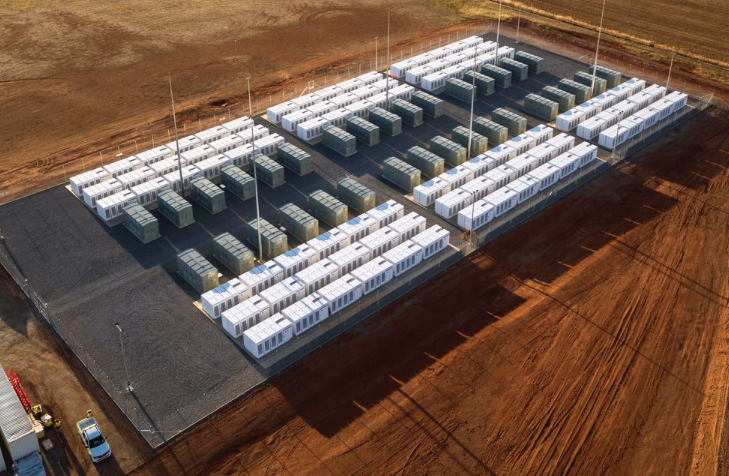
Photo of utility-scale battery plant