
-November 23,2021-
Redwood Mountain Grove may have lost two thousand large Sequoia trees
Losing the Sugarbowl group
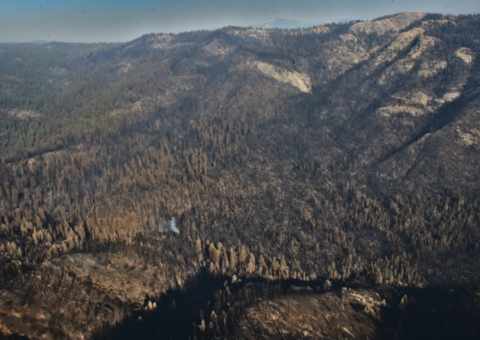 The 3100-acre Redwood Mountain Grove is the world’s largest gathering of Big Trees located mostly in Kings Canyon National Park even though it is drained not by the Kings River but by the Kaweah.
The lightning-caused KNP wildfire that impacted Sequoia National Park late this summer did little damage to the most famous stand of trees located in Giant Forest that includes the 2,100 year old General Sherman Tree, visited by millions every year.
But it has devastated the less-visited but stunning Redwood Mountain Grove where a just released damage assessment of the September/October fire concludes that the firestorm that whipped up winds to 60mph,may have wiped out up to 2000 large sequoias- many of them over a thousand years old.That is a rough estimate says Park ecologist Tony Caprio, one of the few National Park scientists who have ventured into the gloomy disaster zone to assess the damage. It’s an early estimate.
A 1969 inventory of this sequoia grove found almost 16,000 sequoias standing here measuring at least a foot in diameter.
Damage to the scattered but clustered sequoia groves of Sequoia and Kings Canyon National Parks caused by the KNP Complex fire as well as the Windy Fire to the south of the Kaweah, were hit and miss affairs with some groves left mostly untouched and others suffering severe burning – killing thousands of the ancient trees.
“It’s heartbreaking,” said Christy Brigham, head of resource management and science for Sequoia and Kings Canyon National Parks.The fire that first started Sept. 9 burned portions of 15 giant sequoia groves in the park, Brigham says.
But the greatest amount of damage was done in Redwood Mountain Grove in Kings Canyon National Park. Brigham led a media tour of the area in the past week and resulted in the headline that about 19% of the mature sequoias in the southern Sierra have been killed as a result of two consecutive years of wildfire. The legendary trees, the largest living things on earth, grow nowhere else.The two fires burned about 1000 acres of sequoia trees to a degree of high severity. Here, the trees died and land was scorched so the seeds will likely not germinate. There is some talk of a replanting effort.
Alarming trend
The summary of a report ”2021 Fire Season Impacts to Giant Sequoias” says “Combining both NPS and non-NPS lands burned in the KNP Complex with the Windy Fire, ~2,261-3,637 large sequoias are estimated to have been either killed outright or will die within a few years. This suggests that the 2021 fire season resulted in a loss of ~3-5% of the large sequoia population. When considered with mortality from the 2015-2017 fire events and the estimated loss of 10-14% of large sequoias in the 2020 Castle Fire, this fire season contributes to an alarming trend.”
A portion of the estimated 2000 large sequoias in Redwood Mountain lost in the conflagration are in the national park, some clearly dead or others expected to die in the next few years. Also impacted are those sections of Redwood Mountain in the National Forest and lands under UC Berkeley management in once-logged Whitaker’s Forest.
The analysis says the percentage of large trees suffering moderate to severe burning include 42% of the trees in Redwood Mountain within the King Canyon NP jurisdiction, 59% of the Redwood Mountain trees in the National Forest and and 13% of the grove managed by UC Berkeley
The analysis expects 60% of the 4400 sequoia acres that burned in the KNP Fire were in Redwood Mountain.Of that almost 600 acres were in the severe category. The hit and miss aspect to the wildfire is clear from this map of fire severity.
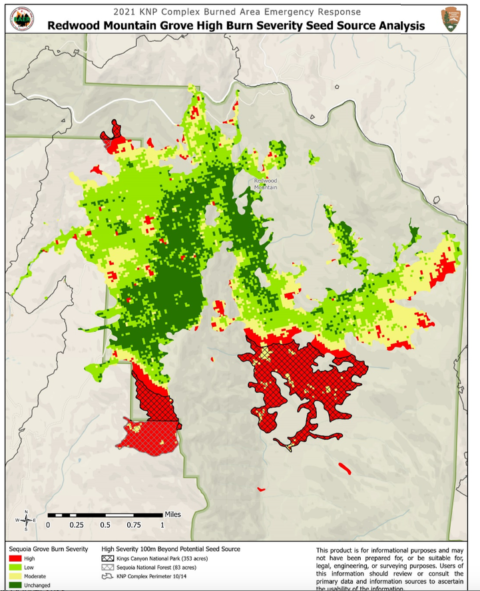 Sequoia National Park forest ecologist Nate Stephenson, says to view this map of Redwood Mountain Grove, with estimated fire severity (derived from satellite images) shown in the various colors. Red shows high severity — areas where it’s likely a large majority of sequoias died. Shades of green show low severity — areas where the large majority of sequoias likely survived. Yellow is intermediate severity.
“It immediately jumps out that the southernmost parts of the grove fared poorly. These were areas that either had never had a prescribed fire, or had had a prescribed fire so long ago that heavy fuels had built up again. In contrast, the green areas tended to be those that had had prescribed fires within the last 15 years or so.”
Stephenson comments on the fate of two very large Sequoia trees in the grove, the Hart Tree and Roosevelt trees
“I don’t know of anyone who has checked on Hart and Roosevelt yet (although it’s possible someone has). However, when I check the map, the Hart/Roosevelt area burned at lower severity (light green), so I’m hopeful they’re okay. But they were also fairly close to an intermediate severity area, so it really will take an in-person visit to assess how they are.”
As for other landmarks in the grove, Christy Brigham says others have checked on Barton’s Log (along the start of the Hart Trail). Even though fuels were cleared around the log, and it was wrapped in protective foil, it apparently burned. Also the Redwood Saddle Cabin burned.
Sugarbowl group lost
Stephenson adds that “For me, one of the saddest results is the Sugarbowl group of sequoias, which shows as red on the map. Additionally, Tony Caprio has flown over the Sugarbowl group on a helicopter recon flight, and his first estimate is that most of them are dead.”The pure stand of Big Trees in the Sugarbowl Grove is located along one of the most popular trails in Redwood Mountain.
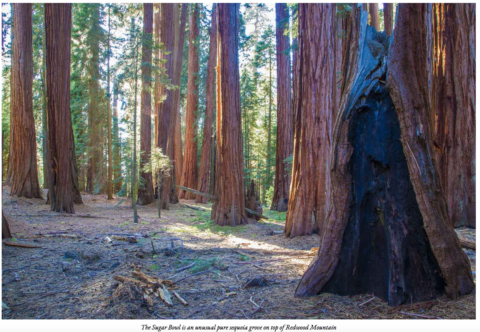
View of the Sugarbowl Grove within Redwood Mountain before the fire
The top photo in this story is an aerial shot from late October of Redwood Mountain hit by severe burning showing a wide swath of dead sequoias.
Also said to suffer widespread sequoia deaths is a smaller grove further south, in Sequoia National Park – the Suwanee Grove. The bulk of the grove burned with high or moderate severity with a couple of small low severity patches.
Overall, the KNP Complex and Windy Fires burned all or portions of twenty-eight sequoia groves, burning a total of 6,109 grove acres out of an estimated ~28,000 grove acres rangewide -almost a quarter of the acres.Sixteen groves in the KNP fire area burned and twelve groves in the Windy Fire in the Tule watershed.
Much of this acreage burned at low severity (3,905 acres) and is expected to have beneficial effects on grove ecosystem functioning, although a total of 2,204 acres burned at moderate to high severity.
The analysis says regarding the Windy fire, they estimate that between 931-1,257 sequoias over four feet in diameter have already been killed or will die within the next three to five years.They do not yet have results from two groves in the Tule River reservation.
Yes, climate change
Stephenson says the widespread extermination of these species is unprecedented.” Data from previous prescribed burns, wildfires, and tree-rings indicate that prior to the impacts of climate change and fire exclusion, large numbers of large giant sequoias were not killed during fire events.”
Looking to the future, the expert analysis suggests “Soil erosion modeling indicates that several groves may experience erosion significant enough to remove seeds located on the surface of the soil. Large areas of Redwood Mountain Grove and Skagway Grove appear subject to surface erosion. Where these areas overlap with large areas of high burn severity, grove regeneration may be compromised.”
“The least understood impacts of these wildfires are impacts to sequoia regeneration in high severity areas. Sequoias generally regenerate well after wildfire, though reports of inadequate regeneration in high severity areas are raising concerns. Regeneration failures could potentially occur if the cones and/or seeds were incinerated during crown fire, seeds did not survive the smoldering fire, or seeds washed away due to surface erosion. In these cases, regeneration would be dependent on proximity to live tree seed sources.”
On a hopeful note “much of the grove area in the KNP Complex burned at low severity and we expect beneficial results for giant sequoias in these areas. These beneficial effects include fuel reduction, small canopy openings ideal for regeneration, and removal of litter and generation of ash – also ideal conditions for giant sequoia seedlings.”
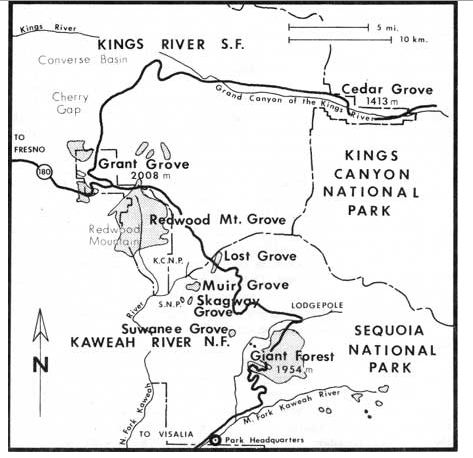 These famed trees “are the premier destination within Sequoia and Kings Canyon National Parks (SEKI), attracting over 1.5 million visitors per year. SEKI has 38 delineated groves of giant sequoias, covering roughly 10,000 acres. Extensive surveys in the 1960s and 1970s, covering 90% of SEKI’s current grove areas, found 84,822 individual sequoia trees greater than 1 foot in diameter at breast height and 25,181 greater than 3.5 feet. All told, Sequoia and Kings Canyon National Parks manage approximately 37% of all existing sequoia grove area.”
While Giant Sequoia are highly fire-adapted, they are not adapted to extensive high severity fire. They cannot sprout after crown loss, and recent work suggests that large sequoia are unlikely to survive with >~85% crown damage for trees with one or more existing fire scars and >~90-95% crown damage for trees without existing fire scars.
The KNP complex burned a total of 4,374 acres of sequoia groves, of which 616 acres burned at high severity. Simultaneous with the KNP Complex, the Windy Fire also burned 1,723 acres of giant sequoia groves in the Giant Sequoia National Monument, of which 411 acres was high severity.
“The sobering reality is that we have seen another huge loss within a finite population of these iconic trees that are irreplaceable in many lifetimes,” Clay Jordan, superintendent of Sequoia and Kings Canyon National Parks told the press. “As spectacular as these trees are- we really can’t take them for granted. To ensure that they’re around for our kids and grandkids and great grandkids, some action is necessary.”
Cutting the risk
Since 2015 there has been a dramatic increase in area burned and amount of high severity fire in sequoia groves, resulting in significant mortality of large, legacy sequoias.This increase is consistent with increases in high severity fire throughout the western US, which has been linked with warmer, drier fire seasons and increasing fuel aridity linked with climate change. The warming climate is also directly impacting forests via “hotter droughts”. The hotter drought of 2012-2016 resulted in widespread conifer die-off, which could be increasing fire severity in this region. The interaction of these climate-driven trends with elevated fuel loads, a result of fire exclusion, is increasingly putting sequoia groves at risk of severe fire.
Other than the whims of the wind, a key factor in how Giant Forest fared better than Redwood Mountain was likely history of prescribed burns. Of the ~10,000 acres of giant sequoia groves in Sequoia and Kings NPs, 4,610 acres have received one or more prescribed or managed wildfires in the last 20 years, mostly in Giant Forest. UC Berkeley’s Whitaker’s Forest began prescribed burning in the 1940s.
—————————————
Fire severity map Redwood Mountain
Aerial photo of Redwood Mountain Grove in late October
All these- credit Shive, Brigham, Caprio and Hardwick 2021
Sugarbowl credit Redwoodhikes.com