
-June 22,2021-
Creek Fire’s severe damage may increase runoff
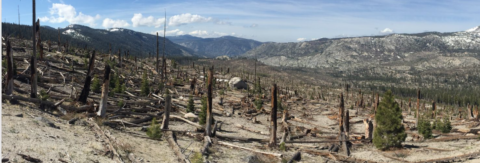
Last summer’s catastrophic Creek Fire burned about 380,000 acres in the upper San Joaquin watershed, the largest fire in the Sierra Nevada’s history.The fire literally exploded, fed by strong gusty winds and 150 million dead trees resulting in the scorching of 43% of the burned area” with high severity” says the Sierra Nevada Conservancy, a state agency.
Altogether, about 36% of the upper San Joaquin watershed burned – the same watershed that supplies 9 dams and impounds water that feeds a million acres of farmland below, along the Madera and Friant Kern Canals.
Experts explain besides tree loss “Fire removes the absorbent layers of fallen and decaying plant matter on the forest floor. These layers, called litter and duff, can store more moisture than soil can. Without these layers, heavy rain can provide more water than the ground can absorb. This contributes to surface runoff.”
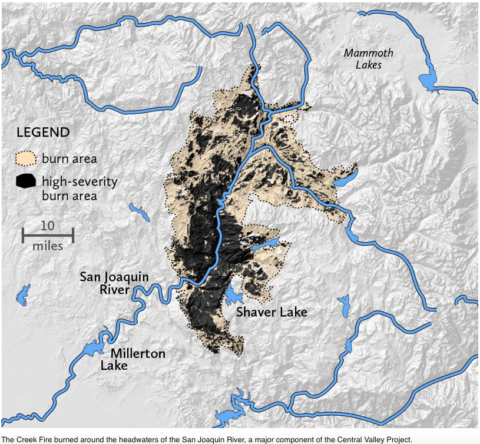 Several agencies have predicted that the huge fire might have impacts on the 2021 Spring runoff, so important to communities and farms along the east side of the Valley including Tulare County.
Friant contractors have been not-so-patiently waiting to see how much water is in the upper watershed this year hoping that there will be enough to allow the Bureau of Reclamation who makes the final decision – to confirm their earlier estimate of a 20% allocation of the Class 1 contract of 800,000 acre feet. That would yield 200,000 acre feet this year.
But as the California drought and extreme heat have grown more shocking in the past few months, fear has been building that there might be a zero allocation to east side farms who have little river water coming down the Kings, Kaweah,Tule and Kern Rivers either this Spring.
Now late word as of June 18 is that the Bureau is realizing there is more water in the upper SJR watershed than they had thought, says Dan Vink, Executive Director of the South Valley Water Assn that has 7 Friant water district members farming about 400,000 acres.
Allocation update
In a meeting with Friant members, the Bureau assured the group there would be “at least a 15% allocation this year,” says Vink, and “maybe more depending if any Friant water has to go to satisfy the San Joaquin Exchange Contractors”
Vink calls the 15%” a floor amount” – about 120,000af
“There could be up to 30% allocation if the Exchange Contractors don’t need Friant water,” says Vink.
The Exchange Contractors water supply depends on how much Shasta water is available this year.
Despite these private discussions the Bureau has yet to make any public declaration.
But Vink adds that “without a doubt there is more water in the upper SJR watershed because of the Creek Fire.”
Indeed several agencies have suggested runoff could increase as much as 30% in the first year after such a fire. Not only are there no trees or brush to soak up snowmelt but the severe damage to some soils could cause it to become water-repellent.
If the is some ironic good news for water users, the dams and hydroelectric plants in this region could be idled, and face higher costs in future due to sediment and debris flow
.
Then there is the difficulty of predicting the impact on salmon in the San Joaquin River who depend on flows and cold water temperatures later its summer
With so much of the upper watershed not able to retain water, next winter’s atmospheric river – if one comes – could be a nightmare and cause massive flooding downstream.
While no one would suggest wildfires to benefit farm water supply, agencies do suggest mechanical thinning of forests could boost water supply as well as forest health.
One prediction – “reducing tree cover by about 40% may result in a 9% increase in water yield. Conversely, burning grasslands leads to negligible increases in water supply.
Managing forests with mechanical thinning and prescribed burning simulates the effects of low- and moderate-severity wildfire—creating opportunities to improve forest health while increasing water supply.”
“You’ve lost brush, you’ve lost canopy, and the soils have drastically changed as a result of the fire,” said David Rizzardo, the California Department of Water Resource’s (DWR) branch chief for hydrology and forecasting. “All of this impacts our modeling efforts,” he said.
pics from Sierra Nevada Conservancy