
Legal settlement plus passage of federal spending bill enables Friant Kern Canal fix to go out to bid next month
-December 23,2020-
In the past week Friant Water Authority has announced a legal settlement with farmers in southern Tulare County represented by the Eastern Tule Groundwater Sustainability Agency (GSA) to contributed at least $125 million to repair the significant subsidence-caused sag in the gravity-fed canal that has cut water deliveries by 60%.
Even with new groundwater sustainability plans the capacity of Friant-Kern Canal could fall by another 10% in the coming years, analysis has predicted, an impact that could be felt by surrounding rural communities, residential well owners as well as ag producers.
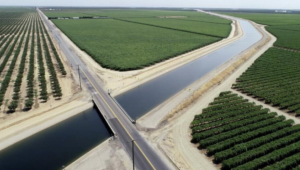 The canal serves farms and communities from Chowchilla in the north to Arvin Edison near the Grapevine in the south. Its waters boost the area’s economy to the tune of millions of dollars. The worst damage from years of vigorous groundwater pumping is along a 33 mile stretch from about Strathmore- south to Delano- a major citrus, nut and grape growing region.
For the past year, the managers of the canal – Friant Water Authority – have been working to cobble together enough money to do a $500 million fix for the problem where the land has literally sunk more than 12 ft since it was put into service in the 1950s. It could get worse – with the land predicted to drop another 3 feet before a sustainability plan is in place by 2025.
This past week there were multiple breakthroughs offering hope the repairs could begin soon since funding appears at hand.
Washington approves monies
After weeks of uncertainty,as of December 21 the US Congress has passed a crucial spending bill that included $900 billion in COVID-19 relief to broad sectors of the economy but also a $1.4 trillion budget that earmarks $206 million in federal funds to repair the Friant Kern Canal.
The measure also includes $200 million for the Delta-Mendota Canal, and $100 million each for the San Luis Canal and California Aqueduct, all of which have been impacted by subsidence as well -the sinking of land that supports the very canal foundation due to adjacent pumping of groundwater over the years.
The Friant Division of the Central Valley Project delivers water to over one million acres of irrigable farm land on the east side of the southern San Joaquin Valley fed by stored San Joaquin River water delivered to more than 30 irrigation districts and cities, and to 15,000 family farms.
So it is a big deal when farmland and communities can get just 40% of their allocated water that may fall to 30% in the next few years.
No surprise that fixing the problem is job one at the Friant Water Authority.
Doing the job includes building a 30 mile parallel canal that would replace the existing one. Friant now figures it needs $480 million – having been whittled down from $500 million.
Besides this federal money that requires a local match Friant now has a preliminary agreement with farmers who arguably have been the cause of the subsidence in this area-now represented by a state mandated groundwater sustainability agency whose job is to reign in rampant pumping -Eastern Tule GSA.
The agreement signed December 11 in draft form, says payments from Eastern Tule to Friant under the agreement” can begin as early as the first quarter of next year, consistent with when construction is expected to begin for the Friant-Kern Canal Middle Reach Capacity Correction Project.”
Spring groundbreaking
Besides the federal funds and Eastern Tule money, contractors along the 150 mile Friant Kern have contributed $50 million says spokesman for Friant, Johnny Amaral – bringing their war chest to near $400 million -enough the go out to bid on the ambitious public works project in January, just weeks from now.
“Construction will start this Spring “ vows Amaral.
The key agreement with the Eastern Tule farmers set out in a draft agreement was announced December 15 by Friant.
On Friday, December 11, the Friant Water Authority (FWA) Board of Directors approved a proposed settlement agreement with the Eastern Tule Groundwater Sustainability Agency (ETGSA) that will resolve a dispute over the impacts of local groundwater pumping on the Friant-Kern Canal. In the settlement, FWA is agreeing to support implementation of ETGSA’s Groundwater Sustainability Plan (GSP) that will gradually reduce overdraft through 2035 in exchange for significant contributions of funding towards fixing the Friant-Kern Canal’s most severe capacity limitations. Payments from ETGSA to FWA under the agreement can begin as early as the first quarter of next year, consistent with when construction is expected to begin for the Friant-Kern Canal Middle Reach Capacity Correction Project.
The middle reach is a 33 mile segment, generally south of Lindsay to Delano.
The final agreement is expected once the Eastern Tule board officially signs onto it – expected in coming weeks.
Attractive lump sum alternative
The draft agreement says Eastern Tule will pay at minimum $220 million if they pump the amount of groundwater expected- more than million acre feet from areas surrounding the canal. The money is to mitigate damage in the both the past and ongoing over the next few years.
Without repairs the canal cannot carry out a key function of why it was built – to convey flood waters during wet periods, water that can replenish groundwater in this overdraft basin.
A key offer- incentive- says that the Eastern Tule can pay far less – a lump sum of $125 million, that would require a positive Prop 218 vote of landowners. Eastern Tule could pay the lump sum in quarterly installments starting in the first quarter of 2021.
If the Prop 218 vote fails, Eastern Tule would pay up to $200 million of penalty monies, says the agreement.
Amaral suggests that work on the canal repair can begin even though there is not yet enough money to complete all the work.
They still hope the state can kick in some money – not in the cards for now – with COVID impacts and Gov Newsom insisting waterworks funding should be done statewide. A few years ago Proposition 3 for public funding, failed at the ballot box with critics suggesting farmers should fix the problem they caused themselves.
Now a key component to the fix is construction of a 30-mile parallel canal that will replace the existing canal while they raise the liner of the canal both south and north of this new segment.
Amaral says there are possible uses for the old canal segment including water storage or recharge.
To move forward, Amaral adds Friant will still need to borrow millions to be reimbursed later. He suggests there will be plenty of competitive bidding on what will be one of the biggest construction projects in the San Joaquin Valley ever.
Saving the canal
Commenting on the news, Eric R.Quinley, General Manager of the Delano Earlimart Irrigation District, a Friant contractor – but not a part of the Eastern Tule group – says landowners in the Eastern Tule would not be agreeing to pay this money if it was not in their self interest to do so. “They would not be moving forward if it didn’t help their bottom line.” The Eastern Tule district has plenty of permanent plantings like pistachios that are making good money.
Quinley says most of the Friant districts have had little to do with the subsidence problem and at least some of the money to fix it “should be borne by those who had a hand in damaging it.”
Ask most farmers about SGMA -the state sponsored groundwater restriction idea and they will say they don’t like it. But implementation of the plan on a local level may yet save the canal that feeds them.
Of course it feeds the entire area economy as well, making it clear the public has a stake in what happens here as well. Halting subsidence doesn’t just save pistachio trees but county roads, rail systems, natural areas, rivers, rural water systems and wells and disadvantaged communities, just to name a few of what adds up to billions of dollars invested in infrastructure in the Valley that is affected.