
September 9,2014
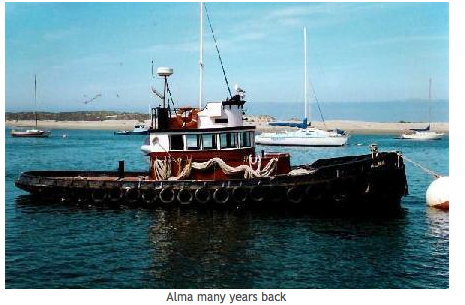 Alma,a historic sea-going tugboat, will go on display as the third vessel holding forth in the the Central Coast Maritime Museum display area and kiosks on the Embarcadero just south of the power plant likely delighting both visitors and locals .
This week the Morro Bay City Council approved a plan to display the tug this fall along with a new kiosk to explain the tug’s history. A staff report says the display will be free to the public although “the interior of the vessels may also be able to be viewed under Museum supervision at times and dates mutually agreeable to the City and Museum, and the Museum may charge a reasonable fee for the viewing.”
The Museum’s website tells Alma’s story.
The Tugboat Alma was built in San Francisco by the Beviacqua Brothers near Fisherman’s Warf in 1927. She was typical of the small wooden tugs and utility craft that worked in harbors along the west coast in the first half of the 20th century. The Alma was traditionally built of sawn oak frames and carvel planked with Port Orford Cedar. In 1974 the last owner operator coated her exterior with ferro cement.
The Alma’s significant action in history came on the morning of December 23, 1941 when she dashed out from her mooring at the Cayucos Pier to search for survivors of the Union Oil tanker Montebello. The tanker had been attacked and sunk by a Japanese submarine off the coast of Cambria, California where she lies today on the bottom in 880′ of water. Of the three lifeboats carrying all 19 crewmembers the Alma picked up two. The others went to shore on their own and landed near Leffingwell just north of Cambria.
In 1995 the Alma was donated by the Kelsey Family (owners of Sylvester’s Tug Service) Today, after more than a half century of service as a line boat, fishing vessel and harbor tug, she rests on land waiting to be spruced up for presentation at the proposed maritime museum.
Specifications
Year Built: 1927
LOA: 48.0 ft.
Breadth: 13.0
Draft: 5.2 ft.
Displcmnt: 16 tons
Here is the account of the Japanese attack on the Montebello oil tanker off our coast – largely unknown to the American public.
On December 23, 1941, sixteen days after Pearl Harbor, an oil tanker belonging to the Union Oil Company (later called Unocal) was attacked by a Japanese submarine just south of Piedras Blancas Light Station. The tanker Montebello was sunk with the crew escaping in lifeboats. Survivors in three of the lifeboats were picked up and taken to Cayucos but the fourth boat foundered on the rocks just south of Cambria.
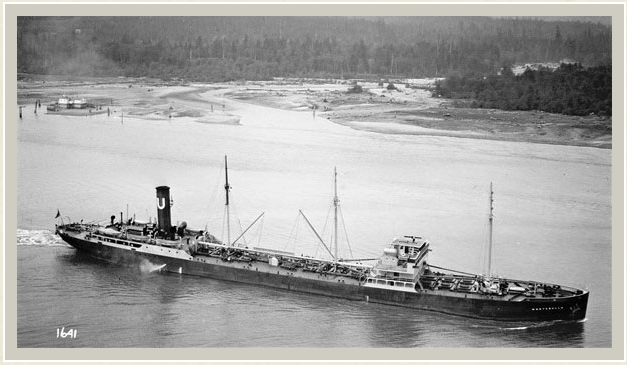 The crew abandoned the ship and got into four life boats which moved away from the ship far enough to avoid further danger but remained in the vicinity to see if the Montebello would sink, which it did at 6:45 AM. During the interval, the submarine used its deck gun to fire on the lifeboats although it is not clear whether the target was the Montebello or its lifeboats.While no one was injured, the lifeboat containing Captain Olof Eckstrom and five other crew members was seriously damaged and began taking on water. While the crew was watching, the Montebello began taking water in the bow which began to sink, ultimately causing the stern to rise up out of the water about 150 feet. At this point the tanker went under and sank to the bottom retaining its bow-down attitude until it hit the bottom about 900 feet below. The bow buried itself in the sandy bottom and the remainder of the ship broke off at the point of the torpedo impact and settled on the bottom in an upright orientation where it remains to this day.