Tulare County Largest Solar Developer Plans More

June 12,2014

Did you know that Tulare County’s largest solar power developer is from New York City. New York City!?

It may be a good ways from the Central Valley but Mark Noyes,Vice President of Con Edison Development, says investing here makes sense.

Consolidated Edison is the nation’s oldest utility but it has spawned an entrepreneurial sister company – ConEdison Development.

“ConEd  Development has been interested in clean energy not only for this country but for the world” says Noyes, adding that ”California has been the  innovative leader for renewable energy.”

“As one of the top five solar developers in North America we want to be part of the action.”

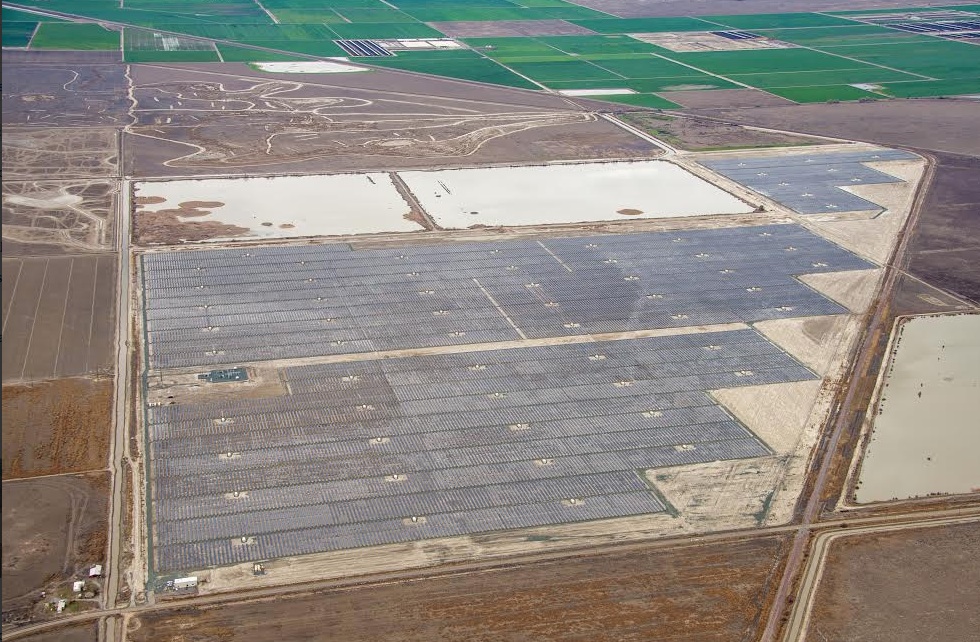
solar farm near Alpaugh in SW Tulare County

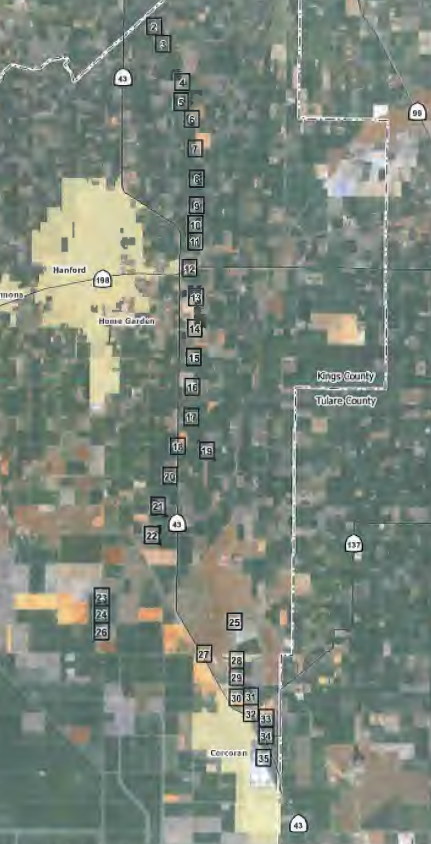
Some 3 years ago, ConEd Development bought 2 solar farms under construction in  remote SW Tulare County near Alpaugh  – 20 MW and 90 MW. The units went on-line 2 years ago. Then a year later, they bought 2 more permitted projects,each 20MW – one called White River and the other across the Kings County border in Corcoran. These projects are under construction with the White River solar farm coming on line in August.

What is new is that ConEd Development has now acquired land for another 20MW project, 3 miles south in Tulare County, that will start construction in late 2014. Lastly, Noyes says the company will be adding another 20MW project near its Corcoran site.

And there will be more,he adds.

All in all,there are 170MW of solar power in their Tulare/Kings portfolio, the most of any other solar developer here, at least so far.

Several Kings County projects are on the cusp of breaking ground as well – all pushed by a looming 2016 deadline to qualify a 30% federal tax credit.

Noyes says several factors make Tulare County attractive for solar development. First, local government support for solar is strong. The the flat land,lacking water supply for farming, has ”tremendous insulation” or solar intensity.The fact that this is a crossroad for the state transmission grid makes it easier to both hook up and send power in any of four directions in the middle of the state. Lastly Tulare County is sandwiched between both big utility company service areas making power sales more competitive.ConEd Development’s electricity buyers are about evenly divided between PG&E and SCE, he says.

All this construction activity is great news for the Central Valley this year – mired in a terrible drought –  meaning fewer farm jobs. Thousands of solar construction  jobs will be added to build a backlog of projects in the 4 county Central valley region over the next 18 months.

Noyes says there is a continuing drop in prices as panel costs decline as well as scale and experience – helping to make everything more efficient.

Besides their utility-scale projects, another sister unit ConEdison Solutions, does customer based solar projects like the solar farm they did for the City of Kerman, helping to reduce costs at their wastewater
plant.

Consolidated Edison, Inc., parent company of Con Edison Development, has publicly announced a capital investment of over $250 million in renewable energy during the next three years through its unregulated subsidiaries. “We are exploring opportunities to develop, own and operate a range of solar, wind, bio-diesel, flywheels and energy storage installations in the United States.”

News Briefs Around Visalia

June 5,2014
Screen Shot 2014-06-05 at 1.23.42 PMBurke St Set To Be Through Street

The City of Visalia is proposing the construction of a portion of Burke Street that will extend Burke Street south to Roosevelt Avenue as part of the City’s Capital Improvement Project. The project will eliminate the existing cul-de-sac configuration and provide a through access to the south. The project site is located approximately 400 feet south of the Houston/Burke intersection.
Burke Street runs from Tulare Avenue across State Route 198 to Roosevelt Avenue and from Houston Avenue to St. John’s Parkway. The project would allow Burke Street to connect from Tulare Avenue to St. John’s Parkway. Burke is the main north south street for the new Civic Center.

May New Home Permits Climb

New single family home permits in Visalia climbed again in May to 26 compared to 18 in May 2013. For the year so far SFH permits are up 23% and valuation is up 38%.  Including commercial remodels and new commercial  – all  types of permits are up 19% this year in Visalia.

EnergySage Website Launched

The City of Visalia is excited to announce the launch of the Visalia EnergySage Marketplace website.  The EnergySage Marketplace provides quotes online from multiple, pre-screened installers and will assist Visalia businesses and residents in comparing offers in an apples-to-apples format across all financing options at no cost to them. The Visalia EnergySage site offers a variety of educational resources, including an “Instant Estimate” tool. With “Instant Estimate” any home or commercial property owner in Visalia can get estimates of solar’s costs and benefits under various financing options for their specific property. The process takes less than one minute to complete and is not connected to any lead generation or sales activities so using the tool doesn’t result in any pressure to buy or annoying sales pitches. If you pay $100 per month on electricity, solar could save you nearly $20,000 over the next 20 years. For more information, visit www.EnergySage.com/visalia.

Dairy Co-op Offers To Buy Corner of Hwy 99 & Caldwell For New Plant / Rail Shipping Center

June 2,2014
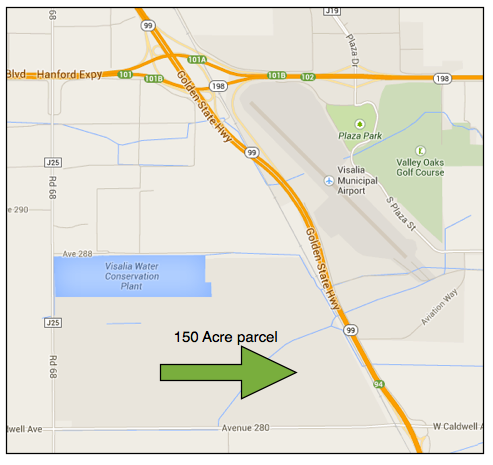
Visalia-based California Dairies Inc (CDI) has offered to buy 150 acres from the City of Visalia at the northwest corner of Caldwell Ave and Hwy 99. The matter was heard in a closed door session this week.

The dairy cooperative that has a 55 acre milk plant already on Plaza Drive has been on the prowl for a second plant site in Visalia to manufacture milk specialty powders for export including those used in infant formulas.

While that is one possible use, there are others says Dave Bush, CDI ‘s ‎Senior VP of Operations. ”This location could have multiple uses for us.” Bush adds that “we are a major exporter these days. We are shipping so many milk powder containers to the Port of LA that we could use a rail shipping facility. We use to send 5 container loads of powder but now we ship 60” over the same interval.

Bush says that CDI needs “to get ahead of the game“ since multiple approvals, permits and EIRs for new development take so long.”

Screen Shot 2014-05-31 at 7.58.39 AMThe Caldwell site is part of a 900-plus acre parcel the city has owned for years surrounding their wastewater treatment plant, now being expanded. Much of the ag land surrounding the WWTP is planted to nuts that helps provide income to the city.

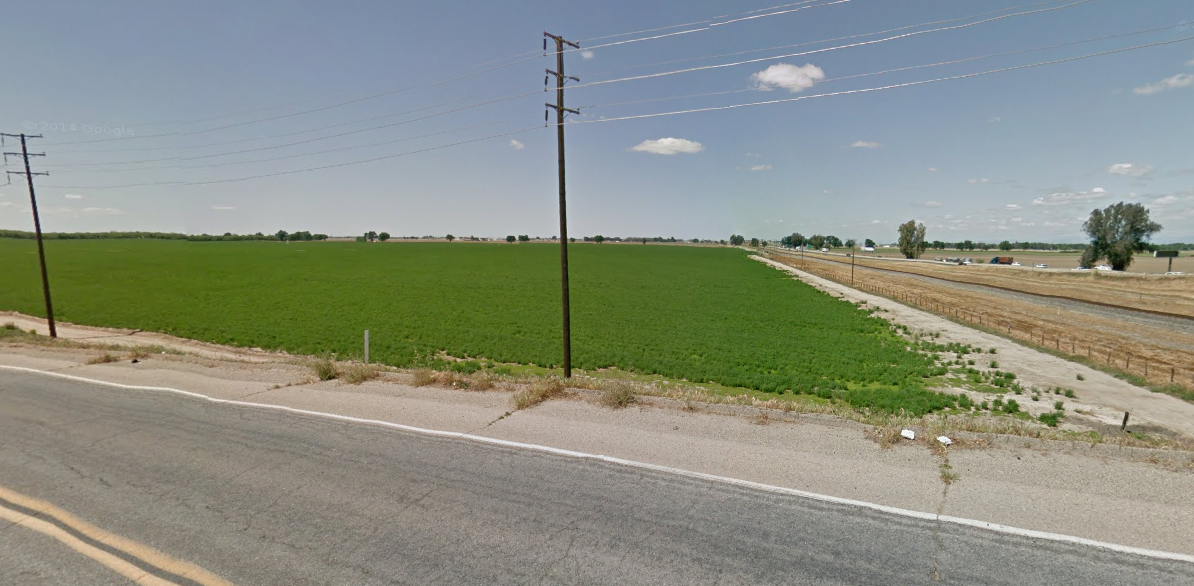
But the corner acreage is open field land.The location enjoys direct access to the Union Pacific railroad that runs along the westside of Hwy 99 through this part of the county.  California Dairies has a similar situated milk processing plant a few miles south near Tipton on the westside of 99, also near an interchange.Unlike that plant that has to pond their waste water on ag land – the new Visalia site would offer direct access to the city treatment plant .

“This location (on Caldwell/99) has rail access, electric power and a treatment plant nearby” adds Bush.

The city council will have to make a judgment whether to industrialize this farmland but it is hard to argue that this use is not ag-related. Milk is the number one agricultural product in the county. California Dairies is one of the largest property owners in the city with its current plant site valued somewhere around $300 million and undergoing an expansion as we speak with a new $4.2 million,130 ft evaporator. The current plant is some 260,000sf.

Preserved To Travel

While fluid sales of milk have been declining – sales of milk in different forms but with still all the nutritional benefits,particularly protein, is booming.This milk is “preserved to travel” says CDI’s president Andrei Mikhalevsky, expecting the number of global consumers to grow to 9 billion by 2050. ”People now eat milk rather than drink milk” he says.

CDI’s milk powder business is the largest in the US. Annually California Dairies, Inc. manufactures 786 million pounds (357,000 metric tons) of milk powder or 40 percent of the milk powder produced in the United States.

With 12 dryers and evaporators, California Dairies, Inc. operates state-of-the art processing plants capable of producing a wide variety of powdered milk products including:
High, medium and low-heat nonfat dry milk and skim milk powder
Powder blends
Buttermilk powder
In addition, California Dairies, Inc. is able to meet a variety of export product specifications and individual country requirements. California Dairies, Inc. exports 47 percent of its powder production.
The land in question is in the city limits even though land on the south east side of the freeway remains in the county. CDI would need a host of permit approvals including assuring no conflict with the airport operation to the east.

New Industrial Park?

If the use is approved – the city would likely embrace this area west of Hwy 99 near the WWT plant as a new industrial park, in need of the proper infrastructure to grow more.The benefits could be large for Visalia as the city would attract more food-related companies that turn the county’s crops into high value products.Unlike the current  industrial park,this location has direct access to the main UP rail and 99 truck corridors and the WWT plant. Like any good industrial park, it has few residential neighbors it might impact.

Screen Shot 2014-06-02 at 12.31.06 PM

News Roundup: New Tower Likely In Downtown Visalia

May31,2014
Kaweah Delta Not Optimistic On Seismic Waiver Request

Screen Shot 2014-05-31 at 7.17.42 AMKaweah Delta hospital’s lobbying effort with the state to retain the Mineral King wing for acute care past the 2030 seismic deadline suffered a setback recently. A contingent of hospital and Visalia city leaders met in Sacramento April 16 with the Office of Statewide Health Planning and Development (OSHPD), but their arguments were rebuffed says CEO Lindsay Mann.

“They told us the law SB1953 provides no exceptions” says Mann. The group had pointed out that Visalia is a much less earthquake prone area than much of the rest of the state including the seismically active Bay Area and LA Basin.

“If they can’t get a favorable ruling in the next year and a half “we need to start work on what could be a half billion dollar replacement complex” Mann said a few months ago.

Friday,May 30 Mann sent out memo to all staff at the healthcare district talking about the issue.

“Our position has been that the seismic risks of the Visalia area are very low in comparison to other areas of California and that the Mineral King Wing would remain in full operation after an earthquake of any probable magnitude. Sustaining this position would require special legislation to exempt Kaweah Delta from SB1953.

Through our study of this matter we have come to three important conclusions:
1. The Office of Statewide Health Planning and Development, with whom we have worked closely, has now confirmed that a full structural retrofitting or replacement of the Mineral King Wing will be necessary by 2030. They have no policies that will support legislation recognizing the lower seismic risks of the Visalia area or for granting relief from the requirements of this earthquake safety law.
2. A structurally retrofitted Mineral King Wing would not meet our physicians’, nurses’, and most importantly, our patients’ expectations for a modern state-of-the-art hospital. We could spend many millions of dollars in a structural retrofitting process, yet the results would be entirely unsatisfactory in meeting our goal of providing the best possible facilities and care for our patients.
3. To best achieve the goal of providing our patients with the best care possible and to invest our funds wisely, we have come to the conclusion that replacement of the Mineral King Wing is clearly our only responsible option “

Mann says they have a consultant group looking at the issue before a final decision is made in the next few months. Mann adds that the Mineral King wing built in 1969 would still be used for non-acute care but planning should start for a new tower that would be built west of the current Aqequia wing. “The community needs to know that the new facility would be needed just to keep the number of beds we already have” says board member Jody Graves

McDonalds Coming To Earlimart

Earlimart’s White River Plaza, off Hwy 99, will be getting a McDonalds restaurant in coming months says Tulare County Economic Development manager Mike Washam. The new shopping center on the north end of town already has an AutoZone and Dollar General and is expected to land a new 35,000sf market by the end of the year. McDonalds approved the location for an eatery earlier this month.

Mortgage Rates Fall Below 4 Percent

Zillow Mortgage Marketplace reported Friday that the California thirty-year fixed mortgage rates stood at 3.96%, down some 8 basis points from last week. Nationwide Freddie Mac reported Thursday that the average U.S. rates on fixed mortgages fell this week for a fifth straight week. helping to provide a boost to the Spring buying season.They quote rates of 4.12 percent, down from 4.14 percent last week.

Tulare’s Sundale Vineyards Adds Solar / Moves To Settle Dispute With Neighbor Harvest Power

Tulare table grape grower Sundale Vineyards has just added a 1.13MW solar arrary at their headquarters in Lovers Lane near Tulare. Owner Todd Kinosian says the ground mounted units are expected to supply 80 to 90% of their power needs. Kinosian says the big energy users at  are both the pre-cooling operation and cold storage. The solar farm has more than 3800 panels suppled by Cenergy. Cenergy has estimated the units could save Sundale $5.7 million in electricity costs during the next 25 years. A 30% federal tax credit is a good incentive to go green.

Speaking of going green,in other news – Kinosian confirms that a year long dispute that turned into a lawsuit with neighbor Harvest Power is about over. ”This settlement is the best for both parties” he adds.The dispute was over a plan by Harvest Power to build a biomethane digester and expand its composting operation. Harvest Power has been unable to move forward on the green energy project  despite a state award of over $5 million from the  California Energy Commission to build the digester and operate a CNG fueling station that uses biomethane. The enclosed digester will take food waste,green waste and manure. Neither party would offer any detail of a settlement but  it appears the project will finally move forward. A similar dispute near Pixley held up plans to build a digester at an ethanol plant with concerns by neighbor California Dairies, were overcome and construction is now underway.

JG Boswell Foundation To Give $8 Mil To Cal Poly

San Joaquin Valley farmer James G Boswell’s foundation will give Cal Poly $8 million to establish the “J.G. Boswell Agricultural Research Center” at the San Luis Obispo campus the college announced in the past week. Plans for the new research center include facilities such as laboratories to support sensory, food safety, plant pathology, enology and genomics.

Judge Denies Restraining Order On SJ River Water Release

Statement of Friant Water Authority Regarding Denial of Temporary Restraining Order on Water Releases To San Joaquin River
May 28,2014
Screen Shot 2014-05-28 at 10.27.51 AMThe Friant Water Authority has issued a statement in response to the May 27 decision by U.S. District Judge Lawrence O’Neill to deny a temporary restraining order requested by the FWA and its member districts in connection with actions by the U.S. Bureau of Reclamation to release water from Friant Dam to supply senior water the U.S. Bureau of Reclamation to release water from Friant Dam to supply senior water.
“The Friant Water Authority (FWA) is disappointed by the federal court’s denial of FWA’s request for a temporary restraining order. However, this is an interim ruling by the court and not a final decision on the merits, so FWA will still have a chance to prove its case when it gets its day in court.
The court considered each of FWA’s three claims. First, while the court acknowledged the considerable economic impacts of the loss of Friant’s water supply, it determined that FWA’s contract-based claims should be addressed by the Federal Court of Claims. Second, the court indicated that it is not convinced that the water supply owed to the senior water rights holders on the San Joaquin River have priority over the refuge water supplies mandated by the Central Valley Project Improvement Act. Finally, the court noted that the Department of Water Resources was an indispensable party to claims related to the Coordinated Operating Agreement, but the state could not be compelled to participate in the federal court proceedings and thus the federal court could not rule on this claim.”
The Friant Water Authority is a public joint-powers agency representing 21 water agencies that deliver Central Valley Project water from the San Joaquin River to more than one million acres along the southern San Joaquin Valley’s East Side.

Judge Allows HSR Access To Kings County Streets For Soil Testing

May 23,2014

locations HSR wants to test in Kings County

On May 23, visiting Kings County Superior Court Judge Leslie Nichols sided with the California High Speed Rail Authority in a dispute with Kings County.

The County,last year denied access to HSR engineers wanting to do soil testing at 58 sites along the proposed HSR route. An encroachment permit had been refused last summer forcing the State of California to seek a court order to allow street access for its geotechnical testing.

The dispute dates from a year ago – May 17, 2013, when the California High Speed Rail Authority advised the County of the survey and soil work it proposed to perform within the county. On May 24, 2013, the Authority was advised that it would need to obtain an encroachment permit for the work that was proposed.But on August 16 the County denied the normally routine permit request, saying the project had failed to address County’s health, safety and welfare concerns.

In their court pleading the County argued the state needed to go through eminent domain procedures and compared the testing to a “taking of property.”

“Petitioner proposes soil borings and piezometer installations for the purpose of measuring ground water levels which will then be sealed with bentonite. Petitioner fails to address or take into account any water quality degradation issues which may affect the County, underlying landowners, or implicate the intervention of the Regional Water Quality Control Board.”

Also the County again cited  opposition to the high speed rail project “which has been fraught with a lack of communication, coordination, and opportunity for meaningful comment to address the concerns of the County, a coordinating agency in the NEPA.”

Further the County argued that if the purpose of the petition is to obtain samples for route design, then it is premature given that there has been no certified alignment or EIR.”

Of course a few days ago, the Authority did certify the EIR.

Replying to the County’s assertions, Cal-Trans attorney John Fredrick Smith argued  that the public right-of -way is land held by the county ”as the State’s agent,subject to the State’s right of use of same.”

“It is regrettable that the County’s enmity toward the high speed train system has colored its approach”…and “ the court should order the access of public right-of-way which the State require,” he concluded.

Today the judge did just that – with the soil testing likely to to begin along the proposed route in a few weeks say sources.

CHSRA spokesperson Elizabeth Jonasson said “We are pleased that the Court agreed with our legal position and has now issued an order authorizing us to perform necessary preliminary testing and surveys in the public right of way.  Work is anticipated to begin shortly.”

Citrus Pest Found North Of Visalia

May 23,2014
ACP USDA -05-23 at 10.48.56 AMIn the first find of Asian citrus psyllids in 2014, three of the dreaded citrus pests were discovered in recent days in traps north of Visalia.The tiny pests were trapped near Ben Maddox and Ave 384 – outside the current ACP quarantine zone, says assistant ag commissioner Tom Tucker.

The discovery in sticky yellow traps placed to detect another pest -glassy winged sharpshooters – are a clear sign adult psyllids are expanding their presence in Tulare County.  Tucker notes the citrus area around Ivanhoe is outside the boundary of the current zone that includes Exeter and Dinuba but not the large citrus growing region in between.

“Information is still a little sketchy“says Tucker, adding that the  samples were just sent off yesterday to a CDFA lab.”We should know more in a few days.”

Citrus scientist Beth Cardwell Grafton told ag reporters this week that if the pest population here builds as it has in southern California, eradication may  no longer practical and the need for a management  strategy will be clear.  Such a program is being worked on, she says.

“The main goal is to slow the spread of psyllid and buy time for the scientists to find a cure,” she told the Packer newspaper this week.

Psyllids can carry hunglongbing, also known as HLB or citrus greening. The bacterial disease, which is harmless to humans, can weaken and even kill citrus trees. In Florida, where the disease is entrenched, it has caused more than $3.6 billion in lost revenue, she said.

Case in point is what has happened to Florida’s grapefruit industry.Florida produced nearly 41 million boxes of grapefruit a decade ago but this year it is expected to produce 16 million.

Friant Seeks Restraining Order Over Feds Water Release

May 21,2014

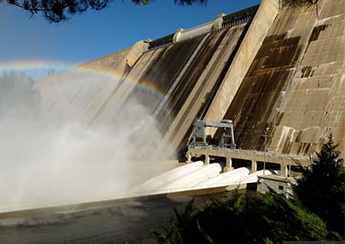
water release 2014-05-21 at 9.36.38 AMFriant Water Authority representing water districts in Tulare,Fresno and Kern counties headed to court this week to try to shake lose some water for their hard hit farms and communities. Friant is seeking a quick ruling asking judge Lawrence O’Neill  for a restraining order to stop release of water down the San Joaquin River.

We “cannot simply sit idly by while the United States drains our farmers’ lifeblood in violation of the federal and state laws protecting the priority to this water.” the lawsuit says.

How the U.S. Bureau of Reclamation has implemented the unprecedented release of water from Friant Dam in order to provide a Central Valley Project water supply down the San Joaquin River to senior water rights holders is now being challenged in U.S. District Court in Fresno by the Friant and many of its member water agencies.

Those Friant Division contractors, all of whom normally would otherwise be receiving supplies of CVP water through the Friant-Kern and Madera canals, instead continue to face a zero CVP water supply allocation from Reclamation. That has resulted in large part because of the Bureau’s decision last week to supply the San Joaquin River Exchange Contractors from the river even though water was available from other sources.
“We want to be clear that our complaint is not against the Exchange Contractors,” Friant Water Authority General Manager Ronald D. Jacobsma stressed. “Our complaint is against the United States for failing to deliver the Exchange Contractors their substitute water supply.”

“Trees and vines that haven’t already been pushed out will soon begin dying without water”

The May 20 filing asks the Court to issue a temporary restraining order and pursue other remedies, said Jennifer T. Buckman, Friant Water Authority General Counsel. She said there is a need for immediate action, which would direct Reclamation to use sources available to it to supply the Exchange Contractors with their substitute water.

“Trees and vines that haven’t already been pushed out will soon begin dying without water and the Bureau of Reclamation will not provide water this year,” Buckman said. The eastern part of the San Joaquin Valley – from the Merced-Madera county line in the north to the foot of the Tehachapi Mountains in the south, stretches 200 miles with more than a million acres of irrigated land, most of which depends on the water behind Friant Dam.
“Our farmers cannot simply sit idly by while the United States drains our farmers’ lifeblood in violation of the federal and state laws protecting the priority to this water. No reasonable person can expect that we would. It is especially important to follow the laws of priority in droughts such as these. It is the fundamental principle that gives our water rights system its stability.”

Friant water has always been there for farmers, even in the driest water years, since the first deliveries were made from then-new Friant Dam in 1944. Until late last week, since 1951, Reclamation had always supplied the San Joaquin River’s senior water rights holders along the valley’s West Side with water pumped and exported at the Delta near Tracy for delivery through the Delta-Mendota Canal to Mendota Pool, west of Fresno, as a substitute supply. This exchange of waters for over 60 years has made possible the diversion of San Joaquin River upstream at Friant Dam for delivery into the two East Side canals, enabling growers to invest heavily in permanent plantings of citrus, fruit and nut trees, and grapes.

Communities Too

It takes at least three to five years to produce anything at all from a new tree or vine, and recovering on the investment of those years takes many more,” Buckman said. “So when the trees die, farmers, their families and those they employ will be the big losers.” Several communities, including Fresno, Orange Cove, Lindsay, Strathmore and Terra Bella also depend on Friant water.

“The United States’ decision was made just May 13, and implemented starting last Thursday (May 15), but with so little water to go around due to the drought, every day that the water goes someplace else, it will create harm that cannot be repaired,” said Buckman. “Before it is too late, the entire Valley needs the Court to adjudicate, even just temporarily, where the water should go. The status quo of the last six decades – that the government should provide the first waters pumped at the Delta to those who have the oldest rights to it, enabling those served by the Friant Dam to receive San Joaquin River water – should be held in place until the Court has time to hear the entire case.”
General Manager Jacobsma said Friant water users “have tried for months to work with Reclamation and the state Department of Water Resources to improve water supply conditions for the Exchange Contractors and the Friant Division. We have made our concerns known but, even with the late season rain events, Reclamation would not take action to provide full substitute water to the Exchange Contractors.” Instead, Jacobsma noted, Reclamation began releasing water from Friant Dam to supply the Exchange Contractors.

“That action is effectively taking all the Millerton Lake water supply that would otherwise been available to keep tens of thousands of acres of permanent plantings — primarily citrus — alive,” Jacobsma said. “We had no choice but to take legal action to protect the water rights of the Friant Division water contractors and the farms and communities supported by that water.”
According to General Counsel Buckman, Friant and its member districts have raised three strong legal arguments:

  The first claim asks the Court to confirm the rights under the Friant contracts with Reclamation. Under these contracts, Reclamation promised it would not deliver any water to the Exchange Contractors from Millerton Lake “unless and until required by the terms of” the Exchange Contract. Reclamation also promised that it would not “knowingly and voluntarily” make decisions that prevent it from supplying substitute water to the Exchange Contractors. Reclamation promised each of the Friant contractors that if there were water available — whether from the Sacramento River and its tributaries or the Delta — the federal agency would never make a voluntary choice not to supply it.

  The second claim is for violation of the Central Valley Project Improvement Act. The CVPIA provides for the Secretary of the Interior to enter into contracts with agencies administering wildlife refuges or entities that supply water to refuges. These include the Grassland Water District and Grassland Resource Conservation District, as well as the U.S. Fish and Wildlife Service. Water for these refuges is to come only from “Central Valley Project yield,” a statutory term defined as “delivery capability of the Central Valley Project . . . after . . . other flow and operational requirements imposed by terms and conditions existing in licenses, permits, and other agreements pertaining to the Central Valley Project under applicable state law existing at the time of enactment of this title have been met.” CVPIA § 3406(b)(2). In a series of prior court cases, the courts have already ruled that the amount of water necessary to provide to the Exchange Contractors as “substitute water” is not to be considered CVP yield under the CVPIA. Under the CVPIA, the marshes for migratory birds – ducks and geese – are thus to be supplied only after the Exchange Contractors’ substitute water requirements are first satisfied.

  The third claim is for violation of the 1902 Reclamation Act, under which the Bureau of Reclamation was established. That law requires the United States to follow state water rights law, including the “first in time, first in right” rule. Here, the United States holds senior water rights to the water collected from the Delta at the Tracy Pumping Plant. By providing the water to junior rights holders – the State Water Project, or the wildlife refuges – the United States is allowing junior water users to line-jump, in violation of California’s system of water rights priorities. Instead, the United States should be serving the priority rights of the Exchange Contractors with the water it obtained as a San Joaquin River exchange supply. 
The Friant Water Authority is a public joint-powers agency representing 21 water agencies that deliver Central Valley Project water from the San Joaquin River to more than one million acres along the southern San Joaquin Valley’s East Side.
The Authority operates and maintains the Friant-Kern Canal for the U.S. Bureau of Reclamation.

KINGS RIVER CLOSED FOR RECREATION DUE TO DROUGHT

May 20,2014

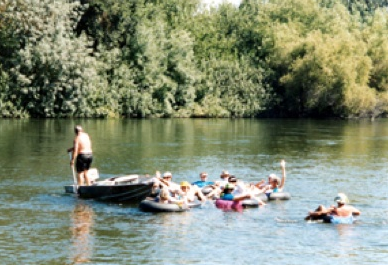
Screen Shot 2014-05-20 at 1.41.37 PMTulare County residents and visitors seeking to use the Kings River for
recreational purposes, such as boating or water skiing, will not be able
to due to extremely low water levels.

Tulare County Parks & Recreation Manager Neil Pilegard said the Kings
River has been closed effective immediately due to drought caused, low
water levels.

*We encourage people to find alternate activities away from the Kings
River and apologize for any inconvenience,* Pilegard said. *Closing
the river is an important public safety measure, as hundreds of people
usually use this river each weekend for recreational purposes.*

The river will remain closed until water flow increases to 400 cubic
feet per second (cfs) at the weir located a half mile west of Highway
99. When the flow rate reaches 400 cfs, motorized watercraft will be
under a 5 miles per hour speed restriction until the water flow
increases to 800 cfs, at which time speed limits will be increased to 30
miles per hour.

Tulare County works with the Kings River Watermaster to determine the
water levels and flow rate. At this point, it is not known when the
water flow will reach 400 cfs. There is no expected time table for any
water release from the U.S. Army Corps of Engineers from Pine Flat Dam,
which feeds water into the Kings River.

The river is extremely dry. For example, there is currently no water in
the Kings River at the Highway 99 bridge near the Riverland Resort.

SCIENTISTS FORECAST ECONOMIC IMPACTS OF THE DROUGHT ON CENTRAL VALLEY AGRICULTURE

May 19.2014

Screen Shot 2014-05-19 at 12.59.26 PMCalifornia’s drought will deal a severe blow to Central Valley irrigated agriculture and farm communities this year, and could cost the industry $1.7 billion and cause more than 14,500 workers to lose their jobs, according to preliminary results of a new study by the UC Davis Center for Watershed Sciences.

Researchers estimated that Central Valley irrigators would receive only two-thirds of their normal river water deliveries this year because of the drought.

The preliminary analysis represents the first socio-economic forecast of this year’s drought, said lead author Richard Howitt, a UC Davis professor emeritus of agricultural and resource economics.

“We wanted to provide a foundation for state agricultural and water policymakers to understand the impacts of the drought on farmers and farm communities,” Howitt said.

The Central Valley is the richest food-producing region in the world. Much of the nation’s fresh fruits, nuts and vegetables are grown on the region’s 7 million acres of irrigated farmland.

The center plans to release a more comprehensive report of the drought’s economic impact on the state’s irrigated agriculture this summer.

The analysis was done at the request of the California Department of Food and Agriculture, which co-funded the research along with the University of California.

“These estimates will help the state better understand the economic impacts of the drought and target its drought relief,” said CDFA Secretary Karen Ross. “The research confirms where emergency drought assistance will be needed most, and efforts are already underway.”

The UC Davis researchers used computer models and the latest estimates of State Water Project, federal Central Valley Project and local water deliveries and groundwater pumping capacities to forecast the economic effects of this year’s drought.

The analysis predicted several severe impacts for the current growing season, including:

* Reduced surface water deliveries of 6.5 million acre-feet of water, or 32.5 percent of normal water use by Central Valley growers. An acre-foot is enough water to cover an acre of land in a foot of water, or enough water for about two California households for a year.
* Fallowing of an additional 410,000 acres, representing 6 percent of irrigated cropland in the Central Valley.
* The loss of an estimated 14,500 seasonal and full-time jobs. About 6,400 of these jobs are directly involved in crop production.
* A total cost of $1.7 billion to the Central Valley’s irrigated farm industry this year, including about $450 million in additional costs of groundwater pumping.
* About 60 percent of the economic losses will occur in the San Joaquin Valley and Tulare Lake Basin.

Growers are expected to replace much of the loss in project water deliveries with groundwater, California’s largest source of water storage during drought years, said co-author Jay Lund, director of the Center for Watershed Sciences and a UC Davis professor of civil and environmental engineering.

“Without access to groundwater, this year’s drought would be truly devastating to farms and cities throughout California,” Lund said.

The additional pumping will cost an estimated $450 million and still leave a shortage of 1.5 million acre-feet of irrigation water, about 7.5 percent of normal irrigation water use in the Central Valley, according to the forecast.

While the current drought is expected to impose major hardships on many farmers, small communities and the environment, it should not threaten California’s overall economy, Lund said. Agriculture today accounts for less than 3 percent of the state’s $1.9 trillion a year gross domestic product.

Other authors on the report are UC Davis agricultural economist Josue Medellin-Azuara and Duncan MacEwan of the ERA Economic consulting firm in Davis.

About UC Davis