Gasoline Watch: Rise May Be Over

A second week of double-digit increases at the pump has pushed up Southern California gas prices by about a quarter since the Aug. 6 fire at the Chevron refinery in Richmond, but there are signs that the spike may be over, according to the Automobile Club of Southern California’s Weekend Gas Watch.

The average price of self-serve regular gasoline in the Los Angeles-Long Beach area is $4.115 per gallon, which is 15.9 cents more than last week, 38 cents higher than last month, and 40 cents higher than last year. In San Diego, the price is $4.100, 16.1 cents above last week, 39 cents above last month, and 38 cents higher than last year.

On the Central Coast, the average price is $4.132, up 15.1 cents from last week, 34 cents higher than a month ago, and 37 cents above last year. In the Inland Empire, the average per gallon price is $4.090, up 17.1 cents from last week, 40 cents higher than last month, and 39 cents more than last year.

Bakersfield’s average price this week is $4.07

“Southern California gas prices have actually only risen by about two cents since Sunday, and most of the week-to-week increase occurred last Friday and Saturday,” said Auto Club spokesperson Jeffrey Spring. “With the refinery still partially open, it appears that wholesale gasoline buyers feel that for now, they have captured most of the cost increase that will result from the fire.”

Some of the best prices in the state are in the Central Valley with a Shafter ARCO at $3.69 today, Amigos Minimart in Avenal at $3.74 and ARCO in Delano at $3.79. Best price in Fresno is $3.85 at Costco; Visalia $3.99 at Houston Ave Market; San Luis Obispo at Costco $4.06.

Spot market gasoline market for LA is down over a dime from earlier this week signaling lower prices ahead.

California Export Trade Surges

LOS ANGELES, CALIFORNIA – Despite battling a strong dollar and weak economic conditions worldwide, California’s exporters still managed to post impressive gains in June, according to an analysis by Beacon Economics of foreign trade data released yesterday by the U.S. Commerce Department.
The value of goods shipped abroad by California businesses in June totaled $15.18 billion, a nominal increase of 9.7% over the $13.83 billion recorded in June 2011. By comparison, overall U.S. merchandise exports were up by only 8.0% over the same period. While exports to some economies – such as Asia and Europe – have flattened, other important trading partners such as Mexico have moved in to fill the gap.
“With the health of most foreign markets in doubt, June’s numbers continue to demonstrate the resilience of California’s export industries, especially in our hi-tech manufacturing sector,” said Jock O’Connell, Beacon Economics’ International Trade Adviser.
The state’s exports of manufactured goods jumped by 10.7% to $9.71 billion from $8.78 billion last June. Non-manufactured exports (chiefly raw materials and agricultural products) declined by 4.1% to $1.58 billion from $1.65 billion, while re-exports rose by 14.0% to $3.89 billion from $3.41 billion.
For the first half of 2012, Beacon Economics’ reports that California’s merchandise export trade is running about 5% ahead of the inflation-adjusted pace set in 2008, the peak pre-recession year for the state’s exports. This success story may have something to do with the impressive employment numbers being posted in the state. “Over the last few months California has been responsible for close to half of the national job growth,” says Christopher Thornberg, Founding Partner of Beacon Economics. “Some of this can be attributed to improving local demand for goods, but much of it is clearly due to continued growth in international demand for goods and services produced here.”
However, Beacon Economics warns that the next few months are apt to feature a combination of strong headwinds and a reduced pace of export growth. With the dollar currently trading about 12% over its value last summer, U.S. exports are accordingly more expensive in global markets.
At the same time, the European Union’s lingering malaise has been affecting export-oriented economies in Asia and Latin America that had come to rely on European demand for imported goods. Major developing economies like India and Brazil have been stumbling lately, in part because fast-paced growth overwhelmed the capacity of their respective infrastructures. Even China has been seeing a slowdown in its normally torrid economic growth rate as it enters a period of political transition that seems unusually fraught with uncertainty.
There is some good international news. Mexico remains California’s largest and most vibrant foreign market, with the value of the state’s exports to its southern neighbor up nearly 25% over last year – and there is little sign of slowing growth. The same applies to another important U.S. trading partner, Canada. Moreover, California’s Agricultural sector is likely to remain a strong point. The droughts impacting the midwest will likely push up food prices globally, benefiting state agricultural producers.

Regional Biz News Nuggets

Harmony Village Tulare

San Francisco: Bay Area economy appeared to gain strength with June job growth and airport landings each signaling rebound. EDD reports the Bay Area added 17,000 jobs in June with the unemployment rate dropping to 8.5%,down from 8.6% in May and compared to 10.7% for the state. Meanwhile, SFO reports June passenger numbers up 8.9% from a year ago with international visitors up 8.3%. The numbers show an acceleration over earlier this year. Domestic cargo was up 35% in June. As far as SF hotel rooms are concerned – occupancy was up 5.9% in June, says Smith Travel.

LAX stats for June are in showing total passenger numbers up 2% and international traffic up 4.6%. Domestic travel is not as strong as earlier this year while international appears to have picked up.

Lindsay: Pucker up people! Ventura based Limoneira has made more forays into the SJ Valley announcing the purchase of 230 acres of citrus growing land near Lindsay.The publicly-traded company said they would plant lemon trees on about 150 acres of the property.Already, Limoneira has added 1,070 acres of growing land this year including 150 acres near Porterville bringing their holdings to 8,000 acres that are either leased or owned.

Visalia: No ball of fire but building figures through July show modest increases in the pace of activity with single family permits through July up 1% and valuation up 9%, res remodels valuation up 32%, number of new commercial permits up 61%,from 18 to 29 but commercial valuation down because of one large project in March 2011. Commercial additions  are up 5% and their value up 10%.

Kingsburg: Closure of the Del Monte cannery in Kingsburg is slated for the end of this packing season – next month says city manager Don Pauley. The plant employed 1100 seasonal workers and about 70 full time. Pauley says Del Monte already has strong indication that their warehouse property will be sold quickly but the old 1920s vintage cannery could be a tougher sell. The city has no other large industrial vacancy, he says.In addition,Pauley says ”Our Downtown is strong and our sales taxes are up.”

Tulare: City council is being asked to support a grant application as well as make a city loan for Harmony Village retirement community on Retherford near the outlet mall. The project is scheduled  to open next summer. The project offers 60 assisted living units and 24 memory impaired units as well as expansion to 75 independent living units. The project is part of the Bethel Family Worship Center (a 29-acre campus with an Alzheimer’s facility, nursing home, senior housing and a new church). Construction will create 50 jobs says the company. Some right of way land is needed by the city to redo the Cartmill Interchange nearby. The Aug 7 city agenda item says “Council consideration and direction to staff on the Application for Economic Development Assistance submitted by HSL Tulare A1, LLC and Bill Brown for City assistance in the form of a loan to the proposed Harmony Village Assisted and Memory Care project.”

Mortgage Rates Drop To 3.49%

Freddie Mac (OTC: FMCC) this week released the results of its Primary Mortgage Market Survey® (PMMS®), showing fixed mortgages rates continuing their streak of record-breaking lows. The 30-year fixed rate mortgage averaged 3.49 percent, more than a full percentage point lower than a year ago when it averaged 4.55 percent. Meanwhile, the 15-year fixed-rate mortgage, a popular choice for those looking to refinance, also set another record low at 2.80 percent.
News Facts
30-year fixed-rate mortgage (FRM) averaged 3.49 percent with an average 0.7 point for the week ending July 26, 2012, down from last week when it averaged 3.53 percent. Last year at this time, the 30-year FRM averaged 4.55 percent.
15-year FRM this week averaged 2.80 percent with an average 0.7 point, down from last week when it averaged 2.83 percent. A year ago at this time, the 15-year FRM averaged 3.66 percent.

According to Frank Nothaft, vice president and chief economist, Freddie Mac, “Market concerns over the strength of the economic recovery brought long-term Treasury yields to new lows this week allowing fixed mortgage rates to reach record levels.  The Conference Board Leading Economic Index showed the largest monthly decline in June since September 2011. Existing home sales fell to 4.36 million homes (annualized) in June and represented the slowest pace since October 2011. Similarly, new home sales fell in June to their lowest level since January of this year.”

Regional Business News

So how is the economy? Take a look at Union Pacific railroad, the largest rail company in the US and the West. Sure,they are shipping 9% less coal but their most recent quarter shows automotive up 25 percent,industrial products up 14 percent, chemicals up 13 percent, intermodal up 10 percent and agricultural up 1 percent.
Union Pacific Corporation (NYSE: UNP) reported 2012 second quarter net income of $1 billion, or $2.10 per diluted share, compared to $785 million, or $1.59 per diluted share, in the second quarter 2011. The company said the results were”best ever.”
Speaking of railroads, Genesee & Wyoming Inc. and RailAmerica jointly announced recently that they have entered into an agreement under which GWI will acquire RailAmerica for an all cash purchase price of $27.50 per share. GWI’s acquisition of RailAmerica will combine the two largest short line and regional rail operators in North America, strengthening GWI’s ability to serve its industrial customers and Class I railroad partners. Rail America owns the San Joaquin Railroad based in Exeter. The SJVR operates 417 miles of track with interchanges with the Union Pacific Railroad at Fresno, Goshen Junction and Bakersfield and the Burlington Northern Santa Fe at Fresno and Bakersfield.
The report of June almond shipments are in and year-to-date looks better than the month of June. YTD domestic sales are up 10.6% while exports are up 15.6%. For June, some export destinations are down including Mexico down12% and Europe down 21% All exports are are down 4% in June.
Car sales look good– witness AutoNation, the country’s largest dealership chain, reported record earnings in the second quarter as revenue rose 17%, to $3.9 billion.
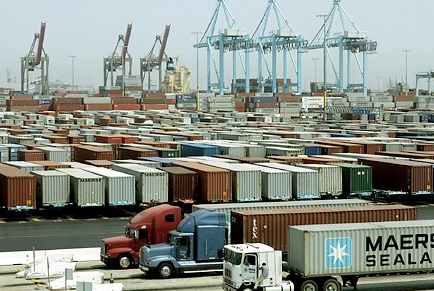
LA area ports are building at a”furious pace” says the LA Times recently with a $6 billion expansion underway. The ports of LA and Long Beach will cut air pollution in half,add more trains and new handling equipment will run on electricity instead of diesel.
US Navy tested a 50-50 blend of biofuel and petroleum earlier this month in a huge maritime exercise off Hawaii. The biofuel is made from cooking oil and algae. Also  the Navy vows to get half its power from renewable sources by 2020.

California’s Jobless Rate Decreases to 10.7 %… Nonfarm Payroll Jobs Increase By 38,300

California’s unemployment rate decreased to 10.7 percent
in June, and nonfarm payroll jobs increased by 38,300 during the month for atotal gain of 475,300 jobs since the recovery began in September 2009, according to data released by the California Employment Development Department (EDD) from two separate surveys.

The U.S. unemployment rate was unchanged in June at 8.2 percent.\

In May, the state’s unemployment rate was 10.8 percent, and in June 2011, the unemployment rate was 11.9 percent. The unemployment rate is derived from a federal survey of 5,500 California households.

Nonfarm jobs in California totaled 14,326,700 in June, an increase of 38,300 jobs over the month, according to a survey of businesses that is larger and less variable statistically. The survey of 42,000 California businesses measures jobs in the economy. The year-over-year change (June 2011 to June 2012) shows an increase of 279,100 jobs (up 2.0 percent).

EMPLOYMENT AND UNEMPLOYMENT IN CALIFORNIA
The federal survey of households, done with a smaller sample than the survey of
employers, shows a decrease in the number of employed people. It estimates the number of Californians holding jobs in June was 16,484,000, a decrease of 17,000 from May, but up 326,000 from the employment total in June of last year.
The number of people unemployed in California was 1,974,000 – down by 20,000 over the month, and down by 213,000 compared with June of last year.

Seven categories (construction; trade, transportation and utilities; information; financial activities; professional and business services; leisure and hospitality; and other services) added jobs over the month, gaining 46,600 jobs. Trade, transportation and utilities posted the largest increase over the month, adding 9,400 jobs.

PAYROLL EMPLOYMENT DETAIL (SEASONALLY ADJUSTED)
EDD’s report on payroll employment (wage and salary jobs) in the nonfarm industries of California totaled 14,326,700 in June, a net gain of 38,300 jobs since the May survey.

This followed a gain of 45,900 jobs (as revised) in May.
Seven categories (construction; trade, transportation and utilities; information; financial activities; professional and business services; leisure and hospitality; and other services) added jobs over the month, gaining 46,600 jobs. Trade, transportation and utilities posted the largest increase over the month, adding 9,400 jobs.

Beacon Economics offered the following analysis:

For the second consecutive month, California made up nearly half of all jobs gains in the U.S. From May to June the state added a seasonally adjusted 38,300 nonfarm jobs. Total private employment fared slightly better, adding 38,800 positions in June.
On an annual basis California also continues to outpace the nation. From June 2011 to June 2012 the state added back nearly 280,000 jobs, a growth rate of 2% for the year. The U.S. grew by only 1.4% over the same time period. Moreover, remove public sector job losses, and California’s numbers improve even more with 313,900 private sector jobs added back, for a 2.6% growth rate from June 2011 to June 2012.
The state’s unemployment rate also ticked down slightly from 10.8% to 10.7%, although the labor force also contracted, indicating that some workers have ended their job search and left the labor market. Still, year-over-year, California’s unemployment rate has fallen 1.2 percentage points from 11.9% in June 2011 to 10.7%in June 2012 – a much faster decline than in the nation overall where unemployment fell by 0.9 percentage points on a year-over-year basis during the same time period.
The Information sector was the fastest growing industry from May to June, adding 5,600 jobs (1.3% growth rate). Most of those gains came from Los Angeles and Orange Counties, as opposed to tech heavy Silicon Valley, indicating that more of the information jobs were in media and publishing as opposed to software development and production.
In absolute terms, the bulk of the most recent job gains came from the Trade, Transport, and Utilities sector, which posted a month-over-month increase of 9,400 jobs (0.3% growth rate). This sector has grown steadily since the recession, keeping in line with the state’s high level of export growth and trade activity over the past year. Construction and Professional and Business Services employment also performed well month-over-month, adding 8,100 and 7,800 jobs, respectively.
Southern California took the lead in job growth this month, with Los Angeles County alone adding 20,100 jobs. San Diego County followed with a 9,300 job gain, and Orange County posted an additional 8,000 nonfarm positions. While this appears to be a major acceleration in job growth for the southern part of the state, it is in all likelihood a statistical “catchup.” The EDD has consistently revised its employment estimates upwards over the past few quarters, and while that does indicate a growing economy, the current bump is most likely a revision that is making up for what seemed like sluggish growth during the winter months.


State Car Dealers See 27.4% Surge In Sales

The California new vehicle market recovery continued in the second
quarter of 2012, with new vehicle registrations increasing 27.4
percent versus a year earlier says the California New Car Dealers Association. It was the 13th consecutive quarterly
increase for the market, going back to the fourth quarter of 2009 indicating the state’s economy might be more robust than thought.

The increase for all of this year is now expected to reach nearly
20%, with another increase likely in 2013, as well. Other key trends
in the state market:
• Chrysler was the brand with the largest percentage increase in
the first half of this year, up nearly 200 percent (see graph).
• Korean, Japanese, and Detroit Three brand registrations each
increased by more than 22 percent.
• Passenger car share increased 0.9 of a share point. SUVs were
down 1.4 points.
The 22.6 percent first half improvement in the state market exceeded the 14.8 percent increase in the nation.

The Toyota Prius was the top selling car followed by Honda Civic and Toyota Camry. Honda CRV was the best selling truck followed by Ford F Series.

The Association says California is likely to register 1.54 million vehicles this year compared to 1.29 million in 2011 and 1.17 million in 2010.

LA Ports See More Traffic

Both the Port of Long Beach and Port of Los Angeles saw an increase in traffic in June.
At the Port of LA total container traffic was 8.7% higher and loaded outbound containers (exports) were a robust 6.9% higher than a year ago.
Both import and export container traffic at the Port of Long Beach rose in June compared to the same period a year ago, with imports up 3.5 percent and exports up 5.6 percent.
Last month, Long Beach Port terminals moved 280,526 TEUs, or twenty-foot equivalent container units, of loaded inbound cargo compared to 271,113 TEUs in June 2011. Export containers accounted for 133,649 TEUs, compared to 126,588 TEUs in June 2011.
June was the busiest month year to date for calendar year 2012 at Long Beach. Through first half of the year, overall container traffic at the Port is down 5 percent. The decrease in volumes is partly due to the elimination of several niche service strings that had called at the Port last year.

Trade Deficit Falls On Exports

According to the  the May 2012 U.S. International Trade in Goods and Services report, U.S. goods and services exports in May 2012 increased 0.2 percent from April 2012 to reach $183.1 billion, with record exports in total services ($52.4 billion), and foods, feeds, and beverages ($11.8 billion).

Exports of U.S. goods and services through the first five months of 2012 were up 5.7 percent, or $48.6 billion, from the same period of 2011 to reach $908.7 billion.
Acting U.S. Secretary of Commerce Rebecca Blank said “U.S. exports posted their second-highest level on record in May despite some tough economic conditions abroad, confirming the progress we are making on the path to achieving the President’s goal of doubling exports by the end of 2014,” said Acting U.S. Commerce Secretary Rebecca Blank. “But there’s much more work to do, and we must keep up efforts to support manufacturers and the auto and transportation industries, including supporting President Obama’s continued efforts to leveling the playing field so that American businesses and workers can compete, win and sell their products around the world to create good-paying American jobs. We are on track toward exceeding last year’s export total of $2.1 trillion, which supported 9.7 million jobs.  One of the bright spots in manufacturing exports has been motor vehicle and parts, which reflects the overall resurgence of cars and trucks made in the United States. ”

Making cars


In May 2012, the monthly U.S. goods and services trade deficit improved by 3.8 percent to $48.7 billion when compared to April 2012. This reflected a $1.6 billion decrease in the goods trade deficit.
 U.S. goods and services exports year-to-date through the first five months of 2012 were up 5.7 percent or $48.6 billion from the same period of 2011 to reach $908.7 billion.
 In May 2012, the average import price per barrel of crude oil was $107.91 per barrel, slightly down from the $109.94 per barrel recorded in April 2012. The decrease in the value of crude oil imports in May 2012 was due entirely to the decrease in price, as the quantity of crude oil imports in May (272.3 million barrels) was up slightly from the quantity imported in April (270.0 million barrels).
TRADE SPOTLIGHT: Transportation Month
 The United States exports a great deal of manufactured goods. Through May 2012, manufactured goods are up nearly 9 percent to $556.5 billion as compared to the same period in 2011. Nearly one-fifth (18 percent) of those goods are transportation equipment.
 Transportation equipment (including aerospace products and parts, automotive vehicles and parts, ships and boats, railroad rolling stock, recreational vehicles, motorcycles and bicycles) accounted for the largest category of U.S. merchandise exports, amounting to $218 billion in 2011

Gas Price Watch: Still Falling

California average gas prices continue to fall approaching mid-July to $3.65 per gallon, down from $4.35 in mid-May. Some stations in the state are as selling as low as $3.33 this wee with the lowest prices in our reading area as follows:

SLO:Costco $3.67. Bakersfield:$3.49 at FoodsCo.Tulare:$3.54 at Super Stop. Visalia:$3.58 at Costco.Hanford: $3.53 at Chevron.  Fresno:$3.45 at Fast Trip. Info courtesy Gas Buddy.

The July 9 California Energy Commission gasoline report says: Still holding the downward trend, falling for a seventh week, Regular is lower then the previous week. Dropping several cents, over last weeks price.

The average price in California for regular gasoline decreased 15.4-cents from the previous week. The average statewide price for regular was $3.733. Mid-grade and premium prices decreased as well.
The national average for self-serve regular is at $3.411, down 2.6 cents from the previous week.This is 32.2 cents lower than the price of regular in California.