
-July 4,2019-
Rabobank ag office relocates
With the merger of Rabobank and Mechanics Bank the Rabobank ag lending office has relocated in Visalia and Bakersfield among other communities. The Visalia office has relocated from s Mooney Blvd to 300 S. Demaree Street, Suite A Visalia.
Approximately 170 employees who currently support the food and agriculture portfolio at Rabobank, N.A. became employees of Rabo AgriFinance as of July 1. This change is part of the merger announced earlier this year between Mechanics Bank and Rabobank, N.A. The vast majority of food, ag, wine and renewable energy clients will become customers of Rabo AgriFinance.
“We look forward to our California colleagues joining us and to serving our California-based clients in their important work of contributing to the safe, abundant food supply we enjoy,” says Curt Hudnutt, head of rural, North America at Rabo AgriFinance.
Two existing Rabobank locations in Fresno and Salinas will become Rabo AgriFinance offices.The Fresno office is now at
45 E. River Park Place West, Suite 507 Fresno. New office locations are in the following cities: Bakersfield, Chico, El Centro, Modesto, Santa Maria, Santa Rosa, Visalia and Yuba City.
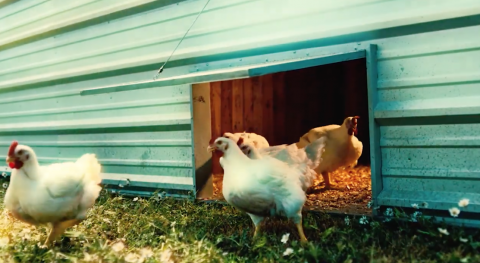
Foster Farms promotes Free Range chicken
Livingston, California-based Foster Farms has launched its “Feels Good to Be Free Range” digital ad campaign, making free range chicken widely available to millions of West Coast consumers. Foster Farms’ Simply Raised, No Antibiotics Ever free range chicken is now available at leading supermarkets from San Diego to Seattle.
“Consumers are increasingly interested in where their food comes from and how it is raised,” said Helen Kurtz, Foster Farms’ chief marketing officer. “Simply Raised is already grown without antibiotics, farmed locally and certified by the American Humane Association, so it was a natural next step to provide outdoor access for our flocks and raise them free range. Our new advertising and refreshed packaging shine a light on a great choice for chicken, that’s now even better.”
The new digital ad campaign features two 15- and 30-second spots and will run on streaming platforms such as Hulu, Roku and YouTube with integrated social media content. The ads celebrate the freestyle dance moves of Foster Farms Simply Raised No Antibiotics Ever chickens set to 1990’s pop music. The campaign was developed by Deutsch Los Angeles, Foster Farms’ creative agency since 2015.
Floodwater on Mississippi increases nitrate runoff
Wall Street Journal
Before reaching the Gulf, the river flows between Arkansas and Mississippi, states that have helped feed the world’s booming appetite for chicken. Arkansas is the second-biggest poultry producer after Georgia.
That has put more nitrates and other contaminants from chicken farms and slaughterhouses into waterways such as the Arkansas River, researchers say, which flows to the Mississippi.
Every summer, nutrients from the Mississippi pour into the Gulf, fueling algae blooms that starve the water of oxygen and kill sea life. Heavy rainfall throughout the Mississippi River watershed this spring led to record-high river flows, boosting nitrate and phosphorus loads. As a result, scientists predict this year’s “dead zone” will total 7,829 square miles, an area roughly the size of Massachusetts, and close to the record set in 2017.
Confused by a veggie burger?
press reports
Producers of beef, poultry, pork and lamb have been pushing to protect meat terminology as companies develop more plant-based products that look and taste similar to meat.
The Good Food Institute says 12 states have enacted what it calls “meat label censorship” laws. In addition to Mississippi and Missouri, the states are Alabama, Arkansas, Kentucky, Louisiana, Montana, North Dakota, Oklahoma, South Carolina, South Dakota and Wyoming.
The Louisiana measure signed by Democratic Gov. John Bel Edwards prohibits veggie products from being called meat, non-rice products from being described as rice and sugar alternatives from being marketed as sugar. It becomes law in October 2020.
The chairman of the Mississippi Senate Agriculture Committee, Republican Billy Hudson of Hattiesburg, was chief sponsor of the meat labeling legislation. He said the state agriculture department and the Mississippi Cattlemen’s Association pushed for it because of concerns that consumers could be misled. The Mississippi law also says food produced using animal tissue cultured in a laboratory may not be labeled as meat.
“They tell me that fake steak looks just like our real meat,” Hudson told The Associated Press on Monday. He said if a consumer sees two similar products side by side, they could think they’re getting meat when they’re not.
“I don’t want to eat meat grown by a test tube in a laboratory,” Hudson said. “If my constituents do, they ought to know what they’re getting.”
Mississippi’s agriculture commissioner said Tuesday that he looks forward to defending the law.
“A food product made of insect-protein should not be deceptively labeled as beef,” Gipson said. “Someone looking to purchase tofu should not be tricked into buying lab-grown animal protein.”
The lawsuit in Mississippi says that Upton’s Naturals does not make meat products but does use terms such as “vegan burgers,” ”vegan bacon” and “vegan chorizo.”
“These terms, as used by Upton’s Naturals, increase consumer understanding of the foods’ characteristics and communicate how the foods should be prepared and eaten,” the lawsuit says.
The Plant Based Foods Association says in the lawsuit that “no reasonable consumer would be misled” by terms such as “meatless steaks” and “vegan jerky.” Jessica Almy, policy director for the Good Food Institute, said the food labeling restrictions in Mississippi should be overturned: “This law is a tremendous overstep of state powers and is really just a sad attempt to censor veggie burgers.”
Bottled water high in arsenic?
 An Oakland-based environmental health group is threatening to sue the manufacturers and retailers behind two bottled water brands for failing to warn consumers about allegedly high levels of arsenic in their products.
The Center for Environmental Health (CEH) has sent legal notices to Whole Foods, which owns the bottled water brand Starkey, and Keurig Dr. Pepper, which owns Peñafiel spring water, sold by Target. The center commissioned testing of the water brands and said it found both Starkey and Peñafiel contained arsenic levels high enough to warrant a health warning under California’s consumer protection law Proposition 65.
In the legal notices, CEH said it will file citizen lawsuits against Keurig Dr. Pepper and Whole Foods if they don’t agree to recall the bottled water already sold, pay a penalty, and either remove arsenic from the water they’re selling or place a warning to consumers on the bottles.
Peñafiel is bottled in Mexico, and marketed to the Latino community in the United States.