California dairy farmers like those raising many other crops are running out of patience with President Trump’s 2-year trade war as prices slump lower. You could feel the exasperation reading this week’s California Milk Producers Council newsletter recounting the latest tweets.“In a series of tweets heard round the world, President Trump lambasted China for stealing America’s intellectual property and “ordered” American companies to look for ways to move their foreign operations out of China. According to President Trump, “We don’t need China and, frankly, would be far better off without them.”
The latest fusillade in the trade war pummeled the markets. Stocks, bond yields, and commodities plummeted. The trade war has weakened the dairy markets on multiple fronts, skewering whey values, subjecting U.S. cheese sales to Mexico to one year of stepped-up taxes and introducing the idea that U.S. suppliers may be unreliable, as the rules and transaction costs for overseas buyers could change in an instant. Less directly, the trade war has slowed global commerce and stunted business investment with crippling uncertainty. This has reduced demand for goods of all kinds.”
As the Dow Jones dropped over 600 points, all the turmoil has also helped ag prices to sag further.A bigger worry remains the long term loss of markets.
US losing market to EU
Reports say whey products and lactose are the top dairy products exported, by value, from the US to China. China’s imports of whey products have declined sharply in recent months. African Swine Flu may have affected the markets because they can be fed to pigs and hogs. Also tariffs by China, in response to U.S. tariffs on certain imports from China, may have contributed to the decline in imports of whey products and lactose from the United States. The U.S. market share declined from 57 percent in 2017 to 51 percent in 2018 and to 38 percent for the first 5 months of 2019. The United States’ largest competitor in this market is the European Union. In the first 5 months of 2019, the European Union increased its market share to 42 percent, up from 36 percent in 2018 and 34 percent in 2017.
It is not just dairy that is getting hit.Wine growers are feeling the pinch. U.S. wine exports, over 90% from California were $1.46 billion in revenues- down 4.8% in value in 2018. Wine is California number two ag export after almonds.
Almonds that already face a 50% Chinese tariff are getting hit again. The latest retaliatory Chinese tariff on $75 billion worth of US goods, just announced, includes and an additional 10% tariff beginning September 1,2019 on seafood, fish, crab, shrimp, fruit, and nuts.
Citrus prices suffer
California citrus farmers are not any happier either with prices reduced by half this past season.
“California Citrus Mutual President Casey Creamer said exports to China last year were off 46 percent with a 50 percent loss in value to the industry.” according to Western Farm Press.
Cotton prices sink further
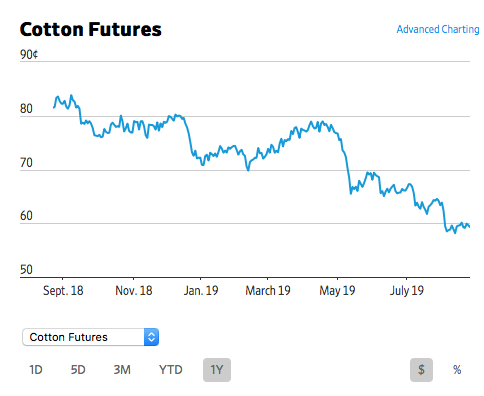 The escalating trade war between China and the US has impacted the world cotton market too with prices falling some 26% in the past year from 81cents/lb to 58 cents/lb on the futures market.
Valley may grow no cotton
California Farm Bureau reports that” for commodities such as cotton, news that China has halted purchases of American farm products “is devastating,” said Roger Isom, president and CEO of the California Cotton Ginners and Growers Association. When trade tensions between the two nations began heating up more than a year ago, he said he had “held out hope” that Washington and Beijing would resolve their differences quickly, “but that hope is gone.”
“I don’t see any end in sight right now,” Isom said. “I have growers who said that unless things change, they won’t be growing pima (cotton) next year; they won’t be growing any cotton.”
He said farmers appreciate the trade-aid payments meant to help them through the trade dispute, but that money is not enough and “not what we would make by selling our crop.” China’s increased tariffs on cotton, he noted, have had “a devastating impact” on market prices for cotton.
“I don’t see any end in sight right now,” Isom said. “I have growers who said that unless things change, they won’t be growing pima (cotton) next year; they won’t be growing any cotton.”
What the beef?
The tit-for tat trade war will make it even tougher for US cattle farmers to sell to China, the world’s second largest beef importer, after Beijing ended a nearly 14-year ban on American beef.China raised tariffs on US beef from 12 per cent to 37 per cent in early July – part of its retaliatory duties on US $34 billion of American goods – dealing another blow to US cattle farmers trying to regain their foothold in the fastest-growing beef market.
With the latest salvo announced last week by China, Beijing will tag beef and pork from the United States with an extra 10% tariff.
Offers to compensate farmers for their crop losses do little to help the overall farm economy since truck drivers and shipping companies won’t get paid, farm workers are idle and implement dealers are not selling as many tractors or pickups. Whole farm communities are suffering. Not just prices but spirits are saging.
Tractor sales sputter
Nationwide tractors sales are down. An industry report says the sale of four-wheel-drive tractors decreased 4.7% in July 2019 compared to a year earlier. U.S. July self-propelled combine sales were also down, decreasing 25.9%.
Total U.S. two-wheel-drive tractor sales were also lower, coming in at 0.1% lower compared to July 2018. Sales of two-wheel-drive tractors under 40 horsepower fell 0.6%, and sales of 100-plus-horsepower tractors declined 9.8%.
John Deere has been feeling the pain say news reports.”Profit at tractor-maker Deere’s agriculture business sank over the past three months as U.S. farmers delayed purchases after losing access to overseas markets during President Trump’s trade war.
The Moline, Illinois-based company, which halved its sales-growth forecast for the division three months ago, said its income plummeted 24% to $612 million in the quarter through July. The decline illustrates the growing damage from U.S. duties on Chinese imports and retaliation from President Xi Jinping, whom Trump is attempting to pressure into a trade agreement.”
Other major a ag firms are suffering. Cargill earnings plunged on trade war and incessant rains says Bloomberg.For the three months through May, net income fell 67% from a year ago.
Growing frustration
Farm groups who have held their tongue till now seem to want to speak up.Although the Trump administration has rolled out aid to farmers stung by China’s tariffs, there is growing frustration in America’s agricultural belt, a key political constituency for Trump as he heads into his 2020 re-election campaign, says a report.
“The view from much of farm country is bleak and anger is boiling over. With bankruptcies and delinquencies rising and prices falling, the frustration with the lack of progress toward a deal is growing,” the bipartisan Farmers for Free Trade group said in a statement.