
-January 29,2019-
A chicken in darn near every pot
Per Capita Beef/Chicken consumption swap places
 Since the mid 1970s US per capita beef consumption has dropped from 91.5 pounds per person to just 57 pounds in 2018. During the same period per capita chicken consumption has climbed from 38.7 pounds per person to about 94 pounds. Figures are from the National Chicken Council.
_______________________________________________
Milk Watch: Continued tariffs offer our competitors a leg up
The US Dairy Export Council offers some perspective over what the continuing trade war means for US milk exports, a green light for our competitors.
-Trade patterns have shifted since China’s implementation of additional tariffs on U.S. products, most noticeably in whey. In 2017 and the first half of 2018, the United States held a 52% share of China whey imports, while European suppliers captured 36%. In the first four months with the new tariffs in place, U.S. share plunged to 32% while EU share jumped to 46%. Meanwhile, Chinese buyers are increasingly looking to Belarus and Ukraine, which accounted for 14% share in the four-month period.
-Likewise, trade deals give New Zealand and Europe new access into Mexico and Japan, respectively. The improved access is relatively small at the outset and may not shake things up much in 2019, but it ramps up over time. More significant is the revamped EU-Mexico agreement, which gives Europe an opening into the United States’ long-time biggest market once implemented later this year or in early 2020.
______________________________________________________________________________
Wine Futures: Watch out below says trade group
Allied Grape Growers this month issued this sobering assessment of the market for California wine. There is concern that we face an oversupply of product.
There is strong evidence that the 2018 winegrape crop will go down as a record on the production side. While the Central Valley probably experienced an average-sized crop overall, the northern interior and coastal regions of California burgeoned with supply. This growth in production was due to two things: increased yields and increased bearing acreage in those regions. AGG is estimating that up to 4.4 million tons of California winegrapes may have been crushed in 2018.
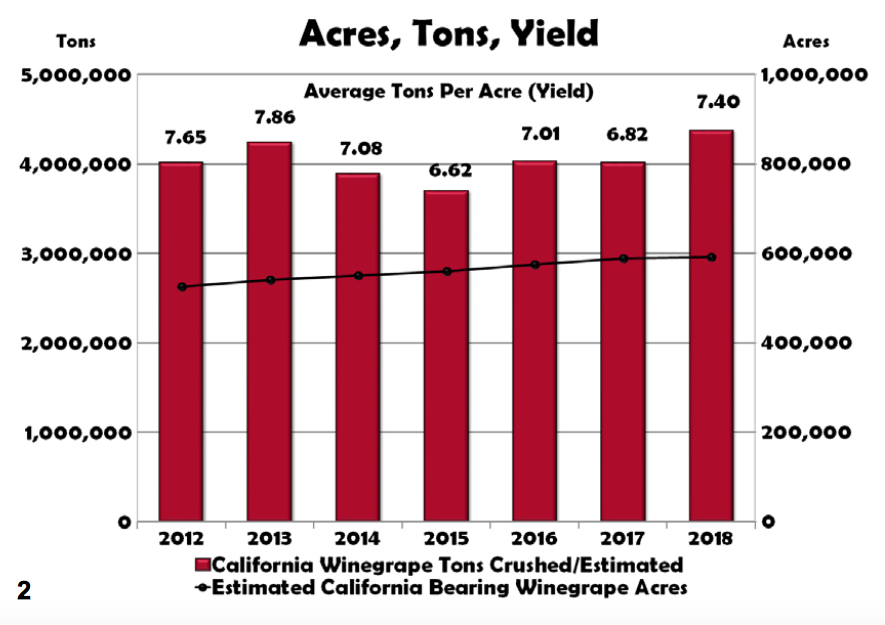
On top of California’s ample winegrape crop, recent reports conclude that global 2018 wine production will be near the largest in the last two decades, estimated to be up a whopping 14 percent from 2017. Evaluating the situation on the surface, it may seem we have entered into a period of market imbalance, with excess supply.
Pull some vines?
Coupled with this growth in supply is a flattening of demand. One thing that we will say for certain, and hopefully with convincing passion, is that struggling vineyards have no place in the future of this highly competitive business. A struggling vineyard is one that is production- challenged in areas where production is necessary for survival (i.e. the interior).
It is also a vineyard that is challenged to achieve proper color (for red grapes) and/or brix requirements to produce quality wine. There are many virus-a ected vineyards statewide that fall into this category and need to be seriously evaluated for their ongoing sustainability. Lastly, a struggling vineyard may be one that is overly dependent upon hand labor for its survival, like non-trellised vines in lower value regions.
The longer-term issues should be of greater concern. What are we doing to appeal to the next- generation consumer? What are we doing to assure long-term viability and sustainability of California agriculture? What are we doing to understand (via research) how we can maintain a competitive advantage in production and winemaking, assuming we have one?