
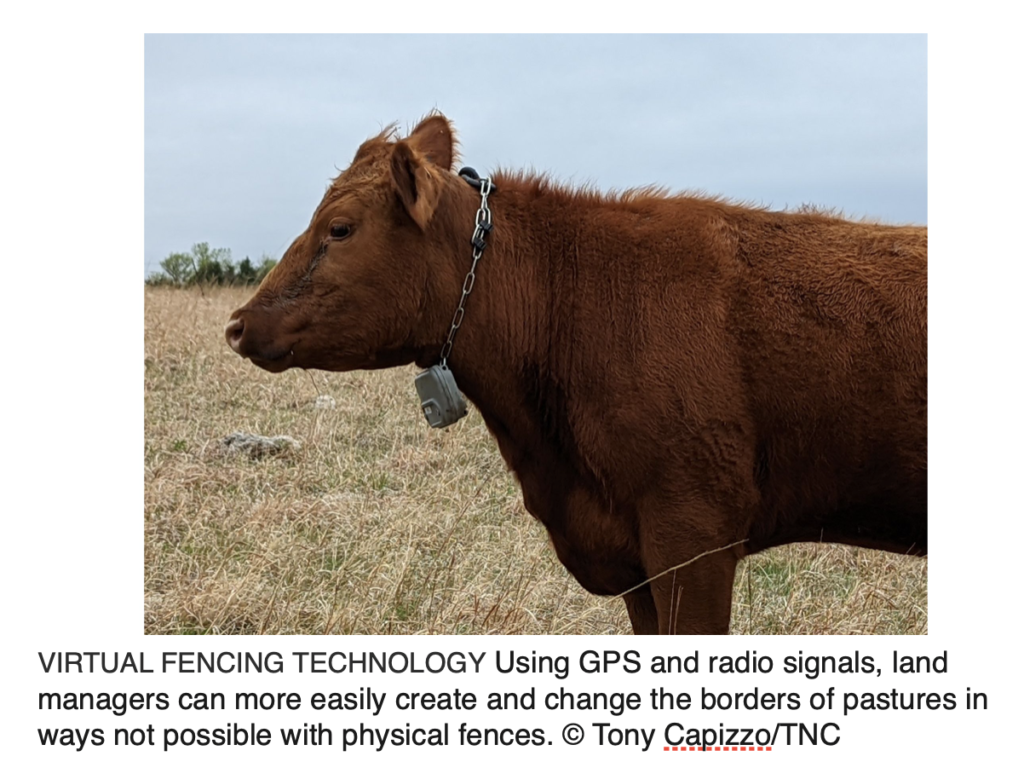
VIRTUAL FENCING TECHNOLOGY Using GPS and radio signals, land managers can more easily create and change the borders of pastures in ways not possible with physical fences.
© Tony Capizzo/TNC
What Is Virtual Fencing?
Hailed by the U.S. Department of Agriculture as a climate adaption strategy, virtual fencing is an innovative technology that enables ranchers to use a smartphone or web app to remotely monitor and control where and when livestock graze. Virtual fences can reduce the need for physical fences, which require significant time, expense and labor to maintain. Physical fences also limit land managers in their ability to change grazing boundaries to adapt to seasonal changes in vegetation or to exclude cattle from ecologically sensitive areas.
How does virtual fencing work?
The cows are outfitted with battery-operated, GPS-enabled collars that emit a radio frequency to communicate with reception towers, creating virtual grazing boundaries set by a rancher or land manager. When a cow approaches the edge of the virtual boundary, the collar emits a sound signaling it to turn around. If the cow proceeds to cross the boundary, it receives a momentary benign shock, signaling that it’s gone too far and should rejoin the herd. Research shows that the cows are trained in as little as four days to respond to the auditory cues alone.
At scale, we believe virtual fencing can help land managers better implement management practices that regenerate land health, help address climate change and biodiversity loss, and improve economic outcomes for ranchers.
Dep. Dir. TNC’s North America Regenerative Grazing Lands Strategy
Virtual Fences as a Conservation Strategy
Grasslands are the least protected habitat on earth and one of the most effective carbon sinks, storing up to 20% of the world’s soil organic carbon. Unfortunately, grasslands are continuing to rapidly disappear for several reasons, including urban sprawl, conversion to row crop agriculture, and energy development. Many remaining rangelands are at risk of further degradation due to extreme weather events, land conversion and incompatible management practices.
For optimum ecological health, most grassland ecosystems need periods of disturbance to aerate the soil, stimulate plant growth and recycle nutrients into the soil. Grasslands also need time to recover, allowing plant roots to take hold, thus decreasing the risk of soil erosion and sediment runoff into waterways. Ranchers accomplish this disturbance-rest cycle by managing the timing, location, herd size and intensity of grazing activities—all of which can be time-consuming and expensive.