
January 24,2020
 A new USDA report in January 2020 says global orange production for 2019/20 is forecast to fall 5.8 million metric tons from the previous year to 47.5 million as unfavorable weather leads to smaller crops in Brazil, Egypt, the European Union, and Morocco. Consequently, consumption, fruit for processing, and fresh exports are also forecast lower. Brazil’s production is forecast to fall 22 percent.
The report offers a reprieve for Florida ,suffering under citrus greening disease noting that U.S. production is forecast to rise 1 percent to 4.9 million tons. Orange production in Florida has been declining for years due to citrus greening, which has decimated groves and increased costs for crop maintenance. Two consecutive years of higher production are a relief after so much decline. Consumption, exports, and fruit for processing are all expected to be up with the production increase.
Juice
Global orange juice production for 2019/20 is forecast 17 percent lower to 1.7 million tons (65 degrees brix) as Brazil’s production tumbles. Consumption is projected to be flat and global trade is forecast lower with smaller imports for the United States and a sizable drop in Brazil’s exports.
Brazil’s orange juice production is forecast to drop 25 percent to 992,000 tons with fewer oranges for processing. Consumption and stocks are both forecast slightly higher while exports are forecast 27 percent lower with the drop in production. Even with lower supplies Brazil remains the largest producer and is expected to account for over three-fourths of global orange juice exports.
Although U.S. production is forecast steady at 330,000 tons, increased carry-in stocks boost total supply 5 percent. Despite higher available supply, consumption is still expected to be flat and ending stocks are consequently forecast to rise.
Mandarins
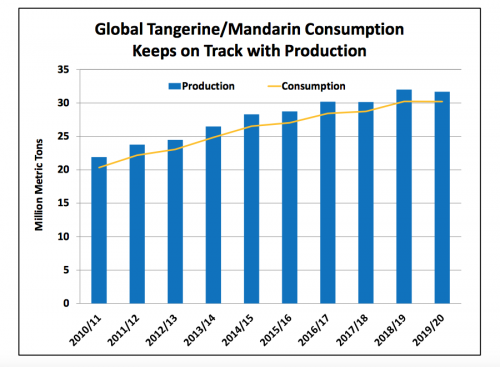
Global mandarin production for 2019/20 is forecast down 1.0 percent to 31.7 million tons with declines in the European Union, Morocco, Turkey, and the United States more than offsetting a larger crop in China. Consumption and exports are both down with the decrease in available supply.
Production has exceed consumption in recent years as world mandarin production has steadily grown.U.S. production is forecast down 14 percent to 844,000 tons due to a smaller crop in California. Consumption is down due to lower available supplies while exports remain unchanged.