
-August 17,2023-
CALIFORNIA TABLE OLIVE FORECAST CLIMBS
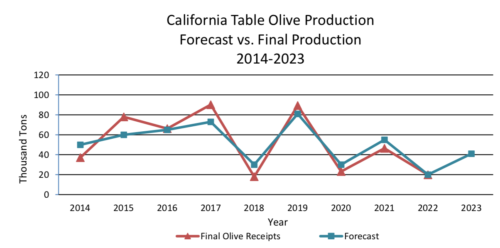
The 2023 California table olive forecast is 41,000 tons, up considerably from last year’s crop of 19,912 tons, according to a survey conducted by the USDA, National Agricultural Statistics Service. Bearing acreage is estimated at 12,400, which results in a yield of 3.31 tons per acre.
The Manzanillo production forecast is 39,000 tons, Sevillano production forecast is 1,900 tons, and other varieties are expected to total 100 tons.
Record snowfall and a series of atmospheric rivers brought relief to the state’s drought. Availability of water was not an issue and many growers reported a heavy bloom on drought stressed trees that had not produced fruit in years. However, unprecedented stormy conditions and flooding hindered bee pollination activity and damaged blooms, causing low fruit sets in some areas. Growers reported variable crop yields by both variety and area. Manzanillo yields were considerably higher than Sevillano yields. Marketing issues continued to be the biggest challenge for California olives growers, with many uncertain how much of their crop will be economical to harvest.
California orange forecast released
California’s all-orange forecast dipped to 44 million boxes, down 1.1 million boxes from the June forecast, says USDA in a July 12 report. The full decrease was in the Valencia variety, now forecast at 7 million boxes.The All Orange forecast for California is up 13% from last season’s utilization, the report said. The California navel orange forecast is 37 million boxes (1.48 million tons), unchanged from the previous forecast but up 17% from last season’s utilization.
California’s lemon forecast dropped to 20 million boxes, down 3 million boxes from June.
The California tangerine and tangelo forecast rose 1 million boxes from June and now stands at 22 million boxes.
Florida continues to suffer huge citrus losses. In Florida, all varieties are forecast at 6.15 million boxes (277,000 tons), unchanged from the previous forecast but down 66% from last season’s final utilization.
Growers Optimistic Over Walnut Outlook
California Walnut Board
What a difference a year makes! The California walnut industry is gearing up for a stellar 2023 harvest and shipping season after several years of drought, record low grower returns, COVID disrupted markets with supply chain challenges and a devastating heat wave in September 2022 that negatively impacted the entire crop. Here’s why this season is lining up to be a different story.
Quality is expected to be excellent due to favorable growing conditions.
Last winter’s prolonged heavy rains in the California walnut growing regions helped restore deep soil moisture and provided for healthy root zones, enabling trees to better tolerate late season high temperatures. The state also benefited from an extensive snowpack which has provided all growing regions with sufficient water to support the trees and the crops through this season.
The much-needed chilling hours were at normal levels, placing the trees into a deep winter dormancy and a prolonged “rest and recuperation” period. Mild spring temperatures were ideal and produced full, vibrant, vigorous tree canopies which supported strong pollination, resulting in robust nut sets throughout the orchards.
“This year, our trees are more capable of handling higher temperatures than the previous years when the trees were under stress due to long-term deficit irrigation,” commented fourth-generation grower and handler Bill Carriere of Glenn, California. “Long-time growers have commented that the trees have not looked this strong and healthy in at least six to seven years. The full leaf canopy provided excellent temperature control and sun protection during the spring and summer months, allowing the walnuts to grow evenly with minimal sunburn. I am very optimistic that this year will mark a return to the premium quality walnuts we are known for in California.”
Acreage adjustments
Record low prices, brought on by an oversupply of darker than normal walnut kernels and weak demand in international markets, have taken a toll on growers, some opting to remove orchards from production.
The extent of the acreage shift became more evident in an acreage survey conducted by the California Walnut Board between October 1, 2022, and June 30, 2023. For the first time ever, the acreage of California walnuts declined with 23,000 acres removed during the nine-month period. The industry will likely see additional reductions between July and December 2023, as more growers decide to shift to other crops and the needed tree removal equipment becomes available.
However, even with the removal of these orchards, the industry has a strong production base with approximately 380,000 producing acres and 37,000 younger non-bearing acres.
“This week, the California Walnut Board released the monthly and year-to-date shipment report which highlighted an additional reason why I am bullish about the upcoming season,” remarked Martin Mariani, a grower/processor from Winters, California, “The data shows that we have shipped the equivalent of 730,488 tons this season from an available inventory of 880,000 tons.” He went on to explain that when taking into consideration the high sales commitments going into the fall, “we are virtually sold out of available inventory, which bodes well for the industry. I can’t wait to bring the new crop to market.”
Big corn and soybean crops in 2023 drops futures
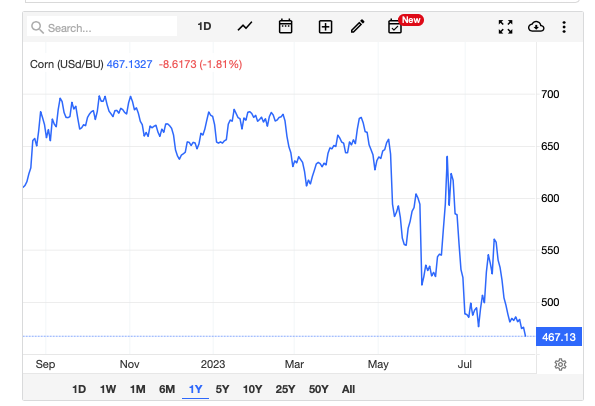 The farm-gate value of U.S. corn and soybeans, the two most widely grown crops in the country, will fall 16 percent compared to last year’s harvests due to a steep drop in commodity prices, says USDA. The season-average price for corn was forecast to be $1.70 a bushel below the near-record prices paid for the 2022 crop, and soybeans were expected to be $1.50 a bushel below last year’s price.
Corn prices reached $8 a bushel last summer but this week corn is expected to trade at 461.85 USd/BU by the end of this quarter, according to Trading Economics to 425.98 in 12 months time.Livestock folks are celebrating the big crop as their feed costs are going down
Likewise for soybean futures -now below $14.0 per bushel ($13.40) – the lowest in two months due to rainy weather across much of the key U.S. crop belt and forecasts for good growing conditions for August.Just over 70 percent of the soybeans grown in the United States are used for animal feed, with poultry being the number one livestock sector consuming soybeans, followed by hogs, dairy, beef and aquaculture.
Since these two crops are tied to so many end product foods we eat, these lower costs could help reduce food inflation in the US,said to be going down.
Imports up – Exports down
At the three-quarter point in the trade year, U.S. food and agricultural imports were nearly $7 billion larger than farm exports, $148.2 billion vs. $141.4 billion, according to USDA data released recently.The agency has forecast a $17 billion food trade deficit for the 12 months ending on Sept. 30, due to a drop-off in corn, wheat, beef, and poultry exports, while demand remained strong for imports that include wine, coffee, beer, fresh fruits and vegetables, and distilled spirits.Around 50% of all U.S. agricultural imports are horticultural products like fruits, vegetables, tree nuts, and more.