
-June 25,2020-
Bayer to pay $11 billion to settle Roundup claims
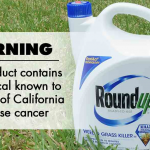 Reuters reports that “German chemical giant Bayer, after more than a year of talks, agreed to pay as much as $10.9 billion to settle close to 100,000 U.S. lawsuits claiming that its widely-used weedkiller Roundup caused cancer, resolving litigation that has pummeled the company’s share price.” The agreement says $9.5 billion will be paid to settle most of pending litigation, while $1.25 billion is earmarked for future claims as well as to research if Roundup causes cancer.The company says they will still sell Roundup
China has ways to go to buy US ag products
China has pledged to buy $36.5 billion worth of American agriculture products under the phase one deal, up from $24 billion in 2017, prior to the trade war.However to date China purchased only $4.65 billion in the first four months of the year, according to USDAThat amounts to13% of the goal set in the trade deal and almost 40% below the same period in 2017.
Trade war redux?
President Trump is considering higher tariffs on European imports over the aviation dispute.He also he may reimpose tariffs on aluminum imports from Canada later this weekcoming just before the North American trade deal goes into effect.
Hog prices not pretty
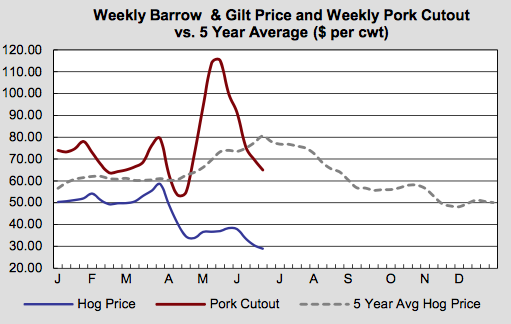
Iowa hog farms remain the epicenter for farm pain this summer as cash prices fall below $30 per cwt (see this USDA chart).That price is 62% lower than a year ago.Mid-summer 5 year average is about to $80. Iowa is the No. 1 hog state in the country, home to one third of the U.S. herd. The National Pork Producers Council says producers face a $5 billion loss from low hog prices and costs of killing hogs that back up on farms due to processing bottlenecks.
Farm Bureau estimates the value of corn, soybeans, beef, pork and other commodities will fall by $50 billion through 2021 nationwide,They are pushing congressional leaders to give the USDA access to $68 billion to address farm losses from the pandemic.
University economists estimate that Iowa farmers — corn, soybean, pork, beef and ethanol producers — will lose nearly $7 billion due to the coronavirus outbreak. The largest hits are to ethanol producers, estimated to lose $2.5 billion, and hog producers, shorted an estimated $2.1 billion.
Corn prices no fun either
“The biggest coronavirus impact will come this fall, when farmers harvest their crops, experts say. Prices for corn, soybeans, pigs and cattle are below the cost to produce them.
“Market prices for this year’s crop have fallen tremendously,” said Dermot Hayes, an Iowa State agricultural economist.
“It looks truly awful,” he said. “Everybody who has corn and soybeans in the ground right now is going to be damaged” if another round of assistance isn’t provided.
Corn prices fell about a dollar a bushel in northwest Iowa when three of five local ethanol plants temporarily closed, said Kelly Nieuwenhuis, a corn grower and Siouxland Energy Cooperative board member.”
“Corn prices haven’t recovered yet,” said Nieuwenhuis, even though biofuels plants are restarting. The manufacture of ethanol uses about half of Iowa’s corn crop annually.
Even with assistance, Hayes expects about half of Iowa farmers to post losses this year.
That will make the state’s economic recovery tougher. Iowa is the nation’s second-largest agricultural-producing state, after California, and racked up nearly $30 billion in farm sales in 2018. Iowa is a leading producer of corn, soybeans, pork, beef, turkey, eggs, milk, ethanol and biodiesel.
Some experts estimate farming drives about 25% of Iowa’s economy, when ag equipment manufacturing, seed production, food processing, crop insurance and other business activities are added.
Farmers already hit by trade losses
The coronavirus’ hit to agriculture comes as Iowa and U.S. farmers have struggled for five years with low prices. “We’ve had a perfect storm of financial devastation,” said Burrack, the northeast Iowa farmer.
Burrack notes that U.S. trade wars with China, Mexico and Canada that began two years ago pushed prices and profits lower. Then came a battle with the oil industry over waivers that cut demand for 4 billion gallons of ethanol, and finally, the global economic fallout from the coronavirus, which has depressed exports.
The Trump administration has already sent nearly $15 billion to U.S. farmers since 2018 to offset trade losses. Iowa farmers have received about $1.6 billion from those programs.
Broiler farms see low price too
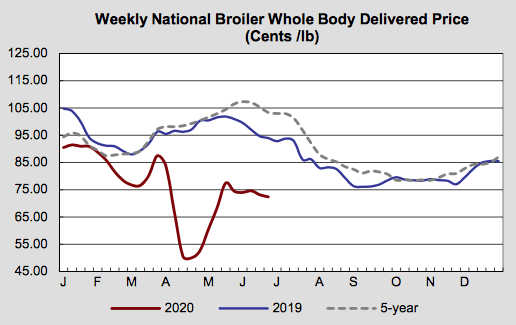
Chicken farms face lower prices this summer as well as other meats. Here is the latest USDA chart.
Avocado oil often rancid says UC study
Consumer demand is rising for all things avocado, including oil made from the fruit. Avocado oil is a great source of vitamins, minerals and the type of fats associated with reducing the risk of heart disease, stroke and diabetes. But according to new research from food science experts at the University of California, Davis, the vast majority of avocado oil sold in the U.S. is of poor quality, mislabeled or adulterated with other oils.
In the country’s first extensive study of commercial avocado oil quality and purity, UC Davis researchers report that at least 82 percent of test samples were either stale before expiration date or mixed with other oils. In three cases, bottles labeled as “pure” or “extra virgin” avocado oil contained near 100 percent soybean oil, an oil commonly used in processed foods that’s much less expensive to produce.
“I was surprised some of the samples didn’t contain any avocado oil,” said Selina Wang, Cooperative Extension specialist in the Department of Food Science and Technology, who led the study recently published in the journal Food Control. “Most people who buy avocado oil are interested in the health benefits, as well as the mild, fresh flavor, and are willing to pay more for the product. But because there are no standards to determine if an avocado oil is of the quality and purity advertised, no one is regulating false or misleading labels. These findings highlight the urgent need for standards to protect consumers and establish a level playing field to support the continuing growth of the avocado oil industry.”
Grapes can fight Alzheimer progression
A new study, published in the scientific journal Neurology found that a higher intake of plant compounds known as flavonols, is associated with a 48% decreased risk of developing Alzheimer dementia. Flavonols are a type of bioactive compound found in grapes, as well as other fruits and vegetables.
US maple syrup production higher
US maple syrup production increased in 2020 as both the number of taps and the yield per tap rose from 2019, the US Department of Agriculture said in its June 11 Crop Production report.
Maple syrup production was estimated at 4,372,000 gallons in 2020, up 4.6% from a revised 4,180,000 gallons in 2019 and the second highest on record after 4,385,000 gallons in 2017, the USDA said. The average price of maple syrup in 2019 was $31 per gallon, down $2.80 per gallon, or 8%, from $33.80 per gallon in 2019 and well below a record $40.70 per gallon recorded in 2008.
Sun-Maid offers new snack-pack
KINGSBURG, CALIF. — Sun-Maid Growers of California is introducing Sun-Maid Bites, a new snack made with ingredients including oats, nuts and fruit.
The bites feature a base of whole grain rolled oats, whole grain brown rice flour, brown rice syrup, chicory root fiber and green banana flour. All four flavors also include peanuts and California raisins.