
Labor issue is tops
August 23,2018-
The California Strawberry Commission reports California strawberry acreage for 2018 continues the trend of increasing fruit production on decreasing planted acreage. Over the past three years, planted acreage has declined by 13% while total volume has increased by 6%, resulting in two consecutive years of record fruit production.
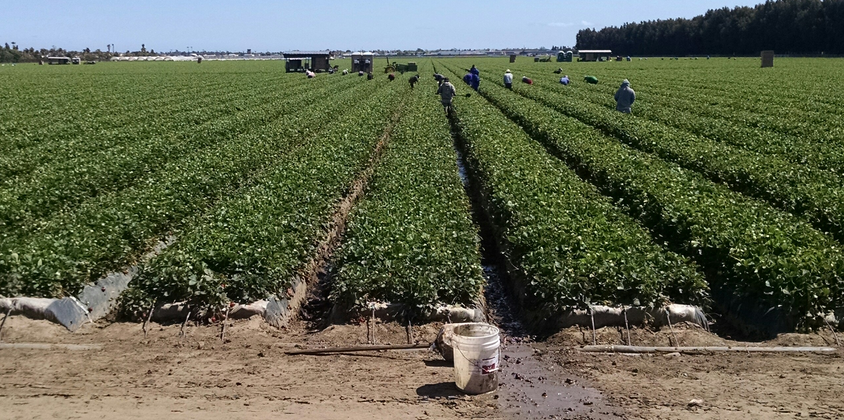 In 2018, reported acreage continues the shift to the highest yielding varieties. With optimum weather, weekly shipment volume in summer and fall months is projected to equal or surpass 2017 totals. Total California strawberry acreage reported for 2018 is 33,838, with organic acreage maintaining a proportional share at 12.6.
While other berries Americans eat are increasingly coming from other countries . strawberry production from California remains top dog by far.
California strawberry production increased to 134 mil flats so far this year compared to 123 mil this time last year. The Santa Maria region grew over 50 mil trays vs 48 mil this time last year
Other berries
Meanwhile California blueberry production is down from 2017 when it was 9.4 million flats to 7 million flats so far this year. Chile remains the top producer to the US with imports of over 32 million flats through mid August.Mexico produced about 14 mil flats this year through mid August.
How about raspberries Mexico produces nearly double what California produces .California acreage has dropped from a peak of 10,000 acres to 6000 acres this year. Production of California raspberries has dropped to 15 million flats to date in 2018 compared to 17 million flats for the same period in 2017 according to the National Berry Report.
As for blackberries Mexico is to producer with 27 mil flats compared to 4.2 mil grown in California.
Labor appears to the big issue when they decide where to plant berries.
According to Migration News Raspberries are more labor intensive than strawberries, requiring up to five workers per acre to harvest them every or every other day.Raspberries that are planted in substrate in pots, usually sterilized coconut shells, generate high yields over their typical four to five harvests and make picking easier for older workers. Half of variable production costs for producing strawberries, and 65 percent of raspberry production costs, are labor cost.
Rising labor costs are an obstacle to using California’s ideal climate for summer berries. Mexico stops producing in the summer months due to high temperatures and rain.
Robotic strawberry harvesters may be used commercially within five years. Blueberries and blackberries are believed to have the greatest potential for growth, in part because machines are available to harvest both of these cane berries, and higher wages could spread mechanization.
Most strawberry growers do not provide housing or transportation and generally hire US pickers directly rather than through labor contractors. Workers wheel a small cart containing eight one-pound clamshells or 12 pints ahead of them, picking from two adjacent rows, and then put full trays on a slow-moving conveyor belt that travels ahead of the crew of 50-60 pickers.
Piece rates in the Oxnard area in June 2016 ranged from $1.65 to $1.95 a tray, with the prevailing rate found to be $1.65 a tray. At these piece-rate wages, strawberry picker earnings averaged $15 to $20 an hour, suggesting that pickers were averaging 12 or more trays an hour. Job orders for H-2A strawberry pickers often specify a minimum productivity standard of five trays an hour.