
March 1,2016-
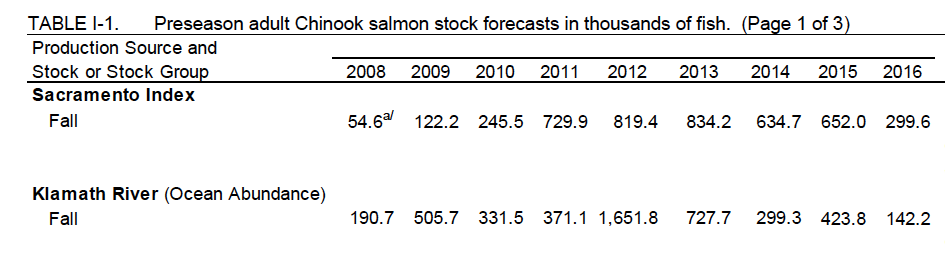
Estimates of the salmon abundance at sea off the California coast in 2016 are less than half the number of fish estimated in 2015 says the Pacific Fisheries Management Council. The salmon stock forecast is 299,600 compared to 652,000 in 2105, the lowest number since 2010. The Klamath index is even lower than 2008. The estimate will likely result in fishing restrictions this year and prompt calls for more Sacramento River water to benefit salmon.
 The PFMC offered this summary of what is expected to be a poor salmon fishing season, perhaps worse than estimated they suggest.
“The abundance of most coho stocks, as well as southern fall Chinook stocks (Sacramento and Klamath), came in well below preseason forecasts in 2015. This pattern of over-predicting abundance for many stocks also occurred during the strong El Niño events of 1982-1983 and 1997-1998. We are currently experiencing another very strong El Niño that in some ways is comparable to those well-described events. Sea surface temperature anomalies indicate exceptionally warm conditions over much of the northeast Pacific over the past two years. In their State of the California Current report for 2016, the California Current Ecosystem Assessment team described several phenomena that can be viewed as unfavorable to salmon. These include low biomass of northern copepods, low biomass of forage fishes such as sardines and anchovies, and recent large-scale mortality events for common murres, California sea lions, and other marine mammals. While local scale ocean conditions may affect individual salmon stocks differently, these large scale indicators suggest relatively unproductive conditions in the California Current. Given the incidence of over-forecasting abundance for many stocks in 2015, and the apparent continuation of unproductive ocean conditions, the STT is concerned that abundance forecasts presented in this report may prove to be optimistic.”
Besides ocean conditions the PFMC pointed to the drought as a compounding problem.
“There are several indicators suggesting that the 2014 and 2015 broods of Sacramento River winter Chinook (SRWC) have very low abundance. Largely due to drought conditions, the estimated egg-to-fry survival rates for the natural-origin component of these broods were the two lowest ever observed.”