
December 21,2015
Congress passed and the President signed important tax breaks for the renewable power industry the week before Christmas that should boost the pace of Central California solar,wind and biofuel projects and add thousands of jobs well after the tinsel comes down.
In the same legislative package – Congress abolished what was a 40-year ban on oil exports as the GOP and Democrats did a bit of old fashion horse trading. This should also be a boost to the ailing Valley oil industry who has lately been shedding jobs locally.
Solar
 The renewable energy incentives include a 5-year solar investment tax credit (ITC) extension ,a 30% federal tax credit that has helped thousands of Californians pay for their rooftop solar system.In the Central Valley there has been a rooftop solar boom with a three-fold increase in the past two years.According to Construction Monitor residential solar systems installed in the Central Valley including Fresno,Kings, Madera and Tulare Counties adds up to 11,717 homes so far this year at $119 million.That compares to 3843 homes for $46 million in 2013. Utility-scale commercial solar projects in the same region were 81 in 2013 adding up to $112 million but this year they number 213 projects and add up to $145 million.
Now look for the trend to continue.
The Solar Energy Industries Association released a statement saying “Thanks to the ITC, solar energy will add 220,000 new jobs by 2020, and with this extension, the solar industry can achieve its pledge of employing 50,000 veterans. Clean solar energy will cut emissions by 100 million metric tons and replace dozens of dirty power plants. Importantly, in the follow up to the Paris accord, this establishes the United States as a model for the reduction of greenhouse gases.
“A five-year extension of the ITC will lead to more than $133 billion in new, private sector investment in the U.S. economy by 2020. And much of this growth will come from small businesses, which make up more than 85 percent of America’s 8,000 solar companies.
“Solar power in this nation will more than triple by 2020, hitting 100 gigawatts. That’s enough to power 20 million homes and represents 3.5 percent of U.S. electricity generation.
Wind
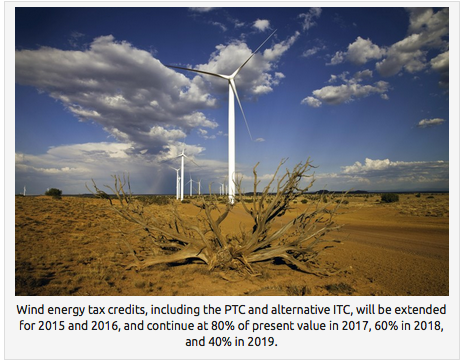 Unlike solar – wind energy tax credits had expired at the end of 2014 until last weeks’s vote after uncertainty slowed new projects.
“We’re going to keep this American wind-power success story going,” said Tom Kiernan, CEO of the American Wind Energy Association (AWEA). Kiernan said the agreement will give the industry a break from the boom and bust cycles that have caused serious disruption in the market in the past.
As a result, the wind energy PTC and alternative ITC will now be extended for 2015 and 2016, and continue at 80% of present value in 2017, 60% in 2018, and 40% in 2019. As before, the rules will allow wind projects to qualify so long as they start construction before the end of the period.
The performance-based PTC has helped more than quadruple wind power in the U.S. since 2008 – up from 16,702 megawatts (MW) installed at the start of 2008 to 69,470 MW by the third quarter of 2015. This is enough power to supply over 18 million American homes.
It has encouraged research and development, construction of factories in the U.S. and maximum productivity, helping reduce the cost of American wind power by 66 percent in six years. Iowa, South Dakota, and Kansas all now rely on wind for more than 20 percent of their electricity; nine other states are over 10 percent. The recent “Wind Vision” report by the U.S. Department of Energy says America as a whole is on track to get 20 percent of its electricity from wind by 2030.
Today’s 73,000 jobs in wind energy can grow to 380,000 jobs by then, DOE projected.
Kern County’s Tehachapi area is California’s largest wind energy production site with 3236 MW installed and 4731 turbines in place.
Wind energy could easily and cost-effectively contribute 20% of California’s electricity supply by 2030 say advocates.
Biofuel
Efforts to wean US drivers from greenhouse producing petroleum-based fuel will get a boost as well as the package included a retroactive extension through next year of a $1/gal blenders tax credit for biodiesel and a $1.01/gal production tax credit for cellulosic biofuels. Those credits had expired at the end of 2014. This will encourage both biodiesel and cellulosic ethnaol production.
Both fuels get a state of California incentive as well from the ARB’s Low Carbon Fuel Standard(LCFS) that kicks in as of 2016.California has legislated a significant increase in the use of sustainable biofuels, with a large share likely to be imported from out of state. Biomass provides liquid transportation fuels (4 billion gallons of renewable diesel or gasoline in 2030) or biogas (over 50% of natural gas demand is supplied with biogas by 2030.
Already the Central Valley has several advanced biofuel production facilities including Pacific Ethanol’s Stockton plant now making cellulosic ethnaol for the first time with the help of of Edeniq of Visalia. Pacific Ethanol plans to do the same at their Madera plant. In the past few weeks a new biodiesel plant began operation in western Fresno County.
Central Valley Favored
 In a related matter the CPUC regulatory staff rejected las week requests by utilities to increase fees and cut payments for rooftop solar customers.
“Combined with the historic Paris climate agreement, long-term certainty for the ITC sends a strong signal to the marketplace that investment in clean energy is the right way to drive continued economic growth and job creation,” SolarCity CEO Lyndon Rive said in an e-mailed statement.
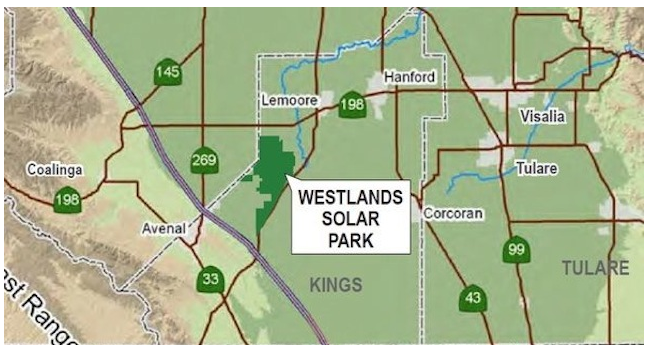
Another key measure that is likely to favor more large Central Valley solar farms is the effort by the CPUC, CEC and CAISO to implement a new policy on the placement of transmission facilities in the state.Through the Central Valley Solar Project initiative – the state‘s key power development agencies are expected to favor the Central Valley’s westside to help meet the new 50% portfolio goal for renewable energy generation through the electric utilities.The policy would direct developers for solar farms to utilize the dry,spent farmland in places like the Westlands Water District where a record high 206,000 acres of agricultural land was fallowed in 2014. This area is favored by environmental and wildlife interests who want to see fewer pristine lands in the desert used for this purpose.Already there are perhaps 20 large solar projects expected to be built in the next few years in Kern, Kings, Tulare and Fresno Counties offering construction jobs to residents idled de to the drought.
–