
– But Fears Persist For New Year –
November 19,2014 –
Concerns that a lack of surface water for Central Valley farmers this summer would lead to a massive bulldozing of dead citrus trees and a huge hit on the local economy did not come to pass after all.
Widely quoted remarks from June that as much as 50,000 acres of Valley citrus could be lost due to lack of state and federal water deliveries from the Exeter trade group California Citrus Mutual (CCM) thankfully were wrong.
“California Citrus Mutual estimates 50,000 acres of citrus will be dozed due to the drought. The result will be a 3-billion dollar hit to the state’s economy” –June 2014 Valley news reports
Contacted this week Citrus Mutual VP Bob Blakely says their current estimate is that about 6,000 acres of citrus trees were pulled over the past 5 to 6 months.
“Our original 50,000 acre number related to citrus trees at risk” he says.
A 50,000 acre loss would of course had a major impact considering SJV navel orange bearing acreage stands at about 126,000 acres as of 2014/15 says USDA. Navels are by far the largest citrus variety.
Blakely says a large portion of those 6000 acres of trees removed were the Valencia variety – on the decline for the past few years. In the past, removal of these trees was based on lack of popularity and profitability – not water. By location, citrus trees were pulled this summer from hard pressed areas like Terra Bella where there was no groundwater available as an alternative.
Emergency water trades, deeper wells and water purchases helped save the day up and down the east side.
Asked if the state’ number one grower Paramount Citrus pulled trees Blakely said he understands they did. Paramount removed whole blocks of trees in southern Tulare County according to reliable sources.
Tulare County is the state’s number one citrus producing county. By the last count in 2013 the county had around 76,000 acres of navels, 17,000 acres of Valencias, 7000 acres of lemons and 14,000 acres of tangerines for a total of around 116,000 bearing acres. That does not include the young trees – over 2000 acres not yet in production.
Blakely says the new citrus crop is now about a month into the picking season and the fruit is slightly smaller than normal but high quality. ”It is moving well and there is good demand.”
USDA has forecast a California navel crop of 78 million cartons this winter – down from 81 million cartons in 2013, a small decline in expected volume based on those earlier fears of a calamity.
But that calamity still could happen.
Asked about the estimate in September CCM’s president Joel Nelsen released a statement.
“After canvassing a significant number of producers and shippers, CCM believe the crop estimate is high,” CCM President Joel Nelsen said in a statement issued Sept. 11. “We know acreage has been removed from production” due to the drought, “but getting figures for a range has been difficult. We know the lack of water has affected fruit size during the growths stages, but surveying 126,000 acres is almost impossible. We also agree there is more fruit on the tree as compared to last year” in terms of the number of pieces of fruit. “However fruit size is a concern. All of this affects the number of cartons ultimately packed.”
At the time of the 50,000 acre estimate in June – CCM was part of an organized effort to shine a light on state and federal policy they said played a big role in the zero allocation of surface water this year. For the first time ever the Friant Kern Canal that feeds the east side of the valley did not deliver water from Friant Dam. Water contractors have sued the state over the state role in the decision.
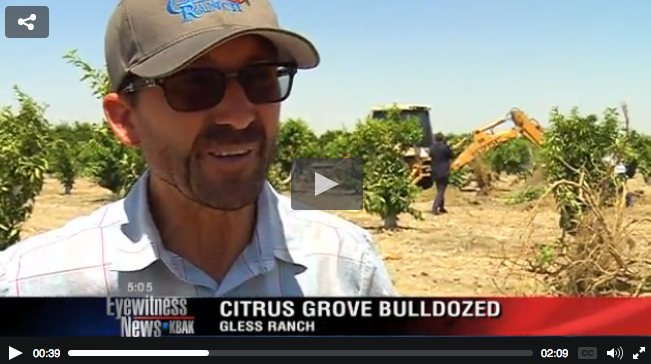
CCM’s media campaign included a news conference hosted by them at a ranch of a Kern County grower who was removing 60 acres of Valencia trees which he said could not last through the summer without water. TV cameras were rolling as the trees were bulldozed. A Bakersfield news report added “California Citrus Mutual will spend the summer highlighting the catastrophe with press conferences in hot, dusty citrus groves. This will illustrate for local and national media the failure of California and federal water policy.”
Nursery Backlog
Contacted this week the Kern farmer – John Gless says he plans to plant the open 60 acres with Cara Cara oranges, a popular variety but has to wait because “there is a 2 year backlog on orders from the nurseries.”
Supply of citrus nurseries was hit last winter as the freeze killed thousands of young trees both affiliated with nurseries and in farmer’s fields. Now nurseries face quarantines measures and a requirement to grow young trees under screen to protect them from the ACP (psyllid)
pest.
Exeter nurseryman Roger Smith of TreeSource says “growers are now facing a new reality like the walnut growers have had to do for a while now.Order well in advance.” Smith says trees to be planted in 2015 are sold out and” early next year will be sold out for 2016.”
“That said, even if we planted them tomorrow betting we will have water, it takes five years to produce fruit”John Gless adds.
Gless says the family-owned enterprise could only survive this past year because they were able to purchase water “at an exorbitant price”- some at 10Xs the price at $1250 per acre ft.
”We leased land to get water rights and drilled new wells – some down to 2000 ft. Otherwise,we would not have made it.”
“If we don’t have an extremely wet winter I don’t know how we survive.”