
November 5,2014-
Another Psyllid Find In Farmersville: Tulare County Ag Commissioner Marilyn Kinoshita says several more Asian citrus psyllids were found in a Farmersville backyard in late October even after a foliar spray was applied nearby. ”Looks like we have resident population of the pest in Dinuba, Tulare and Farmersville” she says. About a month ago the CDFA expanded the quarantine zone to the entire county after more ACP were found. All of Tulare County was placed under quarantine for the Asian citrus psyllid (ACP) following the detection of two psyllids in the City of Tulare. The first ACP was detected in a trap in a residential neighborhood on September 10, in the City of Tulare. The second detection was on September 17, also in a residential setting within the City of Tulare. These detections, when added to previous detections elsewhere in the county, dictate that a countywide quarantine is the most effective response to contain the pest. The quarantine prohibits the movement of host nursery stock out of the quarantine area and requires that all citrus fruit be either cleaned of leaves and stems or treated in a manner to eliminate ACP prior to moving out of the quarantine area.
Popular Farm Chemical Will Be Phased Out
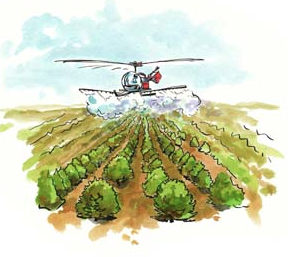 Insect spray Chlorpyrifos will be phased out by EPA says Tulare County Ag Commissioner Marilyn Kinoshita likely by Spring when growers use the material. Made by Dow Chemical,Chlorpyrifos is considered moderately toxic to humans, and exposure has been linked to neurological effects, persistent developmental disorders, and autoimmune disorders. Exposure during pregnancy retards the mental development of children, and most use in homes has been banned since 2001 in the U.S. In agriculture, it remains “one of the most widely used organophosphate insecticides”, according to the EPA. The pesticide is sprayed on 60 different crops including alfalfa, walnuts, oranges and cotton. Up to 2 million pounds each year are sprayed in California. In the Sierra scientists have found Chlorpyrifos in lakes in Sequoia Park, apparently carried by air currents, when they have been studying frog survival there.Monitoring data show some chlorpyrifos detections in air and water contamination in agricultural areas of California. In another move the California Department of Pesticide Regulations wants to make the active ingredient Chlorpyrifos a restricted use pesticide and has opened up a 45-day public comment period on the proposal ending this month. However the EPA action could supersede this.
Citrus Faces Rose Beetle Issue:

Farmers packing citrus this fall are concerned with a pest that could be a problem for exports if found in packed fruit.The Fuller Rose Beetle does not generally cause economic damage in citrus but the presence of viable eggs on fruit exported to other countries such as Korea can be a quarantine concern. Ag Commissioner Marilyn Kinoshita says the pest lays their eggs under the stem cap. Concern is that up to 20% of lots could be rejected. ”We are increasing our inspections. “
Fuller rose beetle adults feed along the margins of citrus leaves, creating notches and leaving a characteristic sharp, ragged appearance.
Drought Layoffs: The Tulare County Workforce Investment Board reports that 264 employees have been laid off or have had their work hours reduced due to drought since March, 2014 .
Saving Water: California’s ongoing drought has made it even more critical for growers to get the most crop per drop of water used. Scientists from UC Division of Agriculture and Natural Resources and UC Davis were honored by USDA for their years of research to help farmers better use microirrigation systems to sustainably irrigate their land.
Patrick Brown, professor in the Department of Plant Sciences at UC Davis, Jan Hopmans, professor in the Department of Land, Air and Water Resources at UC Davis, Larry Schwankl, UC Cooperative Extension specialist emeritus, and Ken Shackel, professor in the Department of Plant Sciences at UC Davis, are the UC researchers participating in the project “Microirrigation for Sustainable Water Use.” Using more precise irrigation management, California growers have increased water use efficiency on processing tomatoes by 54 percent and on almonds by 33 percent since 1990.
Conventional irrigation systems that apply high volumes of water over wide areas can lose a lot of water through runoff, wind, or evaporation. As a result, conventional irrigation systems often over water or under water plants. Instead, microirrigation, or drip, systems use special timers, sensors, and a network of narrow tubes to deliver the right amount of water at the right time.
Weather problems affect nut crops: As nut growers near the end of their harvests, many say their crops may not reach preseason estimates. Almond and pistachio growers say a combination of drought and warm winter weather conspired to reduce harvests in many orchards. Some trees were removed or abandoned due to water shortages. Farmers and marketers say harvests of almonds, pistachios and walnuts will still be large, as nut producers work to fulfill increasing worldwide demand.
Milk Prices Down: The California Department of Food and Agriculture announced the October 4b cheese milk price this week at $20.94 per hundredweight, down $1.45 from September but $4.12 above October 2013. That pulls the 2014 4b average to $20.57, up from $16.17 at this time a year ago and $15.16 in 2012.
The 4a butter-powder milk price is $21.51, down $1.21from September but $1.51 above a year ago. The 4a average is now at $22.93, up from $18.44 a year ago and $15.18 in 2012. On the commodity market butter has dropped from $3/ lb to around $2/lb in a month – after the Christmas orders for butter were filed.
U.S. may produce more pork than beef
It hasn’t happened since the 1950s, but pork production may surpass beef production in the United States next year. Drought across many cattle-producing regions has forced ranchers to reduce herds, and it may take several years after rain resumes for herds to be rebuilt. An American Farm Bureau analyst says competition from increased pork and chicken production could help moderate retail beef prices.