
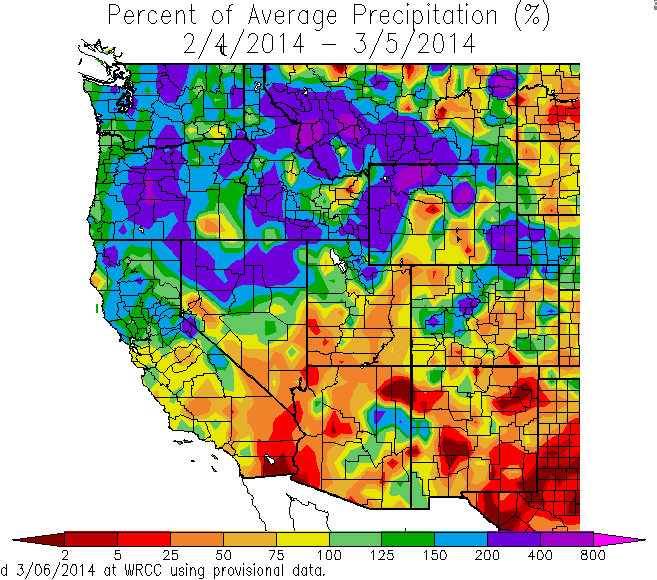
Shasta Reservoir saw over 20 inches of rain in the past month compared to about 5 inches all winter through January. Tahoe ski resorts enjoyed 3 to 5ft of snow in the past week. All this is the first good news of this extraordinarily dry winter for the state as northern California experienced above average rain during February after almost none before. Even parts of the parched Central Coast got above 100% of average for the month with Santa Barbara mountains receiving up to 8 inches this past week . SB city’s Gibraltar Dam went from just 8% of normal rainfall to over 51% of normal.
It appears this is the new normal that when we get rain – we get a big gulp and we had better ready to capture it.
The culprit behind this drought appears to be a stubborn high pressure ridge notes an article in the most recent Friant Water News.
“How big is it? National Weather Service meteorologists have described the high pressure ridge as being four miles high and, at times, some 2,000 miles long, acting like a wall in bouncing Pacific storms toward Oregon, Washington, British Columbia and Alaska. That immense region has been drenched by rain and coated thickly with mountain snow while California has been mostly warm and dry. The ridge has broken down briefly only a few times, and for very short periods, since December 2012, most recently as February came to an end. With the storm door opened, welcomed storms began spreading much-needed wetness across California February 26. A forecaster with the National Weather Service in Monterey told the San Jose Mercury News that the high pressure ridge has been “like the Sierra – a mountain range just sitting off the West Coast – only bigger.”
But finally 10 days of storms have entered California driving up hope the feds and the state might up water allocations promised to farms and communities that now stand as low as zero.
“We are aware of the storms” says Bureau of Reclamation spokesman Louis Moore.” We are still looking at the data and within a couple of weeks we should be making an announcement”. But” right now we’re not there yet.”
Friant GM Ron Jacobsma says if some of that water flowing down the Sacramento River to the ocean could be pumped to San Luis Reservoir, it could be used to supplement a 40% allocation to the Exchange Contractors who will take Friant’s water otherwise. That leaves farmers in Tulare County and elsewhere with no canal water this spring or summer.
But there are water quality issues that have any talk of more pumping on hold says Jacobsma. The state Water Quality Control Board will have to loosen water standards to allow water to be pumped south.
This is where the feds,state and water board appear to be trying to come up with a plan and soon. The issue is important for all water users south of the Delta.
Last week at a water hearing the dilemma was spotlighted.
“As we speak this very moment there’s 25,000 (cubic feet per second) flowing as outflow out to the ocean. At the same time, we’re pumping 4,400 cfs,” said Dan Nelson, head of the San Luis & Delta-Mendota Water Authority, at a drought meeting held at U.C. Merced yesterday, as reported by Stockton Record writer Alex Brietler.
San Luis Reservoir
“I ask you,” Nelson said, addressing State Water Resources Control Board Chair Felicia Marcus, “is this the balance that you anticipated? Is this the balance that you’re working for? I don’t think so. We knew this storm was going to happen last week. Why didn’t we prepare for it?”
Marcus responded that the state board is waiting for an emergency request from the state and federal water projects, which could alter how much water can be pumped south.
“My understanding is they’re talking about it,” she said. “We can’t do it on our own.”
But the spike in flows will probably last only another four or five days, Nelson countered. “While we set up forums to talk about it, water’s flowing to the ocean.”
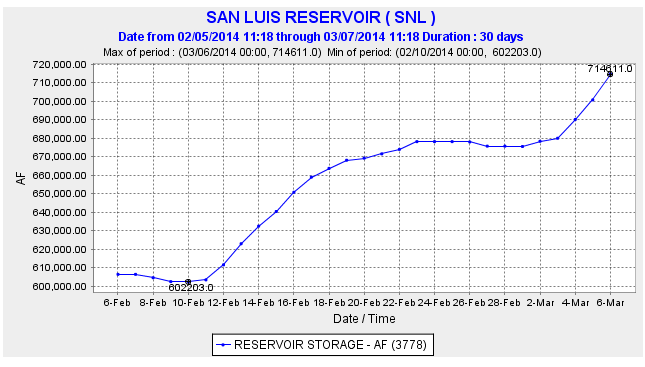 Its not clear if the message has been received but without any announcement San Luis Reservoir, south of the Delta,has gained about 25,000 acre ft in the past few days and over 100,000 acre feet in the past month.
The issue of how much water flowing through the Delta ought to be used beneficially is much debated. The 2005 ”Water Fact Book” published by the California Farm Water Coalition states that in an average year 26 million acre ft pass through the Delta with some 70% flowing out to San Francisco Bay.
Friant Water adds the weather outlook for Fall may be better.
“There is growing hope among meteorologists that conditions may improve when the 2014-15 water year begins in October. Sea surface temperatures in the tropical Pacific are showing signs of possible development of an El Niño weather pattern beginning during the summer and continuing into the fall. In such a pattern, warmer than average sea surface temperatures often (but do not always) result in heavier than normal precipitation in much of California, a change that would be welcomed after three consecutive drought years.”
Meanwhile don’t give up on March that has started out well but now looks kind of dry until mid-month and then perhaps cold and snowy.
Also lawmakers are not letting this drought go to waste with a flurry of dam proposals in California surfacing in Washington and the likelihood of a state Water Bond on the November ballot in California.