
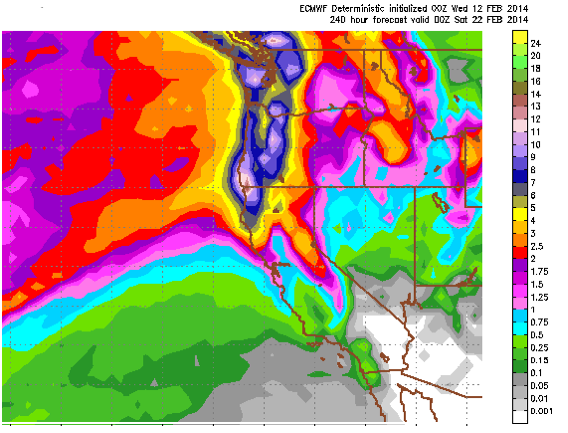
This last week as much as 10 inches of precipitation fell in the Sacramento Valley area and northern California. It was the most this winter in another year of extremely low rainfall totals.
Now there is some hope that more rain in the north could spell relief for south Valley farmers facing possible zero allocation from the big Friant project that irrigates a million acres of farm land from Madera to Kern County.
“It’s possible if it keeps raining there will be enough water to deliver at least some of the contracted supplies to the Exchange Contractors and free up our water stored in Millerton“says Paul Hendrix, general manager at one of the Friant districts – Tulare Irrigation District (TID).
The so-called Exchange Contractors based in the Los Banos area – gave up their right to San Joaquin River (Millerton) water as long as the federal Bureau of Reclamation can deliver water they historically received from the San Joaquin with water from north of the Delta.
High & Dry?
Their water right preceded the construction of Friant Dam. Until the latest storms that was looking tough to accomplish and there are real concerns the Exchange Contractors would make a call for Millerton water this year, for the first time ever, leaving farms in Tulare County and elsewhere along the 152 mile Friant Kern Canal high and dry.
Hendrix says even if TID gets some of their Class 1 contract this year it likely with an agreement in place with Lindsay Strathmore Irrigation District (LSID),that this district will make a call on it since they are in worse shape than many districts. LSID needs water for both crops and people and have little groundwater. They trade water in a wet year for dry years like this.
That would make 2014 the second year in a row TID did not have an irrigation run for their farmers. Hendrix says the district’s groundwater levels have been going down 20 feet a year for the past two years and “could go down more than that this year.”
The US Bureau of Reclamation is expected to make an announcement in late February how it will manage the needs of both the Exchange Contractors and the Friant water interests.
The Valley’s westside farmers appear to be in worse shape scrambling to get water wherever they can.One big farmer – John Harris recently bid $1,350 per acre/ft for water from a Buttonwillow district who will fallow land this year. Most of it was bought be Paramount Farms, who bid $1100 per acre ft to buy 10,000 acre/ft for a cost of $11 million. These high spot market water prices compare to $30 to $50 per acre/feet for eastside contracted water.
Still,between more rain and a new state policy to save water in the system rather than let it go out to sea – may mean thousands of acre feet of additional water this Spring.
10 Day Forecast
On the rain front there is some hope. While the southern part of the state is looking at mostly sunny skies over the next 10 days the 10 day forecast for Redding California, next to Shasta Lake – calls for rain over 7 of the next 10 days. Shasta reservoir gained nearly 7 in of rain since the beginning of this month and the reservoir height has increased about a foot over that time, the first time this winter it has gone up instead of down..
At Folsom near Sacramento, storage has gone from 32% of average to 52% since the first of the month. At Blue Canyon on the American they have received 13 inches of rain this month.
Meanwhile the rain and snow falling in the upper San Joaquin watershed has been more modest at 2 to 3 inches so far this month.
Still, for the north part of the state it looks promising. Weather caster John Lindsey writes todays that “A series of weather systems with plenty of subtropical moisture will move through Northern California and bring rain as far south as Big Sur over the next few days.”
Saving Water in Reservoirs
On the regulatory front as of January 31 the Department of Water Resources and the federal Bureau of Reclamation requested a change to water quality requirements that govern outflows in the
Delta and operation of the Delta Cross Channel gates. These requirements, in place since 1995, help control salinity in the Delta and protect water quality for municipal and industrial, agricultural, and fish and wildlife uses.
The State Water Board’s order approving the petition makes temporary urgency changes in the required amount of outflows into the Delta, enabling water to be conserved in reservoirs in case of continued drought.
The petition submitted to the Water Board also requests flexible operation of the Delta Cross Channel gates, which will enable greater protection against salt water intrusion to the interior portion of the delta while protecting fish populations. These gates typically remain closed during the late winter and spring, which protects fish from straying into the central Delta. However, due to low water flows, keeping gates closed prevents high quality fresh water to flow through the central Delta, reducing saltwater intrusion. The State Water Board’s order approving the petition provides flexibility to operate the gates based on evolving water quality conditions and fish migration information.
As a result of the order, the state and federal water projects will save approximately 150,000 acre feet of water in upstream reservoirs in February. The saved water will be available later in the year for uses in the public interest. If dry conditions persist, and this order is amended, an additional 150,000 acre feet of water will be preserved in March and an even greater amount in April.”