


California is growing.There are more cars being sold and an uptick in freight movement too.But that does not mean traditional petroleum fuels are enjoying more demand. Far from it. There is lots of gasoline available in the state even as the oil industry advises there is a coming boom in shale oil production here, rivaling what is happening in North Dakota. What will a huge supply of product do to already weakening prices?
Oil Heads Down
They are already heading down.Oil this week is under $94 dollars a barrel and California-grown heavy oil from the state’s largest field in Kern County – Midway Sunset – is the lowest price in several years – today $92.58.That is nearly $20 lower than September’s price.
Across the US we are producing millions of barrels of new oil even as we use less in our everyday life. To get rid of it – the industry increasingly exports product.
Why should you be cheering for lower oil prices? An economist at Moody’s Economy.com has stated that every $1 decline in the price of oil saves U.S. consumers $1 billion.
Helping to drive consumption down, higher demand from an improving economy is more than offset by improved efficiencies. In vehicles for example the government’s Energy Information Agency(EIA) says fuel efficiency increased nearly 2% in the first half of of 2013.
For gasoline suppliers the result is lower demand in California where higher fuels costs compared to the rest to the nation are legendary.
Last month the state Board of Equalization reported that Californians consumed 3.68 billion gallons of gasoline in the second quarter, a 0.2 percent decline from 3.69 billion gallons used in the second quarter of last year. The average price of gasoline was $4.04 per gallon in California during the second quarter, and nationally the average price of gasoline was $3.67.
Today some stations in California are selling regular for $3.24. EIA say the average price in California this week (Nov 4) is $3.61 compared to $3.94 this week last year.
Clunkers Bit The Dust
Compared to 2008 – Californians are using about 5% less gasoline than we did then. DMV reports that the number of total vehicles registered in the state fell from 33.5 million in 2008 to 31.3 million in 2013. Translated, some 2 million plus clunkers bit the dust.
Consumers facing years of high gasoline costs have figured out way to cut their use. Here are some things they have done. As more alternative products have become available in recent years California motorists are eager to give them a try.
Tesla In,Hummers Out
Like buying hybrid cars that are less dependent on gasoline to operate. About 585,000 hybrid vehicles were registered in the state in January 2013 – up from 218,000 hybrid vehicles registered in 2008.
Some buyers are switching to electric cars,although more slowly. In a bid to spur electric car sales eight states including our own are pushing to increase EV sales to 3.3 million by 2025 by forming partnerships to build recharging infrastructure across the states. The government backed effort aims to stem emissions that are implicated in global warming largely caused by fossil fuels.
Meanwhile the darling of the California economic rebound is an electric car – Tesla – made in the Bay Area and a new favorite both on Wall Street and with the well healed buyer. Our California dream car has changed from the Hummer to a Tesla!
Also there is a change in the fuel mix that is reducing the amount of traditional gasoline sold. That includes renewable ethanol made largely from corn that has displaced 10% of the US gasoline volume and is moving to a 15% blend including California.Last year, ethanol displaced an amount equivalent to the gasoline refined from 462 million barrels of imported crude oil say advocates helping to make real the idea of energy independence.
The fuel mix is changing for diesel as well.Today California blends petroleum diesel with 5% renewable biodiesel that reduces emissions and harmful particulates.
Then there is the natural gas revolution hailed by politicians,industry and Wall Street investors. Again its not good news for traditional gas stations.
A recent NYTimes article points to the advantages of converting more vehicles to this lower emission fuel. ”According to Energy Department price information from July, natural gas offers economic advantages over gasoline and diesel fuels. If a gasoline-engine vehicle can take you 40 miles on one gallon, the same vehicle running on compressed natural gas can do it for about $1.50 less at today’s prices. To that savings add lower maintenance costs. A study of New York City cabs running on natural gas found that oil changes need not be as frequent because of the clean burn of the fuel, and exhaust-system parts last longer because natural gas is less corrosive than other fuels.”
The Nat Gas Vehicle Assn adds:
-There are about 135,000 NGVs on U.S. roads today and more than 15.2 million worldwide.
-There are about 1,300 NGV fueling stations in the U.S., and refueling appliances are available for home use.
-In the U.S., about 50 different manufacturers produce 100 models of light, medium, and heavy duty vehicles and engines.
-Natural gas currently costs from $1.50 to $2.00 less per gasoline gallon equivalent (GGE).
While some large vehicles and fleets are switching to natural gas -others like school districts are choosing propane – both cleaner and cheaper than diesel.
Even cleaner is the availability of biogas in the state now. Biogas derived mostly from waste material emits 90% less carbon emissions than diesel or gasoline, according to California Air Resource Board estimates, and requires less energy to extract and process. It also makes use of methane that would otherwise be released into the atmosphere. Facilities that capture the methane from waste material are being built in the state right now including several in the Central Valley.
Fleets can now fill their vehicles with fuel made from methane and other kinds of organic waste at 40 “gas” stations in California, thanks to Clean Energy Fuels Corp. (Nasdaq: CLNE).The company, which is backed by T. Boone Pickens, expects to sell 15 million gallons of “Redeem” this year in California and has plans for a nationwide network of 400 “gas” stations they say. Customers already include AT&T, Verizon, Mattel and Williams-Sonoma as well as large fleet operators like Hertz and SuperShuttle.
If some can now fuel up in all sorts of new ways these days other than gasoline – the increasing popularity and availability of mass transit provides another option – leave the car at home.
More efficient mass transit is helping to reduce clogged freeways in places like LA where for the first time you will be able to travel from Downtown LA to LAX by Metro, under construction now.
That prospect in turn, is changing LA’s sprawling land use patterns, encouraging more residential units along transit lines and reducing car commutes in the future.
No wonder gas prices are falling.
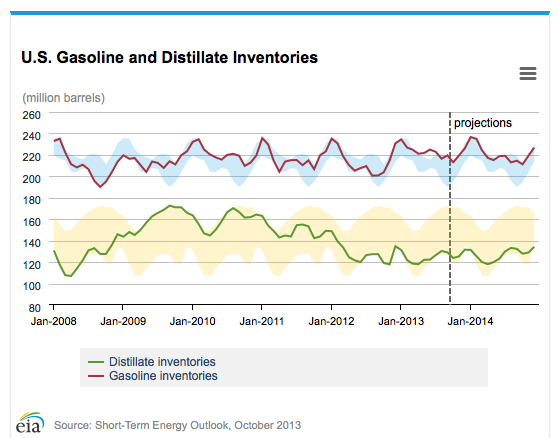 For the first half of 2013, EIA data show gasoline consumption lower than the comparable 2012 period by 50,000 barrels per day, or 0.6%, lower than in the comparable 2012 period. And supply is epected to grow as you can see from this EIA chart from the past few days.
Other Factors:
There are other factors helping to reduce gasoline prices right now. This is the low driving season,winter fuels are cheaper to produce and so far this year there have been no major Gulf storms to worry about.Add to that the relative stability of the Middle East and you see why some believe California motorists will be paying $3 a gallon for regular before Spring.
Low Carbon Push
The fight to stem the rising tide of global warming is a key factor in the state with the policy demanding the carbon intensity of our fuel be reduced. California’s low carbon fuel standard(LCFS) is now law surviving a court challenge. LCFS gives suppliers tradable credits when they reduce emissions during the production, transportation and use of the fuel. The law requires the oil industry to gradually reduce the “carbon intensity” of transportation fuels by at least 10% by 2020.
Why should you be cheering for lower oil prices? An economist at Moody’s Economy.com has stated that every $1 decline in the price of oil saves U.S. consumers $1 billion.