
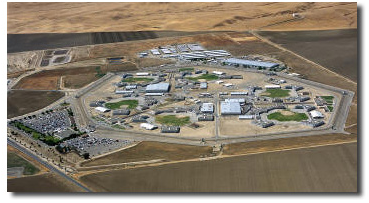
 Avenal city administrator Steve Sopp is playing down reports that a massive shift of state prisoners is underway because of recent Valley Fever finds.
The SF Chronicle reported recently that that some 3300 inmates at Avenal and Pleasant Valley would be transferred out at the direction d of J Clark Kelso,the court appointed receiver for the prison health services.
But Avenal warden C. Wofford told Sopp there was no big transfer in the works with Sopp calling it “a rumor.” He says the warden told him people at high risk for contracting the aliment would be moved but it would not likely be a large number.
Sopp says there are 4973 inmates at the state prison -down about 2000 from 3 years ago. The prison is major employer and tax payer for the small western Kings County town.
Valley Fever cases appear to be rising says the federal Center for Disease Control. In recent months 28 workers at a solar construction sites in eastern SLO county were said to be suffering from the fever probably impacted by flying dust.
The illness seems to hit African Americans and Philippine people the hardest as well as others with weakened immune systems.
Valley Fever, a fungal respiratory infection, dramatically increased in several southwestern states from 1998 through 2011, according to a new study by the Centers for Disease Control and Prevention. Cases in Arizona, California, Nevada, New Mexico and Utah rose from 2,265 in 1998 to more than 22,000 in 2011.
Valley Fever (Coccidioidomycosis) is caused by inhaling a fungus called Coccidioides, which lives in the soil in the southwestern United States. Not everyone who is exposed to the fungus gets sick, but those who do typically have flu-like symptoms that can last for weeks or months. More than 40 percent of patients who get ill from Valley Fever may require hospitalization at some point, with an average cost of nearly $50,000 per hospital visit. Previous studies have shown that, of those who get sick, nearly 75 percent miss work or school – for approximately two weeks.
“Valley Fever is causing real health problems for many people living in the southwestern United States,” said CDC Director Tom Frieden, M.D., M.P.H. “Because fungus particles spread through the air, it’s nearly impossible to completely avoid exposure to this fungus in these hardest-hit states. It’s important that people be aware of Valley Fever if they live in or have travelled to the southwest United States.”
This recent increase in Valley Fever could be related to changes in weather, which could impact where the fungus grows and how much of it is circulating; higher numbers of new residents; or changes in the way the disease is detected and reported to the states or CDC. More research is needed to understand why the number of reported cases of Valley Fever has increased. Between 1998 and 2011, Arizona and California had average increases in Valley Fever incidence of 16 and 13 percent per year, respectively. The CDC has provided grants to these two states to study Valley Fever.
During this time period, nearly 112,000 cases of Valley Fever were reported from 28 states and Washington, D.C., but 66 percent of cases were in Arizona, 31 percent were in California, 1 percent were in Nevada, New Mexico, and Utah, and about 1 percent were in all other states combined.
“It’s difficult to say what’s causing the increase,” said Benjamin J. Park, M.D., chief epidemiologist with CDC’s Mycotic Diseases Branch. “This is a serious and costly disease and more research is needed on how to reduce its effects.”
Doctors and patients should know that the symptoms of Valley Fever are very similar to flu or pneumonia symptoms and a lab test is the only way to tell if an illness is Valley Fever or not. Not everyone who gets Valley Fever needs treatment, but for people at risk for the more severe forms of the disease, early diagnosis and treatment is important. The best way to treat Valley Fever still needs to be studied, especially with the number of cases continuing to rise.