The Department of Water Resources (DWR) today conducted the third snow survey of the season at Phillips Station. The manual survey recorded 28 inches of snow depth and a snow water equivalent of 11 inches, which is 47 percent of average for this location.
The Department of Water Resources (DWR) on Feb 27 conducted the third snow survey of the season at Phillips Station. The manual survey recorded 28 inches of snow depth and a snow water equivalent of 11 inches, which is 47 percent of average for this location. Statewide, the snowpack is 66 percent of average for this date.
Today’s snow survey results show an increase from last month’s measurements following a series of cold, major snow-producing storms that ended a five-week dry period. Unfortunately, the recent storms were not enough to get the state back to average conditions for this time of year. Warmer storms early this week also caused snow melt at lower elevations.
“Although the storms we saw in mid-February were some of the coldest and best snow-producing storms we have seen since 2023, they were not enough to get us back to average conditions,” said Andy Reising, Manager of DWR’s Snow Survey and Water Supply Forecasting Unit. “The snowpack is in better shape than it was one month ago, but we only have a month left of our snow-accumulation season and time is rapidly running out to catch up. Statewide, we are only about 57 percent of where we hope to be by April 1.”
Storms this season have also been unevenly distributed across the Sierra Nevada. While the Southern Sierra Nevada is 90 percent average for today’s date, the Northern Sierra Nevada, where several of the largest major water supply reservoirs are located, is only 46 percent normal for this date.
Tulare Basin is enjoying 111% of average precipitation. Pine Flat reservoir on the Kings River is 128% of average with nearly 600,000 acre feet stored March 1.
“Water supply in California increasingly depends on a small number of big storms,” said DWR Director Karla Nemeth. “We face higher drought risk when they don’t arrive and greater urgency to modernize infrastructure to capture water when they do. The dramatic wet-dry swings this winter remind us again that ever-warmer average temperatures have reshaped the California water cycle. We must adapt.”
Reservoirs at 122%
While the snowpack remains below average, major reservoirs statewide are currently 122 percent of average. State water managers, including the State Water Project, continue to focus on efforts to capture and store as much water as possible. The monthly snow surveys play a critical role in how the State Water Project allocates water each year.
High-Speed Rail completes Kings structure
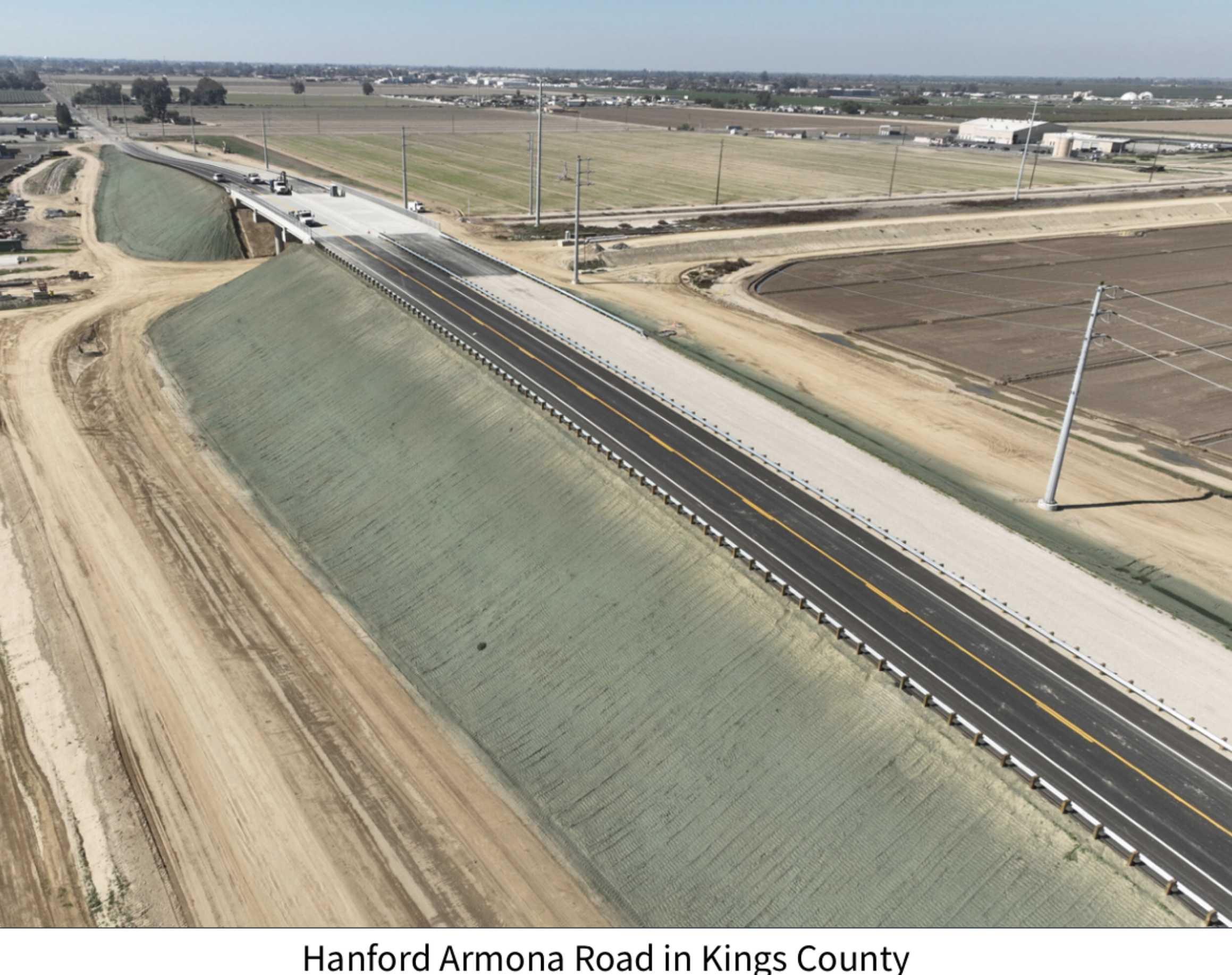
The California High-Speed Rail Authority announced late last year the completion of two more structures within the 119-miles of construction underway in the Central Valley. On October 30 the Authority announced the completion of the Avenue 17 Grade Separation project in Madera County. The next day, the Authority announced the completion of the Hanford Armona Road grade separation in Kings County. The completion of these two projects brings the total number of completed structures to nearly 60.
The Hanford Armona Road grade separation is located east of the city of Hanford between State Route 43 and 7th Avenue. The structure spans 209 feet, 80 feet wide, and will take east and westbound vehicular traffic over the future high-speed rail tracks. It is also located less than a mile south of the Hanford Viaduct, high-speed rail’s largest active construction project.