
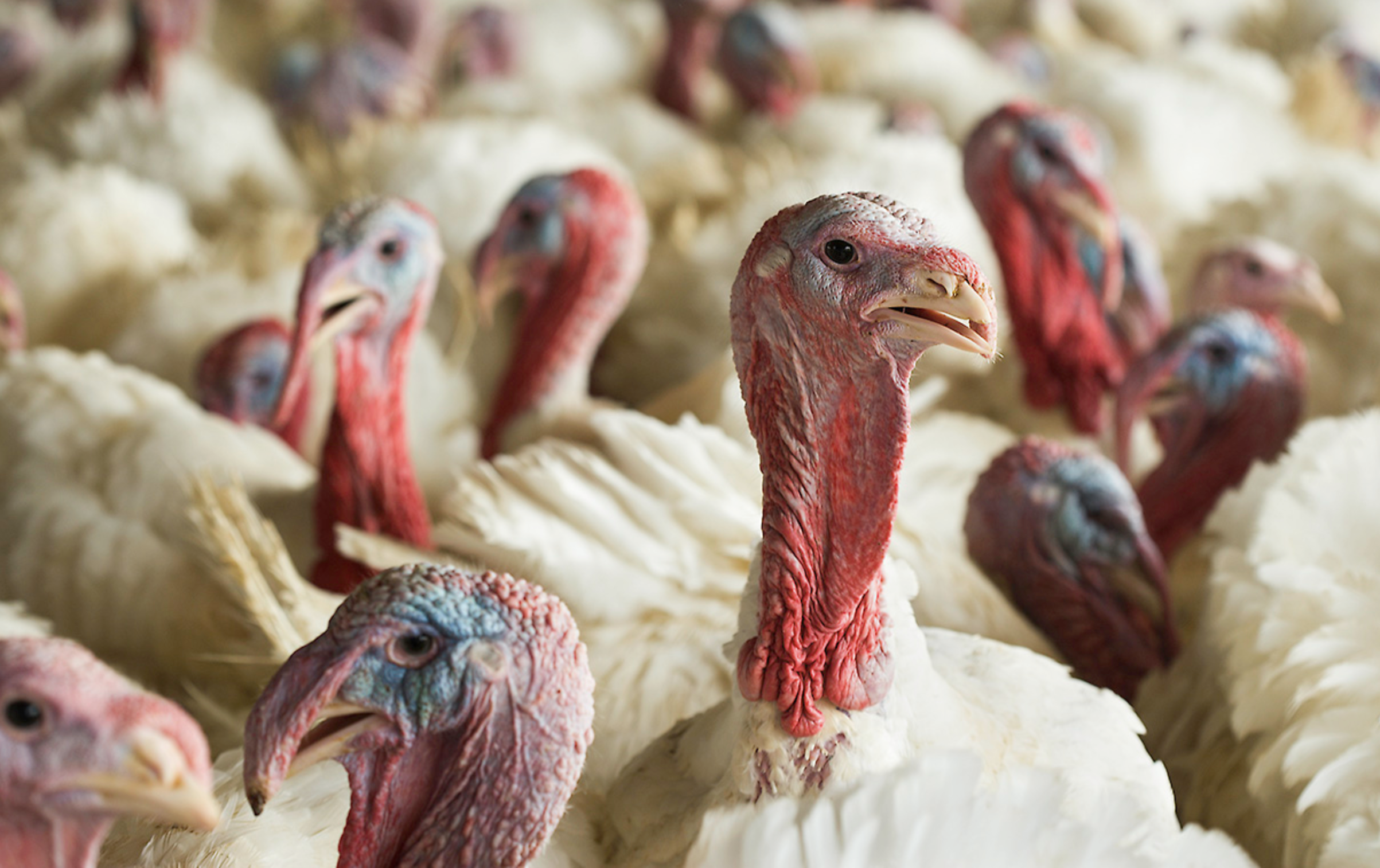
Good luck finding a California turkey this year. Poultry Federation president Bill Mattos tells the Farm Bureau that in the past year California lost top producer Foster Farms who left the turkey business and Sanger-based Pitman Farms moving most of their turkey operations to Utah after avian influenza devastated the state poultry industry last year.
The state’s turkey flock dropped from 6 million birds to just 2 million, says Mattos. California once housed 33 million turkeys.
And bird flu is on the march again this year, notes Mattos. Just this month two California poultry flocks have been hit in recent days in Sonoma County.Also California Department of Fish and Wildlife have confirmed two cases of avian flu in infected Canada geese at Cameron Park Lake in El Dorado County This is time of year for the annual bird migration.
As for California turkeys this year Mattos suggests consumers can probably find a specialty turkey particularly organic in your supermarket, but most consumers will be buying an out of state bird this year.
If you aren’t eating turkey you’re having to dig deeper to afford ground beef. Dollar sales of retail ground beef grew by double digits in August up 13% year over year to $1.7 billion according to consumer tracking firm Circana. Consumers might complain, but dairy folk aren’t since beef sales are an important contributor to their incomes.
California home sales are up for a change. After five consecutive months of year-over-year declines, September home sales activity climbed 5 percent from the 264,240 homes sold in August and rose 6.6 percent from a year ago, when 260,340 homes were sold, says the California Association of Realtors. September marked the 36th straight month in which the seasonally adjusted sales rate remained below the 300,000 benchmark.
At the county level, 40 of the 53 counties tracked by C.A.R. recorded year-over-year sales gains in September, with more than half (25) of those counties achieving double-digit growth. Kings County (46.3 percent) led the way with the highest sales growth from the last year, followed by Calaveras (42 percent) and Santa Cruz (37.9 percent). Tulare County reported a 23% increase in sales.
LAX passenger traffic was down 6.4% in September as both domestic and international arrivals declined.Air cargo also fell by 6% and is down 9% year to date.
Los Angeles port activity was down in September with both Long Beach and the Port of LA reporting declines in cargo volume compared to the same months last year.
“As we’ve reported for the last few months, imports continued to outweigh American exports by a four-to-one ratio. This data reflects the real impact that ongoing trade negotiations are having on our agriculture sector,” Port of Los Angeles Executive Director Gene Seroka said.
“As trade policy unfolds, we can only predict more unpredictability,” Seroka said in a statement. “When sweeping changes were first announced, importers abruptly stopped their orders from China. When those policies were softened and deadlines extended, cargo volume picked up again. The supply chain has been on a roller coaster all year and that ride continues he says.
Softening consumer demand and rising prices driven by shifting trade policies led to a decline in cargo containers moved through the Port of Long Beach in September.
Dockworkers and terminal operators moved 797,537 twenty-foot equivalent units (TEUs) of cargo containers last month, down 3.9% from September 2024. Imports decreased 6.9% to 388,084 TEUs and exports declined 3.6% to 85,081 TEUs. Empty containers moving through the Port inched up by 161 containers to 324,372 TEUs.
“Tariffs are impacting how consumers and business owners make financial decisions and purchases,” said Port of Long Beach CEO Mario Cordero.
Tulare Lake farmers lose round in court over groundwater pumping: Courthouse news reports that the State Water Resources Control Board can regulate groundwater usage by farmers in Kings County, after the state’s appellate court threw out a preliminary injunction and overruled a demurrer.
The pair of rulings means that farmers in the county will have to start metering and reporting how much water they draw from the ground, and pay the state fees of $300 per well and $20 per acre-foot of water used.
A spokesperson for the State Water Resources Control Board applauded the ruling, saying in a written statement that it would “allow the board to resume the important work of achieving sustainable groundwater management in the Tulare Lake subbasin while trial court proceedings continue.”
Dusty Ference, the executive director of the Kings County Farm Bureau, a nonprofit advocacy group representing farmers in the area that sued the state agency, said the group remains optimistic.
“The appellate court left standing our central arguments, including that the state overstepped its Sustainable Groundwater Management Act authority and imposed requirements without following proper process,” Ference said in a statement. “We look forward to having those claims fully heard in the trial court.”
The Farm Bureau did notch one important consolation win. The State Board had asked the court, if the injunction was thrown out, to order the Farm Bureau to pay $7 million in lost fees. The judge rejected that argument, writing that the State Board did not need those funds to proceed with its groundwater program.