
-April 21,2020-
China will import citrus to US
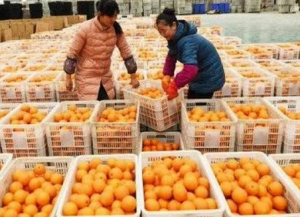 The U.S. Department of Agriculture is authorizing the importation of five types of commercially produced fresh citrus fruit from China into the United States. Varieties include pummelo, Nanfeng honey mandarin, ponkan, sweet orange, and Satsuma mandarin fruit.China promises a series of measures taken by growers, packers, and shippers that, in combination, minimize pest risks prior to importation into the United States.
The Chinese citrus industry is double the size of the US.
California Citrus Mutual objected to the importation but says the deal was part of the Implementation of the Phase One agreement with China that “continues with reduced tariffs” for US citrus.
Critically, “California citrus shipments to China with reduced tariffs would have been in jeopardy had USDA not followed through on their commitment” says CCM. USDA says they believe that Chinese citrus will no be exported to the U.S. in any significant quantity…”
Food spending breakdown
From Rural Migration News
Americans spent a record $1.7 trillion on food and beverages in 2018, including $628 billion at supermarkets and $678 billion in all types of restaurants, including taxes and tips. Spending on food in restaurants first exceeded spending for food at home in grocery stores in 2015, and the gap was widening until the coronavirus closed many restaurants in March-April 2020.
Americans spent another $153 billion on food to be consumed at home at farmer’s markets, mail order, and other non-grocery-type sellers. Over 80 percent of food-at-home spending in 2018 was at grocery stores, warehouse clubs, and supercenters, but alternative sales via mail and direct-to-consumer channels are growing faster than supermarket sales.
Spending on restaurant meals includes full- and limited-service restaurants. Restaurants accounted for 73 percent of the total $931 billion spent on food away from home, with sales divided almost equally between full- and limited-service outlets. Another $253 billion was spent on food-away-from home at university and workplace cafeterias, vending machines, and other non-restaurant outlets.
More salmon expected on the Sacramento
 While the COVID-19 pandemic triggered a delay to the April season along the California coast, salmon anglers can look forward to robust seasons ahead says Fish and Game.
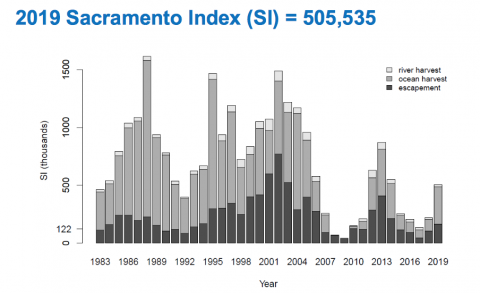
The Pacific Fishery Management Council has forecast a Ocean abundance of salmon from the Sacramento River at just under 500,000 again this year, similar to last year and up from 2015 through 2018.
Since 1995, the numbers have been highly variable, peaking in 2002. After record-low numbers in 2008 and 2009, which led to the closure of commercial and recreational fisheries, the population recovered in 2012 and 2013, then declined in the three years that followed. Now it is moderately higher.
 The fishery is closely watched not just for economic reasons but as a measure of the health of the ecosystem in the Golden State and its affect on water policy.
The 2020 ocean abundance projection for Sacramento River fall Chinook (SRFC), a main salmon stock harvested in California waters, is estimated at 473,200 adult salmon says the Fishery Council.
On April 10, the Pacific Fishery Management Council (PFMC) recommended the following 2020 season dates for the state’s four management areas:
•In the Klamath Management Zone, which is the area between the Oregon/California state line and Horse Mountain (40°05’00” N. latitude), the season is expected to open June 6 and continue through Aug. 9.
•The Fort Bragg and San Francisco areas, which extend from Horse Mountain to Point Arena (38°57’30” N. latitude) and Point Arena to Pigeon Point (37°11’00” N. latitude), respectively, are expected to open on May 1 and continue through Nov. 8.
•The Monterey area, between Pigeon Point and the U.S./Mexico border, is expected to open on May 1 and will continue through Oct. 4.
Trump vows immigration ban amid worker shortage
The Covid crisis has proven what Western farmers have maintained all along. Farmers here are dependent on foreign labor for both the harvest and processing of their crops.Already there is fear among workers of deportation and reluctance to get tested for health issues.
So it is understandably frustrating when President Trump choses this moment to vow a complete shutoff of foreign immigration even as there is a severe worker shortage at processing plants handling perishable goods.
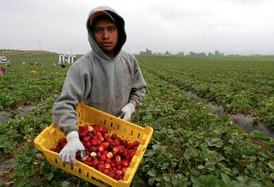 The American Farm Bureau reports that “At least 50-70 percent of farm laborers in the country today are unauthorized. Few U.S. workers are willing to fill available farm labor jobs.”
Trump tweeted Monday night that he’s signing an executive order to “temporarily suspend immigration” into the U.S. because of the coronavirus, POLITICO reported. It’s unclear how or when such a move would be carried out: DHS is still drafting the executive order. It’s also unclear whether it would have any impact on agricultural labor, which has already been hampered by the pandemic. One possibility that has been discussed is an exemption for temporary guest workers, including those who work on farms.
The United Farmworkers are among groups looking to help workers be safe but on the job noting that they too are #EssentialWorkers who pick strawberries for families throughout the country. “The UFW fights to make sure their families are safe and provided for too.”
Trump has been heading in the other direction say critics.
Chief of Staff Mark Meadows is said to be working with Agriculture Secretary Sonny Perdue to see how to reduce wage rates for foreign guest workers on American farms, in order to help U.S. farmers struggling during the coronavirus, according to U.S. officials and sources familiar with the plans.
Opponents of the plan argue it will hurt vulnerable workers and lead to even more shortages.
“To see wages being depressed would be reason for concern and evaluation,” said Chris Valadez, president of the Grower-Shipper Association of Central California, which represents more than 300 companies. “We are one of the few industries still essential, still open for business.”