
-February 5,2020-
Oak trees may hold answer to devastating citrus disease
from CFB
Scientists have found that applying oak leaf extracts inhibits the bacterium that causes the devastating citrus crop disease huanglongbing, or HLB. The disease has reduced Florida’s citrus crop by 90% and led to plant quarantines in Southern California after being found in residential citrus trees. Scientists from the University of Florida and the U.S. Department of Agriculture investigated oaks after farmers observed citrus trees planted near oaks survived HLB.
Fluid milk/ice cream consumption shrinks again / Cheese saves the day
A new USDA report say fluid milk consumption in the US was down in 2018 to 146 pounds continuing a long trend downward from 150 pounds in 2017, 178 pounds in 2000 and 247 pounds per person in 1975. That is a drop of over 40% from 1975.
In the ice cream category it is a similar story.In 1975 per capital consumption stood at 18.2 pounds per person – now down to 11.8 pounds in 2018. That too is around a 40% decrease.
So what dairy categories are up? Yogurt for one up from 2 pounds per person in1975 to 13.4pounds in 2018. Speciality cheese including mozzarella is way up from 6 pounds in 1975 to 22.5 pounds per person in 2018. That is almost a 4-fold increase. American cheese consumption has about doubled.
China exports down -Now what?
China imported $29 billion worth of farm commodities from the US in 2013, $24 billion in 2017, and less than $10 billion in 2019. President Trump in October 2019 said that China would import $50 billion worth of farm commodities a year by 2021, which experts say could happen only if China removes restrictions on US beef and pork.But this week White House National Economic Council Director Larry Kudlow said he expected the fallout from the deadly coronavirus to delay—but not derail—the economic boost the U.S. anticipated from the first phase of the trade deal with China.
State to offer 5% increase for Cooperative Extension
After snubbing the agency last year, Gov. Gavin Newsom has slipped a 5 percent increase for the University of California’s Division of Agriculture and Natural Resources into his $222 billion overall budget proposal for 2020-21.
The boost would mean an increase of $3.6 million annually for UCANR to begin rebuilding its ranks of researchers and educators working with growers, said Glenda Humiston, the division’s vice president.
Farm bankruptcies climb 20%
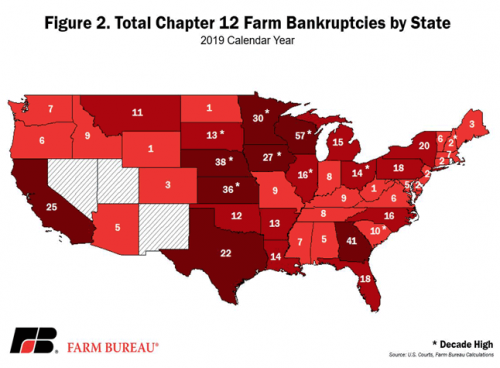 OMAHA (DTN) — Though the number of farms filing Chapter 12 bankruptcy increased in 2019 from the previous year, an American Farm Bureau Federation analysis found the number of filings in the fourth quarter fell from the previous two quarters.
The agriculture economy is coming off five years of falling commodity prices and weather disasters on top of trade and federal biofuel policy uncertainties.
The AFBF analysis released on Wednesday shows overall Chapter 12 farm bankruptcy filings increased from 2018 to 2019 by about 20%. It is the largest increase in filings since 2010 when Chapter 12 filings increased by 33% coming off the recession of 2009.
There were 595 Chapter 12 filings in 2019, according to AFBF’s review of court data, or about 100 more than in 2018. The highest number of filings in recent years was in 2011, when 637 farms filed for Chapter 12.
So, in 2019, there were 2.95 bankruptcies per 10,000 farms, just below 2.99 in 2011. There are a little more than 2 million farms in the United States.
AFBF Chief Economist John Newton told DTN the group will continue to watch Chapter 12 filings closely.
“Until things start to show general signs of improvement, we’ll continue to do so,” he said.
The rate of filings was much higher in 1987, the year after the Chapter 12 provision was created. According to AFBF, the rate stood at a little higher than seven bankruptcies per 10,000 farms in 1987.