
December 4,2018-
from Environment Reporting Network
State releases map where they are finding nutria
Wearing chest-high waders, biologist Sean McCain tries to tiptoe to the edge of a marsh in California’s Central Valley. A biologist with the state Department of Fish and Wildlife, McCain squints as he searches the shoreline.
“I don’t think they know we’re here yet,” he whispers. Then, excitedly, he points. “Is that one right there? I think we’re looking at one right there.”
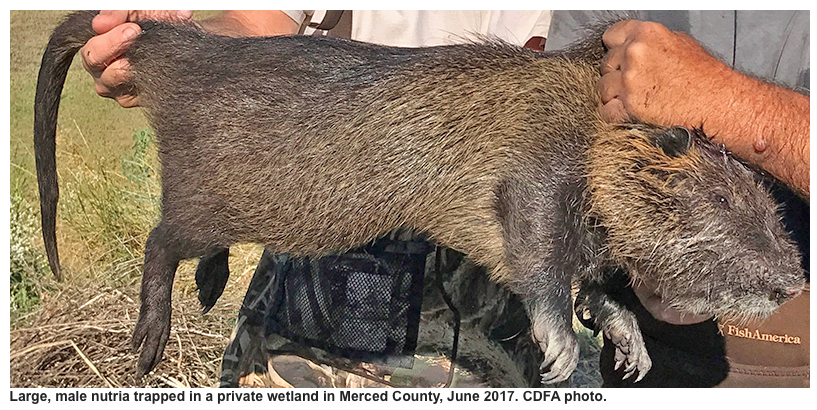
What he sees is a 20-pound rodent that looks like a cross between a rat and a beaver, with a scaly tail, webbed feet, and big orange bucked teeth. It’s a nutria and it’s poking its head out of a dark cave of tule reeds.
McCain’s first saw a family of nutria here two weeks ago, and since then he’s returned to this spot almost every day to check on them.
Nutria can eat up to 25 percent of their body weight in one day. They munch on the roots of green duckweeds, cattails, and tule reeds. If they clear cut an entire marsh like this one, they put all the birds and frogs and other species that depend on it at risk. “I’ve been watching the vegetation recede away from the middle of the pond,” McCain says.
They can also tear up crops and levees, damaging the state’s water infrastructure, and threatening farms.
California is trying to eradicate nutria, an invasive rodent that is damaging irrigation ditches and farms.
Nutria aren’t native to California, or the United States. Fur farmers brought the South American rodent to Southern California in the late 1800s as an attempt to make an affordable mink alternative. After multiple attempts, the nutria fur business never took off, but the rodents went feral. California’s Department of Food and Agriculture determined they were eradicated in the 1970s.