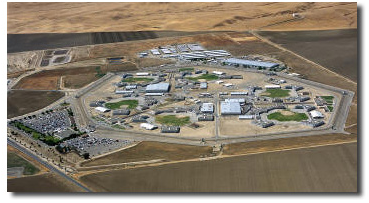
Avenal Administrator Plays Down Valley Fever Problem At Prison

Avenal city administrator Steve Sopp is playing down reports that a massive shift of state prisoners is underway because of recent Valley Fever finds.

The SF Chronicle reported recently that that some 3300 inmates at Avenal and Pleasant Valley would be transferred out at the direction d of J Clark Kelso,the court appointed  receiver for the prison health services.

But Avenal warden C. Wofford told Sopp there was no big transfer in the works with Sopp calling it “a rumor.” He says the warden told him people at high risk for contracting the aliment would be moved but it would not likely be a large number.

Sopp says there are 4973 inmates at the state prison -down  about 2000 from 3 years ago. The prison is major employer and tax payer for the small western Kings County town.

Valley Fever cases appear to be rising says the federal Center for Disease Control. In recent months  28 workers at a solar construction sites in eastern SLO county were said to be suffering from the fever probably impacted by flying dust.

The illness seems to hit African Americans and Philippine  people the hardest as well as others with weakened immune systems.

Valley Fever, a fungal respiratory infection, dramatically increased in several southwestern states from 1998 through 2011, according to a new study by the Centers for Disease Control and Prevention. Cases in Arizona, California, Nevada, New Mexico and Utah rose from 2,265 in 1998 to more than 22,000 in 2011.

Valley Fever (Coccidioidomycosis) is caused by inhaling a fungus called Coccidioides, which lives in the soil in the southwestern United States. Not everyone who is exposed to the fungus gets sick, but those who do typically have flu-like symptoms that can last for weeks or months. More than 40 percent of patients who get ill from Valley Fever may require hospitalization at some point, with an average cost of nearly $50,000 per hospital visit. Previous studies have shown that, of those who get sick, nearly 75 percent miss work or school – for approximately two weeks.

“Valley Fever is causing real health problems for many people living in the southwestern United States,” said CDC Director Tom Frieden, M.D., M.P.H. “Because fungus particles spread through the air, it’s nearly impossible to completely avoid exposure to this fungus in these hardest-hit states. It’s important that people be aware of Valley Fever if they live in or have travelled to the southwest United States.”
This recent increase in Valley Fever could be related to changes in weather, which could impact where the fungus grows and how much of it is circulating; higher numbers of new residents; or changes in the way the disease is detected and reported to the states or CDC. More research is needed to understand why the number of reported cases of Valley Fever has increased. Between 1998 and 2011, Arizona and California had average increases in Valley Fever incidence of 16 and 13 percent per year, respectively. The CDC has provided grants to these two states to study Valley Fever.

During this time period, nearly 112,000 cases of Valley Fever were reported from 28 states and Washington, D.C., but 66 percent of cases were in Arizona, 31 percent were in California, 1 percent were in Nevada, New Mexico, and Utah, and about 1 percent were in all other states combined.

“It’s difficult to say what’s causing the increase,” said Benjamin J. Park, M.D., chief epidemiologist with CDC’s Mycotic Diseases Branch. “This is a serious and costly disease and more research is needed on how to reduce its effects.”
Doctors and patients should know that the symptoms of Valley Fever are very similar to flu or pneumonia symptoms and a lab test is the only way to tell if an illness is Valley Fever or not. Not everyone who gets Valley Fever needs treatment, but for people at risk for the more severe forms of the disease, early diagnosis and treatment is important. The best way to treat Valley Fever still needs to be studied, especially with the number of cases continuing to rise.


Around Visalia: High Speed Rail,New Civic Center & More

HS Rail Staff  “Mistaken”Over Route Says City Manager

Visalia city manager Steve Salomon says a recommendation of the staff of the California High Speed Rail Authority released earlier this month  to run the rail line on the west side of Hanford would be “a mistake for both them and for the region.”

“It would be a mistake to leave behind a million people who will who will be living here by the time it begins to run.” Most of them would live east of Hwy 99,far from any station site near Lemoore.

Salomon says he still hopes the board of the authority will break with the staff engineers and chose the east of Hanford route with a station at 198 and Hwy 43, about 11 miles closer to the big population centers on a round-trip basis.

“I don’t want to be a skeptic but the CHSRA seems to decide just the opposite of what we suggest” says Visalia council member Warren Gubler.

“We said we wanted the route to come down Hwy 99 on the UP line and they picked the BNSF route. Then they veered from the BNSF route and appear to want to go on the other side of Hanford.”

Visalia argues that erecting a station east of Hanford will boost ridership and revenues for the rail line more than enough to overcome any cost difference.

The CHSRA staff has estimated the route west of Hanford would be $800 million less expensive and impact fewer diaries. Still the west route as it comes near to 198 would be in a 45 ft deep trench and there are questions of how the 16 to 22 ft water table would impact the engineering.

The west of Hanford station would be in a trench as opposed to a east of Hanford site – at grade making the station development cost for the east of Hanford option less expensive.

Frustrating to many is the fact that the CHSRA has yet to certify the region will even get a station at all. Without a station Kings County will see only impacts and no benefits says Hanford city manager Darrel Pyle.

”That would be unacceptable.”

In addition, Kings EDC president John Lehn says a west of Hanford alignment would rule out any chance for Kings County to compete for a heavy maintenance facility that could employ 1500 because all their  submitted candidate sites are on the east side.

The CHSRA board is set to make a decision on alignment of the 114 mile route through Kings County to near Bakersfield on May 2. Chair of the board Dan Richard told the crowd in Fresno at the last meeting that his board ,not the staff ,will make the final determination.

Last week the authority selected the bid from a joint venture of Tutor Perini/Zachry/Parsons who submitted the “best apparent value” bid of $985 million for the first segment of the rail line from near Merced to Fresno. That bid was below the $1.09 billion proposal by the next-lowest bidder and well below the engineer’s estimate of  the cost of the first segment at $1.2 billion to $1.8 billion. This segment is set to break ground this summer.

Visalia Wants To Extend Rail In Industrial Park

The City of Visalia is exploring ways to extend freight rail lines in the  city industrial park to include some 640 acres between Goshen  and Riggin with no rail access and also 1300 acres north of Riggin. ”This lack of access could potentially serve as a barrier to attracting future business to the industrial park” says a report.

In the past few weeks it has been the Shafter industrial park in Kern County that has snagged a big tenant thanks to their multi-modal shipping options.

The industrial park owned by investor                                                                                                                                                                                                                                                                                                                                                                                                                                                                                                                                                                                                                                                                                                                                                                                                                                                               Stewart Resnick has seen a major infrastructure rail upgrade through the city in the past year and announced that 1500 jobs and a new 1.7 million square foot Ross Dress For Less distribution center are coming in part because of shipping options available by both highway and rail.

The state lis looking  more favorably on rail shipping offering less pollution than shipping by truck.

If Visalia wants to compete with the rest of the state – distribution and manufacturing sites must have rail access. The county’s TCAG group is working to do the same thing with preservation of the short lines in the county.

City Council Looks At Refinance Option That Could Launch New Civic Center

The Visalia City Council will take up the possible refinance of the city Convention Center that could free up $15 million to use for several city projects. The council will meet May 6 to hear some options says city manager Steve Salomon.

Salomon says refinancing could allow the city to take advantage of lower interest rates but extend the same payment funded by revenues from the convention center. As much as $15 million could be made available without hurting cash flow says a city report and the funds used to upgrade the convention center – say $5 million of that – and keep $10 million to help fund the 911 Communication Center project as well as possibly use some funds for the long awaited Civic Center.

The 911 Center will be built on a 16 acre city-owned parcel at the SE corner of Goshen and Burke. A construction manager has been selected and the project could break ground this year.

The current city council chamber was built for a town of 10,000 in a city that has grown into 125,000 residents. The city has wanted to cluster the new city projects including a police and fire admin building with the others on the city’s east side,old railroad-owned property that will anchor a new part of Downtown Visalia in the near future.  Already a new children’s museum is slated to break ground nearby this summer along with the enhancement of Mill Creek with a trail along it.

Valley Jobless Rate Tumbles

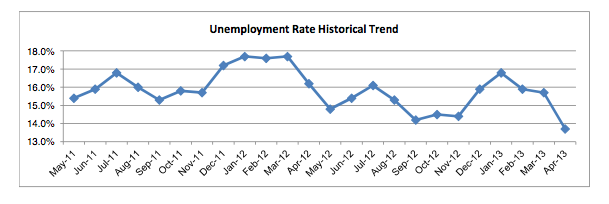
Tulare County jobless rate falls

Tulare & Kings Unemployment Falls

Central Valley counties reported the most dramatic decline in the number of jobless  in April after years of persistent rising jobless rates. The state EDD reported a consistent 2 full point drop in April in the unemployment rate in a number of counties year over year.

The unemployment rate in the Tulare County was 13.7 percent in April 2013, down from a revised 15.7 percent in March 2013, and below the year-ago estimate of 16.2 percent. There were 2600 more jobs in the  county in April 2013 compared to April 2012  – almost all in the non-farm sector.

More jobs translated to a 15% decline in people looking for work in a years time –  5000 fewer people – down from 33,400 in April 2012 to 28,400 in April of this year.

Likewise in Kings County where the unemployment rate was 13.8 percent in April 2013, down from a revised 15.3 percent in March 2013, and below the year-ago estimate of 15.7 percent. Kings reported 400 more jobs than a year ago.

These rates compare with an unadjusted unemployment rate of 8.5 percent for California and 7.1 percent for the nation during the same period.California’s  nonfarm payroll jobs increased by 10,400 during the month for a total gain of 756,900 jobs since the recovery began in February 2010

In Kern County the unemployment rate was a Valley best 12.1 percent in April 2013, down from a revised 13.6 percent in March 2013, and below the year-ago estimate of 14.2 percent. EDD reports there were 6800 more jobs than a year ago.

10,000 Fewer Jobless in Fresno County

In Fresno County  the EDD reported the agriculture season began with a gain of 4,700 jobs. The unemployment rate in the Fresno County was 13.4 percent in April 2013, down from a revised 14.9 percent in March 2013, and below the year-ago estimate of 15.8 percent.

The number of unemployed dropped by 10,000 in Fresno County year over year.

The last time the jobless rate in Fresno County in April was this low was in April 2008 when it was 9.7% before the Big Recession. By April 2009 April’s unemployment rate was up over 14.4% and jumped to  16.9% in April 2010 and 16.7% in April 2011 in the county.

The EDD said between March 2013 and April 2013 ,total wage and salary employment increased by 6,300 jobs (up 2.0 percent) to total 328,200. The month-over gain was concentrated in farm employment, which grew by 4,700 jobs (up12.8 percent), while nonfarm employment expanded by 1,600 jobs (up 0.6 percent).

Also in Fresno County

• Farm employment posted a normal seasonal increase, rising by 4,700 jobs. Strawberries
are being harvested and sold at roadside stands. Harvest of asparagus continued; as broccoli and spring lettuce wrapped-up for the season.
•Professional and business services expanded by 700 jobs and educational and health
services added 400 jobs.

•Major industries that edged up by 200 jobs each included: trade, transportation, and utilities, manufacturing, and leisure and hospitality.

Between April 2012 and April 2013 , total wage and salary employment increased by 5,200 jobs (up 1.6 percent). Nonfarm employment added 5,100 jobs (up 1.8 percent) and farm employment rose by 100 jobs (up 0.2 percent).

•Professional and business services reported the largest year-over increase with the addition of 2,300 jobs. Gains were in professional, scientific, and technical services (up 1,200 jobs) and administrative and support and waste services (up 1,100 jobs).
• Trade, transportation, and utilities added 1,500 jobs. Wholesale trade increased by
800 jobs, transportation, warehousing, and utilities added 500 jobs, and retail trade grew
by 200 jobs.
• Construction netted 900 jobs to reach its highest April total since 2009.
•Leisure and hospitality grew by 800 jobs. Food services and drinking places accounted
for the majority of the job gain (up 500 jobs).
•In contrast, educational and health services scaled back by 500 jobs. Educational
services decreased by 400 jobs and health care and social assistance fell by 100 jobs.

South Valley Unemployment Rates Fall

The unemployment rate in the Tulare County was 15.7 percent in March 2013, down from a revised 15.9 percent in February 2013, and below the year-ago estimate of 17.7 percent.The county  added 2500 non farm jobs in the past year  but lost 200 farm jobs. The biggest jump came in manufacturing – up 1100 jobs.

The unemployment rate in the Kings County was 15.4 percent in March 2013, down from a revised 15.6 percent in February 2013, and below the year-ago estimate of 17.2 percent.

The unemployment rate in the Fresno County was 14.9 percent in March 2013, down from a revised 15.3 percent in February 2013, and below the year-ago estimate of 17.0 percent. This compares with an unadjusted unemployment rate of 9.4 percent for California and 7.6 percent for the nation during the same period.

In Fresno between February 2013 and March 2013, total wage and salary employment increased by 2,800 jobs (up 0.9 percent) to total 322,400. Nonfarm employment rose by 4,000 jobs (up 1.4 percent), while farm employment declined by 1,200 jobs (down 3.2 percent).
•    Government posted the largest month-over gain with the addition of 1,700 jobs to reach 66,600. Federal government (up 1,300 jobs), accounted for 76 percent of the job gain in this sector. State government and local government each grew by 200 jobs.
•    Professional and business services expanded by 700 jobs and leisure and hospitality added 400 jobs.
•    Major industries that edged up by 300 jobs each included: construction and educational and health services.

In Kern County the unemployment rate was 13.6 percent in March 2013, unchanged from a revised 13.6 percent in February 2013, and below the year-ago estimate of 15.3 percent.

Valley Voice Newspaper Coming Back

story written by George Pilling of Visalia in Valley Voice

Can’t keep independent journalism down.

A few weeks ago the Tulare Voice led by editor Julie Fernandez  and local investor Phil Smith restarted as an online weekly newspaper and now Visalia’s Valley Voice newspaper is coming back as both a print and  online community paper. Founded in 1979 in Visalia the publication was last printed  in December 2011.

Restarting the Valley Voice will be husband and wife team Catherine Doe and Joseph Oldenbourg. Cathrine wrote for the free paper before and her father Russ Doe was an investor. The paper succumbed from tough economic times.But now  papers for both towns are back. Each now is independent of one another.

“We are going on-line May 30th and will be in the racks June 6th.” says Doe.
“The Valley Voice is going to be about the same as it was, water, ag, politics and farm issues. The only new section is we have a Student Life page” she adds.

To reach Valley Voice email:  news@ourvalleyvoice.com.

You can see Tulare Voice online at tularevoice.com.  New stories issued weekly and updated through the week.

Tulare Backs Funds For Juice Maker

Tulare airport area on the east side of 99 has little sewer capacity

Its a pretty smooth deal for both a juice maker and the city Tulare as the city council voted this week to help bring a new company to town.

The Etchegaray family of Visalia own Sunmet Juice of Kern County -maker fruit pulp purees – used in smoothies- for food processors to add as ingredients.The company is in escrow to buy the 58,000 sf, 12.7 acre – former Structures Plus property near the Tulare airport.

The juice maker is requesting the city‘s help to bring in sewer capacity  to the Tulare airport area needed to process their product. Tulare has plenty of sewer capacity for food companies but it is not available currently near the Tulare airport on the east side of Hwy 99.

That’s where the city’s annul CDBG funding comes in.The city council voted this week 4 to 1 to use its federal Community Development Block Grant (CDBG) funding that totaling $400,000 to assist with the location of this juice manufacturing company in the existing facility at 19860 South Highway 99.

In Tulare where milk is the major industry this wood be the second juice maker to open in town in the past year.

Etchegaray Farms, LLC started in the livestock business in the early 1960’s. In the most recent years, the Company has moved to become vertically integrated through processing, packaging and storage operations.

Since 2008, Etchegaray Farms, LLC has had an existing juice manufacturing facility in Kern County ( Sunmet) which takes raw product (fruit or vegetable) and processes into purees, concentrates or NFC juice for the beverage industry. Sunmet Packing is a major player in both the stone fruit and pomegranate  industry.

Their products are sold as an industrial ingredient to major companies in the US and abroad. Now Etchegaray Farms wants to relocate and expand its operation in Tulare.

A Tulare city report suggests the juice company would generate about 27 direct jobs.

“Company representatives provided data to show the company typically spends approximately $1mil on an annual basis on new or used equipment. This new facility will require the purchase of new equipment, which the company will declare the City of Tulare the point of sale for purchases when possible. Assuming the Juice Company expends $1mil on equipment, it will add $10,500 to City revenue.”

Added to the benefits of job creation to the community, the juice manufacturer will utilize local service providers to assist in their manufacturing process. In 2012, the company expended over $2.6mil in “major cost items” consisting of trucking, cold storage services, packing, sanitation and chemicals, equipment (service & parts), repairs/maintenance, electrical (service & parts) and forklifts. Again, to calculate the potential benefit to our existing local vendors, an analysis of the 2012 juice manufacturing company’s key vendor list and expenditures was performed. Out of the top 25 sales tax generating businesses for Tulare, it was deduced at least 15 of those extending vendors will have the potential to supply a service or product to the juice company, which will in turn increase the overall sales tax to the City says the city report.

Company representatives provided data to show the company typically spends approximately $1mil on an annual basis on new or used equipment. This new facility will require the purchase of new equipment, which the company will declare the City of Tulare the point of sale for purchases when possible. Assuming the Juice Company expends $1mil on equipment, it will add $10,500 to City revenue.

New Life For South Tulare

The staff report adds that “the proposed juice manufacturer will inject life into the southern-most portion of Tulare’s industrial lands. The infrastructure upgrades will open up the entire area for potential development including the city owned airport property the city is marketing for lease.”

The company proposes to hook up to the City’s water well located at the airport. These fees will generate additional income to the City.

The addition of a juice manufacturing company to the City of Tulare will expand the diversification of the City’s industrial base. The idea behind industrial diversification is to increase the stability of the City by making it possible to enjoy revenue from more than one source. With a diversified industrial base, the City stands a better chance of surviving if a slump in demand for dairy-related products occurs.

In order for the facility to meet the needs of the juice manufacturing company, the City industrial sewer line will need to be extended from at or about the South Tulare sewer line along Avenue 196 at the existing stub on the east side of highway 99 northerly up to the facility at Hosfield Road. The City engineers estimate to extend that line was $662,000. A private engineering estimate was obtained by the current property owner, which came in at $440,924.

County/ Cities Agree On General Plan MOU And Property Tax Collection Dispute

County administrator Jean Rousseau says all eight cities have now agreed to a memorandum of understanding laying how the new county 2030 General Plan will work with cities on impact fees and revenue sharing issues.

“I got a call from Porterville City Manager John Lollis who said his council voted in closed session this week to accept our final offer.”

Porterville was the last of the Tulare County cities to sign on to the county’s proposal. A lawsuit over the issue had been filed.

“This settles a dispute that goes back 5 years. It’s just huge.” Still pending before the General Plan can be implemented is a second suit with the Sierra Club.”We have not made as much progress on this one.”

In a second breakthrough – Rousseau says the county is preparing to refund $4.2 million to the 8 cities settling another lawsuit over how the county collected property taxes since 2006. The settlement will mean Visalia gets around $1.9 million back and Porterville would be refunded around $700,000.

Salomon says the funds will be used to backfill Visalia’s lagging  emergency reserves to its historical $5 million level, he hopes by June 2014.

Rousseau adds “We are offering each city cash by June 30” at a meeting with all city managers this week.

At issue in the General Plan suit filed by Porterville last year is the fact the county plan calls for cities to help collect impact fees the county wants to charge to help their revenue stream. Another issue has been whether the county would mandate city standards in development in   county land within a city’s urban development boundary. Cities have complained  about lax standards approved in the past by the county that when land is annexed cost the cities lots to upgrade. The county has agreed to do this.

Around Tulare County / 48 To Be Laid Off In Visalia / Dollar Stores Update / More

Visalia-based Medical Billing Technology (MBT) plans to lay off 48 employees in early June according to a state WARN notice this week.The firm has an office on Caldwell and according to its website, employs 100.

“With Federal and State program changes, it’s necessary for MBT to adjust our business operations so that we can continue to offer our industry leading service to our clients,” states Roberta Stephens, CEO. “MBT has always been focused on our district clients, and that is not going to change. The adjustments we’re making to our service delivery will allow us to be more agile, while still maintaining our dedication to assisting districts to recover valuable reimbursement funds.”

Founded in 1994, MBT helps connect California’s students to health insurance and health services by assisting school districts and other local agencies in accessing important federal reimbursement funds.
Workforce Investment Board (WIB) staffer Sandy Miller says the company did not have to issue the state public notice because the layoffs were under 50 but doing so helped the employees get WIB agency services.
“We are going to see more of this with all the changes in managed care “ says Miller.

The proposal to build a Dollar General retail store in downtown Lindsay has been withdrawn by the developer.The Embree Asset Group wanted to demolish the Central California Citrus Exchange building on East Hermosa Street and North Mirage but several residents opposed the plan citing the historic nature of the building. No word if the company will try to build elsewhere in town.
Meanwhile there is no letup for Dollar General in Tulare where the company has confirmed they now want to build a second store says city planner Bonnie Simoes. With a Dollar General under construction at Prosperity and J Street,the retailer says they want build another store on the west side of town at Santa Clara and Inyo. Also in Woodlake, the company is underway on construction of new store at 301 W Naranjo.
In Visalia,the long vacant Copeland Sports store on Mooney is getting a new user, Sheik Shoes spending $600,000 to do tenant improvements on the 14,000 sf building at 1100 S Mooney. The  building has been empty since early 2007 after the sporting goods chain went bankrupt. The outlet will likely be the biggest shoe store in town.
More former commercial spaces are being occupied by local churches. In Visalia the former Franey Floor Coverings on Encina  is being sought by Crossroads Community Church who received city planning commission approval this week to set up in the building. In Tulare, the former movie theater at Tower Square is being sought by a church represented by TAE. The last use of the space – a paint ball operation.

With No Snow – Central California Ski Resorts Throw In Towel :It’s April 2013 and its been a duster for the past three months. So it should come as no surprise that Central Sierra ski resorts have closed for the season.

At China Peak management announced that “unfortunately we are closed for the 2012/13 season, unless we receive a significant snowfall (2-3 feet) in April, where we would possibly reopen. The lack of snow in the first quarter of 2013 is historic, and unfortunately we ran out of snow much earlier than is almost always the case; we are generally open until the end of April, which is our plan for 2013/14!” In Yosemite Badger Pass closed as of March 31.

Still open for skiing is Bear Valley,Alpine Meadows,Squaw Valley,Northstar and Mammoth to name some of the more popular places.

If skiing ends early – let the hiking and tourist buses begin.

That’s what is happening in Sequoia /Kings Canyon where the early snowmelt and warm weather has prompted the return of tour buses early this year.

Already tourists can drive the road to Moro Rock and popular Crescent Meadow. I personally hiked up the cross country ski road to Panoramic Point a few weeks ago taking a picnic lunch to enjoy the Great Western Divide view at the top. The road to Cedar Grove at the end of Kings Canyon will open April 26.

Speaking of tourists Three Rivers is expecting a big crowd this weekend for the 40th Annual Jazz Affair with 11 bands at four venues – April 12-14.Local Tom Sparks says as New Orleans styled jazz has faded in popularity the venues remaining to showcase the music are even better attended. This weekend’s event is followed by the popular Lions Rodeo next weekend.

Visalia Milk Co-Op Poised For Expansion

CDI Visalia

Is there too much milk or not enough? Not enough going to the right market says Visalia-based California Dairies Inc CEO Andre Mikhalevsky. ”Right now we can process only 60% of our members milk.” That means 40% goes to fluid milk where the profits are not that high with little room for expansion, he says.

Instead,“the best return for our members is to dry the milk and ship it for export” says Mikhalevsky.”We can make a lot more money.” Top destination – China where they need a boat lead of baby formula.

Agreeing with this view is CDI board member John Moons who runs a dairy just a few miles west of Hwy 99. “With the leadership if Mr Mikhalevsky – we’re going to take our co-op to the next level.”

Moons says CDI’s goal is to invest in technology to make higher end spec’ powder that lasts longer without refrigeration. “We have some dryers that have been upgraded to produce these products but we need to do a major upgrade at all our plants.” Moons says besides equipment upgrading to make these long shelf life powders requires unprecedented levels of cleanliness in the production rooms to reduce bacteria levels and slow spoilage.

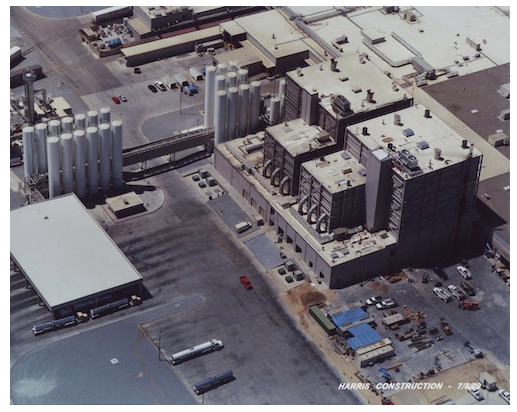
CDI filed a building plan review heard April 10 with the City of Visalia for two new 100 foot evaporator/dryers and a 10,000 sf building that would house a new lab along with a production room. The two new dryers would be added to the 13 dryer units already in place at the 52 acre Visalia plant – already the single largest powdered milk-producing site in North America. The new dryers would handle powder with increased shelf life.

Investment here is already in excess of $250 million.

In a phased expansion, Visalia – the co-op’s newest production facility -is poised to get larger still. Based on what appears to be about a 15% expansion in Visalia right away the co-op’s new strategic plan calls for upgrading their Tipton powder/butter plant as well.

The strategic plan outlined in this months CDI member newsletter, calls for 4-phases that includes adding enough capacity to process an additional 150 loads of milk a day – adding 7.5 million pounds of milk capacity to the 10 million pounds a day already in place, a 75% increase. That would be some four year away.

In the five to ten year horizon the cooperative would look to build a new “greenfield” plant to produce specialty products for the export market,says the newsletter.

Biz Trends: Cheese Prices Up / 24% Jump For Tangerines/ More Solar Panels Installed / PACE Program For Tulare County

Visalia-based Proteus trainees install solar panels

Good news for dairy farmers this week as block cheese prices in Chicago have jumped to $1.80 a pound .That’s up from a low $1.55/lb  in early March. If dairy prices are up there is more good news – feed prices are down.Corn for May delivery closed at $6.48 today down from $7.35 a bushel in late March.

This year’s tangerine crop looks to be a whopping 24% larger than last year says USDA.Little freeze damage has bee seen. Navel production is flat and Valencias are down 4%.

Home owners are installing more solar panels so far this year compared to last year at this time. Construction Monitor reports there were 564 permits for solar panels on residential units issued for Madera,Fresno,Kings and Tulare counties so far this year,That compares to 427 permits for the same period a year ago – about a 20% jump.

Boosting the demand is the drop in solar panel prices. Solar guru Arno Harris writes.”This will also be the year Americans start to realize just how affordable solar has become. Rooftop solar can now be installed for under $4 per Watt, making it competitive with retail electric rates in many regions.

Meanwhile, utility solar costs have broken through the $2 per Watt barrier. As a result, the price utilities pay for solar electricity from new plants has declined to $60-$70 per MWh ($0.06-$0.07 per kWh). In fact First Solar just announced a contract with El Paso Electric Co. just below that at $57.9 per MWh. “

PACE Program Could Help Businesses – Dairies  in Tulare County

Tulare County and the City of Visalia plan to offer a version of the PACE program later this years offering financing for  businesses to get into solar without a big upfront cost.The amount borrowed through the program is paid back through your property tax bill .The board is scheduled to adopt the program April 23. Staffer Mike Washam says he is hopeful dairies will use the program allowing them to improve cash flow with no upfront cost or impacting their credit .

The City of Visalia has supported the PACE effort but seeks changes that  would allow use for residential properties.

PACE enables local governments to create property tax finance districts to issue low-cost, long-term financing to eligible property owners to install solar and energy efficiency projects. Property owners repay the assessments as a line item on their property tax bill. PACE programs create jobs and boost local economies by enabling property owners to finance energy efficiency and alternative energy projects to reduce their energy use and cost.

The  Visalia City Council has supported PACE since 2009; how ever, in July 2010, the FHFA issued a policy statement which prevented federal residential mortgage lenders Fanny Mae and Freddy Mac from lending on properties with PACE liens, effectively halting residential PACE programs. A vast majority of home loans are held by one of the aforementioned loan programs.