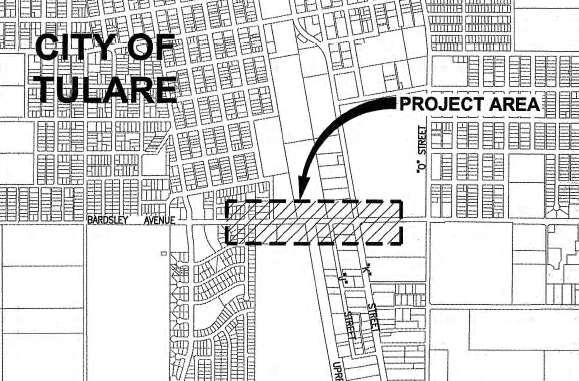
Tulare City Council approved a contract to build the new Bardsley rail underpass for $10.7 million to Clovis-based Emmett’s Excavation.The low bid was $1 million less than the engineer’s estimate.That means both grade separations (Cartmill was the other one) came in a total of around $3.2 million less than Measure R budgeted says city engineer Mike Whitlock.The city will ask TCAG if that $3.2 million can be applied to the new Cartmill interchange says Whitlock.The city is in final negotiations with property owners around the interchange with the goal being to “control the right of way by the end of this year.” The new Bardsley tunnel will begin construction in late February or early March. Whitlock says they opted for an underpass because there was no room for a bridge.
Category: Central Valley
It’s Alive… Aquatic Weed Chokes Friant Kern Canal

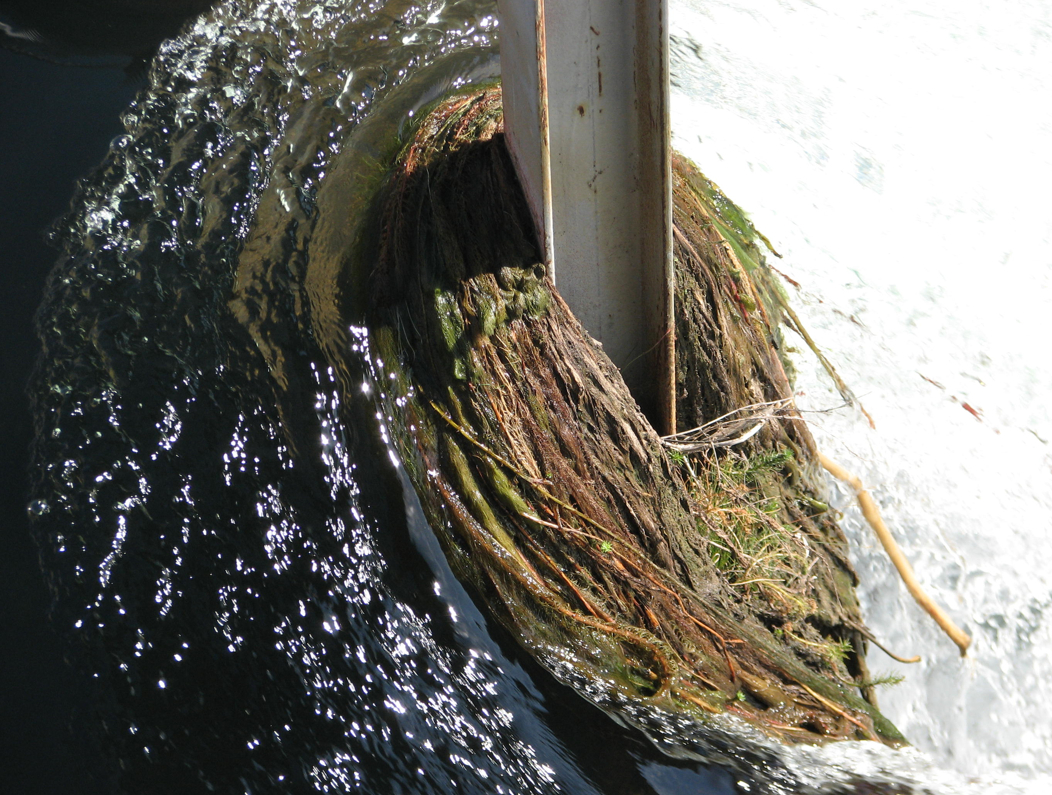
Water districts up and down the Central Valley will participate in a massive dewatering of the 152 mile Friant Kern Canal beginning this month to allow for chemical treatment on a 23 mile segment to fight Western watermilfoil, an aquatic weed that can grow 10 ft long that is clogging canals,water meters and micro irrigation sprinklers alike.
“It’s a huge problem” says Scott Edwards of Lindsay Strathmore Irrigation District who says the invasive weed “grows like kelp – forming huge mats of vegetation that are impeding water flow from Orange Cove all the way to Bakersfield.”
To make matters worse – when the canal water – filled with weed fragments – is pumped to irrigation spigots and micro-irrigation emitters, the small weed particles are covering tiny filters that protect the devices. “I’ve got 1000 meters out there in the district that need to be cleaned by hand and in this summer, they needed to be cleaned again a few hours later” adds Edwards.
The aquatic weed was first noticed in the Valley’s most important canal in 1998 near Hwy 180 and since has spread at least 23 miles south,well into Tulare County, says Eric Quinley maintenance manager for the 28 district Friant Kern. How did it get there? One story suggest somebody may have dumped their aquarium in the canal.”Nobody really knows” adds Quinley.
The problems has been getting worse particularly where the canal is earthen instead of concrete, says Quinley, through the Orange Cove and Stone Corral water districts.The earth allows the weed to plant itself and reproduce – to take root although this tough customer can attach itself in any crack in the concrete too.
The upshot is that the capacity of the vital canal that irrigates one million acres is increasingly compromised says Quinley. But it gets worse at the canal turnouts where each district takes water,requiring that maintenance staff clear the intake systems regularly right when water is most needed.
Floating Nightmare
The plant fragments and spreads rapidly in a nightmare scenario, the fragments grow roots,stems and leaves as they float along on the current.So the water carries the debris of this invasion with it – creating havoc wherever it flows. And it will be back next year – the plant is perennial.
“This plant poses a problem from the district all the way to the end user – the grower in the field” notes Quinley. In recent years growers have dramatically cut back on water use adopting micro irrigation technology that is now vulnerable to clogging from the plant’s voracious growth.
The Delano area on the canal route was hit hard this summer as this communication to growers explains.
”While it has had a presence in the Friant Kern canal for a number of years, 2012 was the first year that it became a major problem for Delano Earlimart ID. Milfoil has caused a number of operational problems for the District and its growers alike, from plugging pump intakes to clogging filter screens and emitters. The problem became so acute that at one point in August, the entire District shut down for a short period of time when milfoil completely clogged the trash screens within the Friant Kern, preventing water from entering the District’s mainlines. The milfoil has be-come so invasive and present in such massive quantities within the Friant Kern that it has taken the combined efforts” to tackle the problem.
The newsletter explains their staff is required to” keep the district’s intakes clean, requiring milfoil removal by hand twice a day, seven days a week just to keep water flowing …”
Quinley,who is in charge of doing battle with this dragon-like pest, doesn’t have a sword to slay the monster but does have a budget and a plan. So far, the Friant Water Authority has had to budget more than $1 million to handle this weed invasion but has high hopes this winter’s pre-emergent application will make headway in reducing the scale of the problems.
With work underway this month to begin the dewatering of the entire 152 mile canal for a 3 month period there are operational issues that must be tackled including the fact that municipal and ag contractors along the route will not have access to any water from the canal until March1, sooner if it can be managed.
A Drinking Problem
That‘s a problem in Orange Cove where 12,000 customers depend on the water for drinking along with irrigation customers who often don’t have much groundwater.
In Orange Cove the city council has had to spend $750,000 for a temporary supply of well water brought into the city. Improvements are required to convey the well water purchased from land owners through the Orange Cove irrigation District to the City water treatment system.Treatment is necessary due to the high level of nitrates found in the well water says a city staff report.
Canal water is used for drinking in Lindsay,Strathmore and Terra Bella too,all places with little groundwater and high nitrates too.
Lindsay Strathmore ID has municipal customers and supplies them from an alternative well source on the Kaweah River, not high in nitrates.
Quinley says in the past, the district has tried to remove the fast growing plant that grows underwater by hand,using mechanical devices and even treating small areas with chemicals but all attempts have fallen well short.
Now with the consultation of USDA and UC Davis the Friant district will go to war with the weed using several pre-emergent chemicals after the canal is dewatered and the silt is removed. The treatment with the chemicals should kill the emerging plant chutes next spring, everyone hopes.
To insure the chemicals applied do not hurt drinking water, Friant has been working with the state Dept of Public Health,Dept of Pesticide Regulation and the manufacturers to insure no harmful residues remain once the trillions of gallons of water refills the canal in March.The two chemicals- fluridone and imazamox are certified by EPA for use to treat drinking water. Of course the water will be tested before it enters the muni systems next spring.
A Choke Hold
Despite their best efforts this water loving weed like most weeds “may be with us forever” shrugs Edwards.
Farmers may not be big global warming believers but they do believe they that got a plant that was not here a few years ago with choke hold on their hydraulic empire that seems to like the heat.The NWS says we had 23 days of 100F or over in August in the Valley and across the US, September was the 16th straight month of higher than average temps in a row.
The consequence: farmers will have to do battle with this green monster from now on.

Tulare County: 20 Mile Quarantine Expected With 2nd Citrus Pest Find
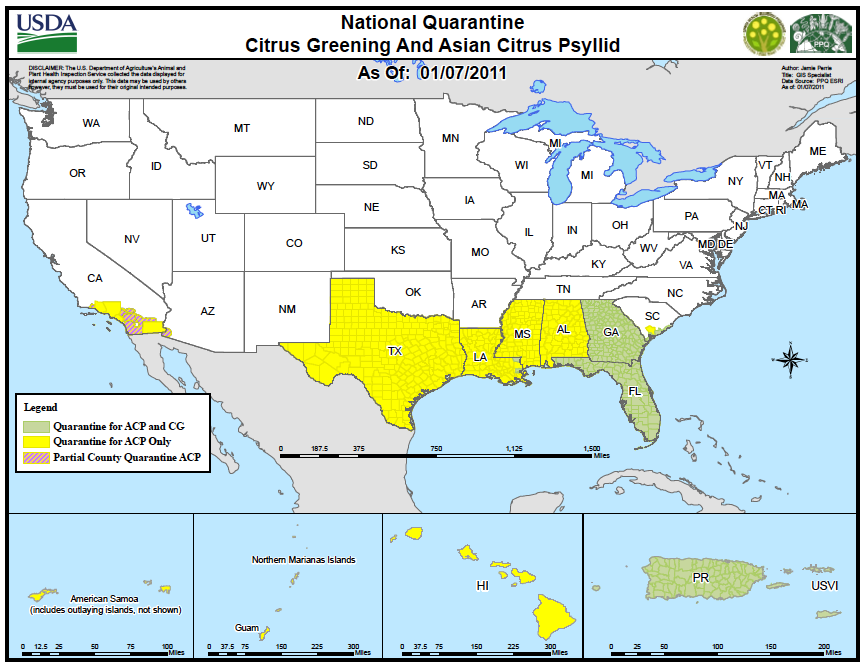
The discovery of a second find of a single Asian citrus psyllid in a Tulare County citrus grove insect trap near Strathmore is expected to spur CDFA and USDA to establish a 20 mile quarantine on any citrus plant material movement soon. So says Tulare County Agricultural Commissioner Marilyn Kinoshita who expects a formal announcement by CDFA tomorrow, November 20 after she was briefed today.
Kinoshita says this latest pest find dates from October but several tests were needed on the insect by USDA labs resulting in the announcement this weekend, weeks later, of the find by Kinoshita’s office.
“Since it’s the second find this year it looks CDFA will recommend to USDA the 20 mile quarantine zone be established.”
Kinoshita says a map of the zone will be made available on the ag commissioner’s web site but its rough boundaries would go from Woodlake, south to Ducor and the City of Tulare on the west, a large swath of Tulare County’s big citrus growing region along the eastern foothills.
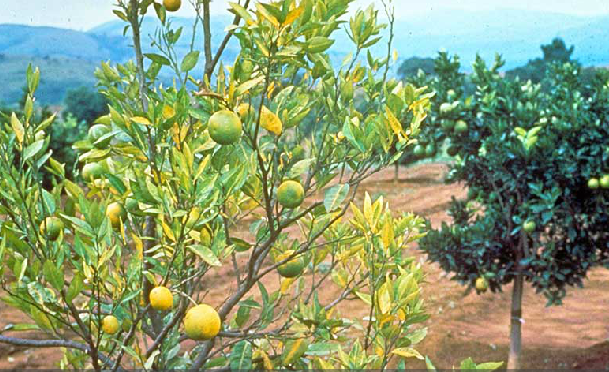
The dreaded pest can carry citrus greening disease that has devastated other citrus growing regions in the world including Florida in the US. The disease kills the trees after just a few years of being infected by the bacteria even as it stunts growth and production (see pic).

Kinsoshita says USDA will be testing trees near the find to see if they show any signs of the disease although there is a year long period before symptoms are seen. So far the tiny pest has been found in southern California as far north as Ventura County but not the dreaded disease. The first find of the insect in California came in 2008
The first find of a phyllid in Tulare County came in February 2012 and was found east of Lindsay. After the find, a dense quantity of pest traps were set up in citrus groves to determine if the insect was an isolated ”hitchhiker” from southern California or if the find signaled a potential infestation.
This time around CDFA seem to be worried about an infestation.
The citrus industry is the county’s number two crop after milk,valued at over $600 million annually with about 120,000 acres of citrus trees vulnerable to the voracious pest.
Kinsoshita says impact of the quarantine will hit growers who will now have to run all citrus fruit on rollers to remove any leaves or debris,nurseries who will face restrictions on plant movement unless the nursery trees are being grown under a screen and juice plants who will have to take extra precaution when they bring fruit in and out of the quarantine zone.

Kinoshita also says a citrus grower meeting to discuss the new quarantine zone will be held November 27 at a location to be announced.
Just what if any – impact on citrus exports to foreign countries will be remains to be seen depending on what those governments want to do.
One thing for certain.”Famers lives just got more complicated ”adds Kinoshita.
Judge Denies Injunction For High Speed Rail
Sacramento Superior Court Judge Tomothy Frawley denied a request for a preliminary injunction to halt work on construction of the Central Valley segment of the high speed rail line late today says a source answering the phone at Judge Frawley’s courtroom. The injunction sought by plaintiffs,including farm groups,would have prevented the rail authority from buying land along the proposed route and other work needed to move the huge project forward. The ruling is a key victory for the builders of the project.
“We welcome the Court’s ruling,” said Dan Richard, Chair of the California High-Speed Rail Authority Board of Directors. “Both the voters and the Legislature have spoken on High-Speed Rail. And since the Governor signed the bill modernizing the state’s transit system in July, we’ve made significant progress on many aspects of the program. The Judge’s decision ensures that we can continue to move forward with our preparatory work to build the first segment of high-speed rail in the Central Valley, with a plan to break ground next summer.”
Tulare / Kings Retail RoundUp
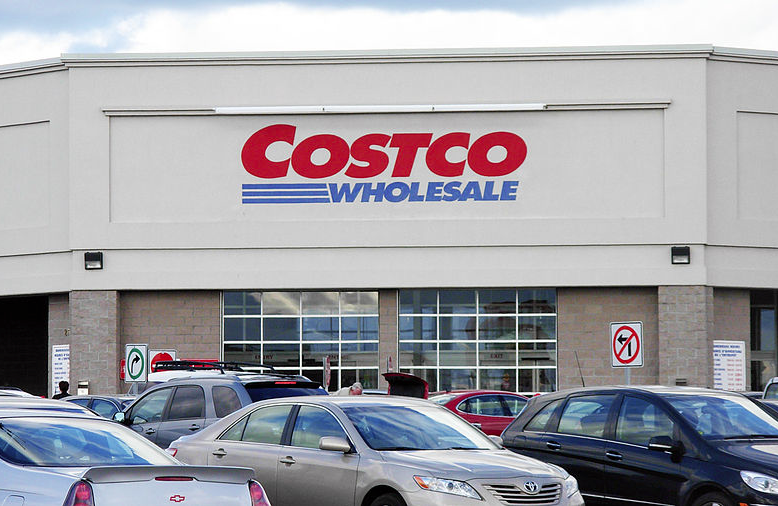
In Hanford the city council will offer sales tax incentives to Costco to locate at store on the east side of town.The council passed two resolutions this week.One resolution expands the Incentive Program to allow developers to receive sales tax incentive funds if a new retailer has sales in excess of $23 million a year. The developer for the project located at Hwy 198 and Hwy 43 is Fresno’s Kashian Group. A second resolution extends a reduction in Impact Fees for Development Projects for an additional 12-month period. The reduction will remain at 30% for Water, Wastewater System, Storm Water, Refuse and Recycling and Transportation Impact Fees. The city is already processing an environmental impact report for the potential 58 acre retail complex, now farmland.
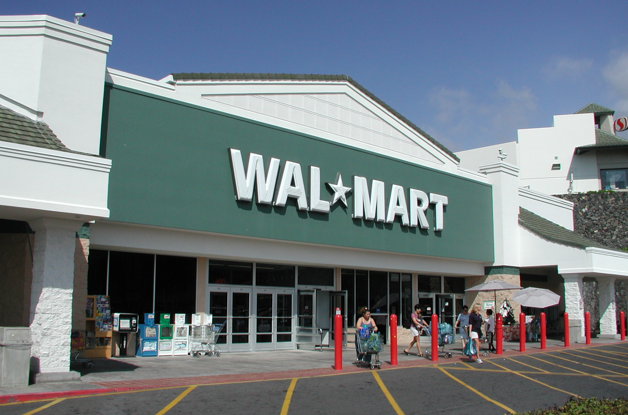
In Lemoore it appears Walmart may be throwing in the towel on their big plan.After years of delay, construction of a new Walmart Supercenter near the college is stalled again after the big retailer restarted a new EIR earlier this year but has not responded to city questions for months now. City planner Holly Smyth says a month ago Walmart who owns the 21 acre site, put up a For Sale sign on the parcel.
In both Tulare and Visalia, Bakersfield-based Smileland is proposing infill sites to put up new dental centers in retail districts.In Tulare they have filed for a permit to remodel the former Blockbuster at 1407 Hillman,reportedly buying the property. In Visalia, the company is buying two long vacant parcels on mid Mooney Blvd to erect a new dental clinic with extra leasable space. The Mooney properties have been sore thumbs on the strip for several decades, an old transmission shop and cabinet shop next to IHOP. Smileland will be 2 story, 8000sf .
Also on Mooney in Visalia, Shiekh Shoes, a leading specialty retailer of lifestyle footwear and apparel with more than a 134 stores is preparing to file remodeling plans for the former Copeland Sports building on Tulare and Mooney. The 14,700sf space has been vacant for years and had attracted interest from Fresh & Easy who are now out of the picture. Sheikh has stores in California, Nevada, Texas, Arizona, New Mexico, Washington and Oregon.Its product selection is aimed at the teenaged urban market, featuring athletic footwear and apparel from brands like Nike, Jordan, Adidas, Reebok, K-Swiss, Sketchers, Lacoste, Converse, and DC Shoes including many exclusive products not sold by other retailers. Shiekh Shoes also manufactures and sells its own brand of footwear, which is only available through its stores and website.Most locations like two in Fresno, are at malls.
More Mooney Moves; The Visalia Staples store on South Mooney will relocate to a downsize location in the same Dick Sporting Goods-anchored shopping center according to a plan filed with the City of Visalia. The office supply retailer submitted tenant improvement plans on a smaller 17,000 sf storefront next to Dicks enabling them to vacate their larger 29,000 sf store just south.Sources say the vacated space will provide a chance for a new retailer to Visalia to locate here.
Visalia Eateries Come & Go; This week, Bravo Farms opened their new “Smokehouse – Modern Barbeque” on Willis, the site of the old Wagon Wheel Steakhouse. Led by chef Jonathan Van Ryn,Bravo Farms will also open its new Kettelman City gift shop and ice cream parlor next year. Closing recently is El Presidente restaurant and bar on Santa Fe, a long time Visalia Mexican eatery.
Dollar Wars: Small town retail continues strong in Tulare County now coming to Ivanhoe, population 800 north of Visalia, with plans filed to construct a new Family Dollar Store at the corner of Ave 328 and Rd 168. Meanwhile competitor Dollar General has filed plans for a new store in Woodlake along Naranjo. Woodlake already has a Family Dollar.The same two competitors will soon go head to head in nearby Farmersville and Tulare as well.
Election Could Mean Green Light For Green Projects In Central California
Results of the presidential election should boost the spirits of supporters of green energy and green transportation projects in Central California. Critics on the other hand are disappointed but not giving up on thwarting these “boondoggles.”
“Without his $8 billion in High Speed Rail stimulus, half of which has gone to California, it’s unlikely that construction would be taking place on the first segment of the project next year” admits high speed rail fan and blogger Robert Cruickshank, pointing to Obama’s key role in the huge Central Valley project.
One group who had vowed to float a new voter referendum to stop the state project pulled the plug on the idea a few days ago with an inadequate number of signatures hoping pending lawsuits will do the trick. Meanwhile, Valley rail critic, House GOP representative Jeff Denham,one of the loudest opponents in Congress, has won reelection so the debate will continue.
State lawmakers have already approved spending $5.8 billion, including $2.6 billion in state rail bond funds, to begin construction of the line hoping to curb pollution in the Valley with 200mph bullet trains.
Obama vs Romney
If Romney had been elected this week it seems clear he would end all efforts to build such a high speed rail system having already called for an end to Amtrak subsidies.
Meanwhile, candidate Romney had also vowed to pull the plug on green energy projects in the US including several billion in loan guarantees on solar,clean coal and wind projects being proposed or already being built in Central California.
Mitt Romney’s presidential campaign came out against extension of the wind industry tax credits vowing to let it “expire” and also claiming that about half of $90 billion pledge in tax breaks for green energy have gone to companies that went belly up like now-bankrupt solar panel manufacturer Solyndra.
But the real number is only three of the 33 companies that received DOE loans have failed, representing under 2 percent of federal money budgeted.
A recent advertisement from the Romney campaign suggested such stimulus money was a boondoggle but FactCheck.org – responded by highlighting several Central California projects.
”The Romney ad targets the solar company SunPower, saying: “More than a billion dollars in loan guarantees. Lost half a billion last year. Laying off workers.” The FactCheck response continues.
“On Sept. 30, 2011, SunPower got a $1.2 billion loan guarantee to build the California Valley Solar Ranch Project, a 250-megawatt solar plant in San Luis Obispo County, Calif. And SunPower reported an operating loss of $534 million last year. But after that, the ad’s case starts to fall apart.
Before any federal funds were released, SunPower sold the project to NRG Energy. So NRG is the owner of the loan guarantees and the company responsible for repaying them. SunPower is now the lead contractor on the project.
Despite its losses, SunPower is financially solvent, and– as the same KGO-TV report cited in the Romney ad notes — the company’s new majority stockholder is Total, “a French company that ranks among the top oil and energy companies in the world.”
As for SunPower layoffs, according to a public filing with the SEC last November, the company did announce that it would be laying off 85 employees. But as was the case with First Solar, most of those layoffs were overseas, and represented a small fraction of the company’s global workforce. In its public filing, the company stated that it was consolidating or closing facilities in Europe “in response to reductions in European government incentives, primarily in Italy, which have had a significant impact on the global solar market.” The number of layoffs ended up being less, a company spokeswoman told us, and together with newly created jobs, the net reduction was 41 jobs.
More important, the jobs related to the DOE-backed California Valley Solar Ranch( in San Luis Obispo) are unaffected. According to SunPower, more than 350 workers are currently constructing the solar power plant. The plant, company officials said, will begin generating 25 megawatts of power by September, and when completed will generate enough electricity to power 100,000 California homes (and is already contracted to do so).”

Bigger Than Anything
A similar tale surrounds First Solar who also has sold their SLO project with the loan guarantee money never touched and the huge green project under construction. Such government loan guarantees are common in plenty of businesses including small business lending and housing including the now famous auto bailout that helped Obama win Ohio.
Between the two huge green energy projects, San Luis Obispo has added about 1600 jobs and the county’s unemployment rate has dropped to 7.4% The two large commercial solar plants are set to produce 800 megawatts of power – enough to power 260,000 homes.
These deals have firm contracts in place to buy the power. The SLO Tribune pointed out a few weeks ago ”The California Valley Solar Ranch will be in the top 10 solar plants in the world, said Fong Wan, PG&E’s vice president of energy procurement. The utility has contracted to buy both plants’ electricity for the next 25 years.
“When combined, they are clearly bigger than anything in the world,” Wan said.”
Looking at the US energy loans eighty-seven percent of the DOE funds were used to back loans to power generation projects, mostly solar and wind, which otherwise would have had a difficult time accessing financing. A relatively small portion of this money went to fund technology start-ups – including Solyndra.
Regarding the wind tax credits there is no doubt they have worked well points out the LA Times.” Since its enactment in 1992, wind generation in the United States has grown from almost zero to about 47,000 megawatts, according to a study done by Lawrence Berkeley National Laboratory for the Energy Department.”
Obama critics had also counted on Romney pulling the plug on Obamacare “on day one” that will also not happen now – instead offering health insurance to thousands in Central California who do not have health insurance.
One of the biggest green energy projects important to help cut greenhouse gases that cause global warming and rising sea levels is the voter approved California High Speed Rail project supported big time by Democrats in both the White House and Sacramento state house.
Again a major focal point right now is the Central Valley.
Funded and awaiting the green light to start construction on a 28 mile section (Madera-Fresno) of a 110 mile stretch between Madera and Bakersfield next year, opponents are doing everything they can in court to derail the project or at least slow this train down.
A lawsuit to halt work on the project comes from several Farm Bureau led entities with Sacramento Superior Court Judge Timothy Frawley scheduling a hearing for Nov. 16. Frawley will hear a request from the plaintiffs for a preliminary injunction to stop construction due to what they call the deficiencies in the CEQA process.
Opponents hope to delay the project long enough to kill the Federal funding. But in CEQA law the bar is set fairly high, say attorneys, for a judge to allow an injunction especially if it could kill it.
In September Obama ordered CHSR to be fast tracked.
But clearly, the huge project faces delays in any case.
California High Speed Rail Authority CEO Jeff Morales who worked for both Chicago Transit and Cal Trans before joining the CHSRA this summer recently announced the Authority would postpone opening construction bids due earlier this month, on the 28 mile segment north of Fresno until January 15.
Morales said the five consortiums vying to build the line “are serious and asking all the right questions” suggesting the delay will likely result in more competitive bids on the state’s largest public works project with the 110 mile segment expected to cost between 1.2 billion to $1.8 billion. He expects construction on this 28 mile segment to start next June.
Meanwhile,the next segment in the Valley is Fresno – Bakersfield where the draft EIR has now closed comments as of October 19 with the Authority anticipating certification of this EIR in mid-2013.
Morales says with CEQA certification of this Fresno to Bakersfield span we would find out which alignment through Kings County will be selected and If Tulare/Kings gets a station or not and the preferred location for the planned 1500 job heavy maintenance station.
In an additional boost to Californian a state law will require the trains be built in-state.
More Lawsuits
In the most recent comments submitted to the Authority, Visalia has asked the CHSRA to select the east-of-Hanford route to locate the station closer to the big population centers in Tulare County.
Kings County has commented that it fears loss of Amtrak service to Hanford noting that Hanford is the third busiest stop on the San Joaquin line. “The loss of a station in Hanford would mean a yearly loss of 90,000+ Amtrak riders. At an average ticket price of $50, this would mean a loss of $4,500,000 yearly. If the average ticket cost of $100 is used, it would be a loss of $9,000,000 yearly. Add in the loss of revenue from hotel rooms, food, gas, rental cars, and merchandise, and the yearly loss is considerably more. The EIR-EIS indicates that existing riders would shift to HST service as it becomes available. Based on existing Amtrak ticket prices and the estimated cost of HST, it is unlikely that most riders would shift.”
While the City of Hanford did not want the high speed route to go through their town that put the track out on Kings County farm land.
Kings County is siding with farmers here who oppose the project.The Kings County Farm Bureau is preparing to file a similar lawsuit to Merced and Madera’s Farm Bureaus over concerns about HSR’s impact on farmland along the proposed Fresno-to-Bakersfield route says their program director Diana Peck. They say 13 dairies in the county are in the path of the train.
Milk Co-ops Plead For Relief One More Time
On election’s eve California’s strapped dairy operators are back at CDFA’s ag secretary’s front door pleading for a change in the milk pricing formula in California that might offer them ”emergency” relief.
Informed sources insist that after being rebuffed several times, the latest petition just might bear fruit.
This latest request for a public hearing, the third this summer,was filed November 2 and penned by the state’s three big dairy co-ops,California Dairies, Dairy Farmers Of America and Land O Lakes. They ask for the so-called 4b price formula to be adjusted higher for a 12 month period. Ross has yet to respond but has announced that she would take a good look.
The Secretary has 15 days to respond to the petition’s hearing request. If a hearing is granted, it could be held as early as December 1.
The petition lays out how feed cost have gone up about 55% since 2010 and the cost of feed makes up 70% of the cost of making milk. Impacted severely by the Midwest drought this year the letter concludes that while there is merit in forging a “strong foundation and a viable dairy industry … our members need to survive in the short term first.”
A closed door meeting a few weeks ago with ag secretary Karen Ross,a representative of the governor and producer leaders may have set the stage for this latest attempt,the third in a matter of months, to adjust the milk formula for cheese,that accounts for about half the milk produced in California.
Ross has a tough balancing act in considering the price paid by cheese makers to California’s milk producers. The state wants to offer incentives to the state’s big cheese industry to accept the higher cost of doing business here offset with a slightly lower cost of milk than they can get elsewhere.
California‘s dairymen are the nation’s low cost producers but the drought this year has rejiggered the economics such that an estimated 100 dairies have called it quits this year alone, many solid multi-generation operations held in high regard. Big dairy counties like Kings are reporting about 10% less milk being produced and San Bernardino is down 11% in September vs a year earlier.
In recent months the scale of the suffering has been overwhelming and Ross may now be ready to compromise rather than just say no once again.
California’s newly formed 28-member Dairy Future Task Force — composed of dairy producers, processors and cooperatives — held its first meeting late last month to address immediate and long-term challenges facing the state’s dairy industry last month in a meeting attended by Ross. Ross announced the panel’s creation earlier this summer, after hearing a petition by producer groups to adjust the state’s whey factor in Class 4b minimum milk pricing formula. The action came in the face of skyrocketing drought-related feed costs, forcing many producers into bankruptcy.
Secretary Ross issued a statement following the task force’s meeting: “The Dairy Future Task Force is made up of dairy producers, processors and cooperatives asked to come together to find common ground upon which they can build a new, more stable and contemporary path for the dairy industry. The first session, held October 23-24, provided an opportunity to agree on a common fact base and develop a sense of what the group wants to accomplish in the coming months. The task force achieved alignment around a shared vision for the future of the California dairy industry, which is a significant accomplishment and a key step toward long-term success. ”
Expedited Review
“Based on the discussion of concepts for potential short-term solutions, CDFA anticipates receiving a petition shortly and will evaluate it on an expedited basis. I very much look forward to working with the talented and passionate producers and processors who are willing to provide leadership to this very important sector of the agricultural community,” added Ross.
Ross also faces a lawsuit from some producers (not the petitioners) and has seen several noisy rallies held on her front steps in Sacramento in the past few months where the rhetoric got pretty rough.
The good news- milk commodity prices are rising.
One of the groups who has sued CDFA, California Milk Producers, say that the latest October figures show cheese makers paid $19.43 per hundredweight -” a vast improvement over the recent prices (in fact, it’s the highest Class 4b price reported since 2007), but a steep discount that cheese makers in Federal Milk Marketing Orders paid last month – $21.02 per hundredweight, a whopping $1.59 per hundredweight above the California Class 4b price. Using a
conservative estimate of 1.3 billion pounds of milk equates to more than $20,000,000” difference the group says.
California cheese makers are a huge engine for the state’s economy but you can not make cheese if you don’t… Got Milk.
If this does not work, the state’s dairy co-ops may be ready to try a federal marketing order the co-ops announced this week while another group plans to work on legislation.
California Dairies Inc Buying SoCal Diary Co-op

Visalia-based California Dairies Inc.(CDI) has purchased the assets of Security Milk Producers Association,a milk cooperative that produces around 1.3 billion pounds of milk a year with sales if around $300 million. According to CDI’s president Andrei Mikhalevsky, the CDI board will finalizes a deal this week at their regular meeting.
By contrast CDI has some 490 members, produces 16.9 billion pounds milk annually and is the nation’s second largest milk cooperative. revenues in excess of $3 billion have been cited.
California Dairies, Inc. is the result of a 1999 merger of three of California’s most financially successful cooperatives; California Milk Producers, Danish Creamery and San Joaquin Valley Dairymen.
Less Milk
Mikhalevsky notes that this year milk volumes have been down around 5% from its historic range and is expecting that in 2013 member milk volume will be down around 4% largely due to the loss of some producers who have exited the business and the tough margins in the the business right now.
Mikhalevsky says Security has no physical assets except their fleet of trucks that deliver milk to Southern California processors. Most LA kids drink Security milk in their morning cereal every day.
Security general manager Hank Perkins said he could not comment but a another Security official who declined to be identified says the merger approved makes sense “because CDI already is very efficient and we need to work together to get prices up in California.” The dairyman says “things are really rough right now with the high feed prices.”
A few years ago Perkins was searching in Tulare County for a site to build a milk plant.Sources say Security,more recently, was looking to buy a so-called balancing plant that would convert milk to powder when processors did not take all the fluid milk the co-op produced but lost an opportunity and decided to hook up with CDI who has a large balancing capacity.
Both dairy co-ops have been lobbying CDFA ag secretary Karen Ross to modify rules that affect how much the state’s dairymen get for their product sold to cheese companies. California dairy producers say cheese makers pay much less here than dairymen are paid outside of California for their milk.
After some heavy lobbying there are signs Ross may entertain a new hearing on the matter sources say.
Higher Ag Income Fuels Demand For “Good Ground”

With the exception of the dairy sector the rest of the Valley’s farm commodity markets are having a banner year and that is fueling demand for farm properties says Jim Olivas,a veteran farm realtor with Pearson Realty. “Prices for farmland are up 30% in the past two years in Kings and Tulare counties “says Olivas who says he” has just one word for it… unbelievable”.
Olivas adds that his biggest struggle is finding suitable properties for buyers. The increase in sales activity is confirmed by Visalia Wells Fargo bank manager Bill Hoover who offers “We’re just slammed with loan applications and the appraisers are too” noting that some of the activity may have to do with the approaching year-end tax deadline and potential changes in the tax code.
Noting the extremely low loan interest rates right now – banks and appraisers say they are busy with refinance applications as well.
Farmland broker John Grimmius say “investors now have the sentiment that with all the dollars being printed and bonds being bought up – people want to invest in something that won’t fly away – like farmland.”
Visalia appraiser Keith Hopper agrees. “It’s not just good commodity prices but the fact this investment is tangible and the rates of return are very good compared to other ways to invest money.”
Role Reversals
Hopper adds that the economics favor not just open land in the countryside but so called transitional land near urban areas like Visalia.
Historically, this land would be much higher in value because of the opportunity to covert it to urban uses like new home subdivisions.Today, the market for some of those edge-of-town lands is “to plant permanent plantings, like walnuts” says Hopper.”These investments are long term,at least a decade.” With much less new development slated in urban areas, the price and demand for land held to be converted to subdivisions later is down while farmland is up. It is a role reversal from where it was just a few years ago.”
If they are not selling as many new homes here, California is selling lots more more fruit and nuts overseas with record crop sales appearing to be a driving force.
Commodity Prices Drive Higher
Just last week, the USDA reported walnut sales for the crop year ending Aug 31,2012 averaged $1.46 per pound compared to $1.02 the year before, 85 cents in 2009 and 64 cents in 2008. Raisin prices were at record levels in the latest crop year as well with prices at $1,632 per ton compared to $1.489 in 2010, $1292 in 2009 and $1,273 in 2008.
Then there’s almonds who set a record too. US domestic almonds shipments of 48.3 million pounds were 11% ahead of 2011 while export shipments (91.4 million pounds ) were up 34%. Total shipments were 139.6 billion pounds or 25.2%. In 2011, for the first time ever, the value of the California almond crop surpassed the state’s iconic grape industry to move into second place, behind dairy.
Acreage Up Nearly 4X
Forty years ago, California farmers produced less than 100 million pounds of almonds on about 200,000 acres of almond orchards. Mechanization, improved irrigation efficiency, advances in insect and disease management, pruning research and fertilization studies have fueled explosive growth in the industry. Farmers in California’s Central Valley now tend 760,000 acres of almond trees, producing about 2 billion pounds of shelled nuts a year. “Even with this record production, we have more demand than we have supply,” said Bob Curtis of the Almond Board.
Grapes and nuts were not alone with USDA reporting in the past few weeks that cattle income was up 20%,greenhouse nursery up 14% and hay income was up 68% in this most recent crop year ending August 31.
Like so much in the state’s ag sector – hay is up on export demand,to China of all places. Alfalfa exports to China from America ballooned to 177,423 metric tons in 2011 from 2,321 metric tons in 2007, and they are on pace to exceed 380,000 metric tons in 2012 says the Wall Street Journal.
Another Role Reversal
There is even opportunity knocking in the troubled dairy sector but more to do with the potential conversion of large dairy field cropland,used to grow feed,and dairies themselves into other crops.
“Right where I am standing (on a Kings County dairy) everywhere I look I see land being planted to pistachios” shrugs Hanford dairyman Joaquin Contente. Jim Olivas confirms the trend. ”I have a dairy owner who is downsizing and there are plenty of offers for his land”.
Ag broker John Grimmius who specializes in dairy has seen it all. The boom years where scores of dairies from the Southland relocated to Kern, Kings and Tulare Counties pushing up demand for open ground. The number of cows in Tulare County went from around 60,00 in 1970 to just under half a million in 2011 with an equal number of replacement animals that all need to be fed and surrounding crop used to deposit manure. Translation,lots of land needed.
”As recently as 2008 it was dairy buyers who were crowding out other buyers because they could pay more.”
Not today. Because of several tough years for milk prices and the sky high cost of feed – it is now dairy operators who are being crowded out, says Grimmius. Another role reversal.
Dairyman Contente says because his industry is dependent on feed from the Midwest he would like to buy more land to grow more of his own feed but can’t compete with investors wanting to plant trees.
“I can’t afford to pay $15,000 to 18,000 an acre like they can.”
Grimmius points out another factor that mirrors what is happening in the existing home sales market right now.”It’s a tight market because landowners don’t want to sell unless they have to.”
With low returns elsewhere in the economy and fear on Wall Street “ag land sales are in a perfect storm right now, when you consider how much demand is way up” says Pearson real estate agent Mark Johnson.
The increase in farmland values reflects crop values like in Kings County where last year the dollar value of crops produced was up 29%.
Retail News / Staples & Walmart
Visalia Staples Will Move Next Door
The Visalia Staples store on South Mooney will relocate to a downsize location in the same Dick Sporting Goods-anchored shopping center according to a plan filed with the City of Visalia. The office supply retailer submitted tenant improvement plans on a smaller 17,000 sf storefront next to Dicks enabling them to vacate their larger 29,000 sf store just south.Sources say the vacated space will provide a chance for a new retailer to Visalia to locate here.
Visalia Walmart,Lemoore Walmart On Different Paths
The City of Visalia is recirculating the EIR on the expansion of the Noble Ave Walmart after the Superior Court found in favor of plaintiffs that more analysis was needed on construction impacts of the expansion that will add a groceries.The city expects the new analysis should satisfy the court and the addition of a grocery store allowed.Right now the city is awaiting comments with the final plan to be certified by city council. Also in town Walmart is building a new Neighbored Grocery Store at Demaree and Houston.
In Lemoore it appears Walmart may be throwing in the towel.After years of delay, construction of a new Walmart Supercenter near the college is stalled again after the big retailer restarted a new EIR earlier this year but has not responded to city questions for months now. City planner Holly Smyth says a month ago Walmart who owns the 21 acres, put up a For Sale sign on the parcel.