
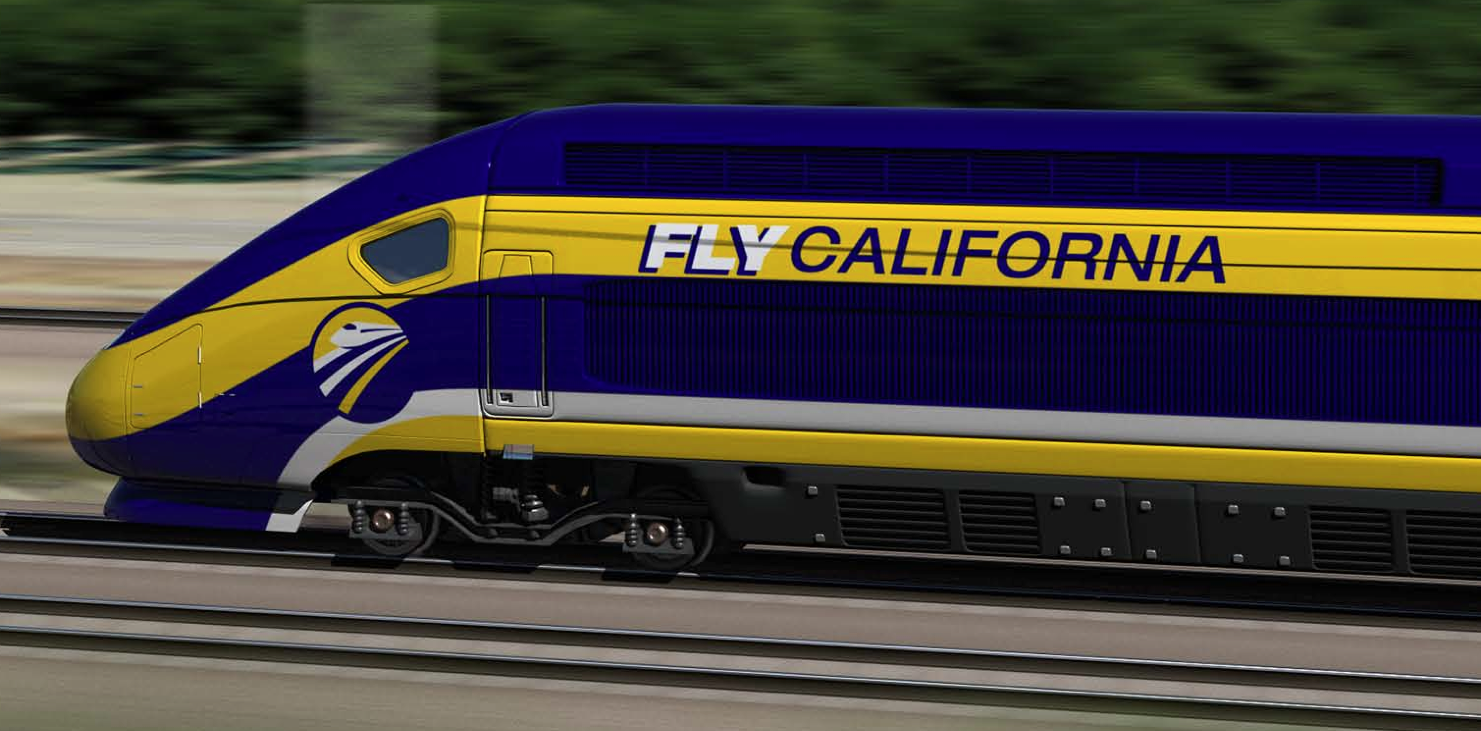
Results of the presidential election should boost the spirits of supporters of green energy and green transportation projects in Central California. Critics on the other hand are disappointed but not giving up on thwarting these “boondoggles.”
“Without his $8 billion in High Speed Rail stimulus, half of which has gone to California, it’s unlikely that construction would be taking place on the first segment of the project next year” admits high speed rail fan and blogger Robert Cruickshank, pointing to Obama’s key role in the huge Central Valley project.
One group who had vowed to float a new voter referendum to stop the state project pulled the plug on the idea a few days ago with an inadequate number of signatures hoping pending lawsuits will do the trick. Meanwhile, Valley rail critic, House GOP representative Jeff Denham,one of the loudest opponents in Congress, has won reelection so the debate will continue.
State lawmakers have already approved spending $5.8 billion, including $2.6 billion in state rail bond funds, to begin construction of the line hoping to curb pollution in the Valley with 200mph bullet trains.
Obama vs Romney
If Romney had been elected this week it seems clear he would end all efforts to build such a high speed rail system having already called for an end to Amtrak subsidies.
Meanwhile, candidate Romney had also vowed to pull the plug on green energy projects in the US including several billion in loan guarantees on solar,clean coal and wind projects being proposed or already being built in Central California.
Mitt Romney’s presidential campaign came out against extension of the wind industry tax credits vowing to let it “expire” and also claiming that about half of $90 billion pledge in tax breaks for green energy have gone to companies that went belly up like now-bankrupt solar panel manufacturer Solyndra.
But the real number is only three of the 33 companies that received DOE loans have failed, representing under 2 percent of federal money budgeted.
A recent advertisement from the Romney campaign suggested such stimulus money was a boondoggle but FactCheck.org – responded by highlighting several Central California projects.
”The Romney ad targets the solar company SunPower, saying: “More than a billion dollars in loan guarantees. Lost half a billion last year. Laying off workers.” The FactCheck response continues.
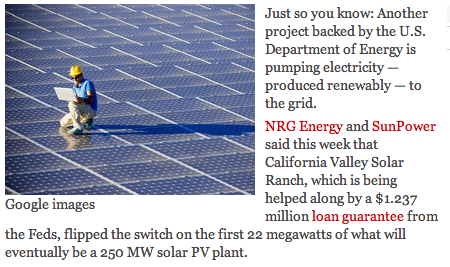
“On Sept. 30, 2011, SunPower got a $1.2 billion loan guarantee to build the California Valley Solar Ranch Project, a 250-megawatt solar plant in San Luis Obispo County, Calif. And SunPower reported an operating loss of $534 million last year. But after that, the ad’s case starts to fall apart.
Before any federal funds were released, SunPower sold the project to NRG Energy. So NRG is the owner of the loan guarantees and the company responsible for repaying them. SunPower is now the lead contractor on the project.
Despite its losses, SunPower is financially solvent, and– as the same KGO-TV report cited in the Romney ad notes — the company’s new majority stockholder is Total, “a French company that ranks among the top oil and energy companies in the world.”
As for SunPower layoffs, according to a public filing with the SEC last November, the company did announce that it would be laying off 85 employees. But as was the case with First Solar, most of those layoffs were overseas, and represented a small fraction of the company’s global workforce. In its public filing, the company stated that it was consolidating or closing facilities in Europe “in response to reductions in European government incentives, primarily in Italy, which have had a significant impact on the global solar market.” The number of layoffs ended up being less, a company spokeswoman told us, and together with newly created jobs, the net reduction was 41 jobs.
More important, the jobs related to the DOE-backed California Valley Solar Ranch( in San Luis Obispo) are unaffected. According to SunPower, more than 350 workers are currently constructing the solar power plant. The plant, company officials said, will begin generating 25 megawatts of power by September, and when completed will generate enough electricity to power 100,000 California homes (and is already contracted to do so).”
Bigger Than Anything
A similar tale surrounds First Solar who also has sold their SLO project with the loan guarantee money never touched and the huge green project under construction. Such government loan guarantees are common in plenty of businesses including small business lending and housing including the now famous auto bailout that helped Obama win Ohio.
Between the two huge green energy projects, San Luis Obispo has added about 1600 jobs and the county’s unemployment rate has dropped to 7.4% The two large commercial solar plants are set to produce 800 megawatts of power – enough to power 260,000 homes.
These deals have firm contracts in place to buy the power. The SLO Tribune pointed out a few weeks ago ”The California Valley Solar Ranch will be in the top 10 solar plants in the world, said Fong Wan, PG&E’s vice president of energy procurement. The utility has contracted to buy both plants’ electricity for the next 25 years.
“When combined, they are clearly bigger than anything in the world,” Wan said.”
Looking at the US energy loans eighty-seven percent of the DOE funds were used to back loans to power generation projects, mostly solar and wind, which otherwise would have had a difficult time accessing financing. A relatively small portion of this money went to fund technology start-ups – including Solyndra.
Regarding the wind tax credits there is no doubt they have worked well points out the LA Times.” Since its enactment in 1992, wind generation in the United States has grown from almost zero to about 47,000 megawatts, according to a study done by Lawrence Berkeley National Laboratory for the Energy Department.”
Obama critics had also counted on Romney pulling the plug on Obamacare “on day one” that will also not happen now – instead offering health insurance to thousands in Central California who do not have health insurance.
One of the biggest green energy projects important to help cut greenhouse gases that cause global warming and rising sea levels is the voter approved California High Speed Rail project supported big time by Democrats in both the White House and Sacramento state house.
Again a major focal point right now is the Central Valley.
Funded and awaiting the green light to start construction on a 28 mile section (Madera-Fresno) of a 110 mile stretch between Madera and Bakersfield next year, opponents are doing everything they can in court to derail the project or at least slow this train down.
A lawsuit to halt work on the project comes from several Farm Bureau led entities with Sacramento Superior Court Judge Timothy Frawley scheduling a hearing for Nov. 16. Frawley will hear a request from the plaintiffs for a preliminary injunction to stop construction due to what they call the deficiencies in the CEQA process.
Opponents hope to delay the project long enough to kill the Federal funding. But in CEQA law the bar is set fairly high, say attorneys, for a judge to allow an injunction especially if it could kill it.
In September Obama ordered CHSR to be fast tracked.
But clearly, the huge project faces delays in any case.
California High Speed Rail Authority CEO Jeff Morales who worked for both Chicago Transit and Cal Trans before joining the CHSRA this summer recently announced the Authority would postpone opening construction bids due earlier this month, on the 28 mile segment north of Fresno until January 15.
Morales said the five consortiums vying to build the line “are serious and asking all the right questions” suggesting the delay will likely result in more competitive bids on the state’s largest public works project with the 110 mile segment expected to cost between 1.2 billion to $1.8 billion. He expects construction on this 28 mile segment to start next June.
Meanwhile,the next segment in the Valley is Fresno – Bakersfield where the draft EIR has now closed comments as of October 19 with the Authority anticipating certification of this EIR in mid-2013.
Morales says with CEQA certification of this Fresno to Bakersfield span we would find out which alignment through Kings County will be selected and If Tulare/Kings gets a station or not and the preferred location for the planned 1500 job heavy maintenance station.
In an additional boost to Californian a state law will require the trains be built in-state.
More Lawsuits
In the most recent comments submitted to the Authority, Visalia has asked the CHSRA to select the east-of-Hanford route to locate the station closer to the big population centers in Tulare County.
Kings County has commented that it fears loss of Amtrak service to Hanford noting that Hanford is the third busiest stop on the San Joaquin line. “The loss of a station in Hanford would mean a yearly loss of 90,000+ Amtrak riders. At an average ticket price of $50, this would mean a loss of $4,500,000 yearly. If the average ticket cost of $100 is used, it would be a loss of $9,000,000 yearly. Add in the loss of revenue from hotel rooms, food, gas, rental cars, and merchandise, and the yearly loss is considerably more. The EIR-EIS indicates that existing riders would shift to HST service as it becomes available. Based on existing Amtrak ticket prices and the estimated cost of HST, it is unlikely that most riders would shift.”
While the City of Hanford did not want the high speed route to go through their town that put the track out on Kings County farm land.
Kings County is siding with farmers here who oppose the project.The Kings County Farm Bureau is preparing to file a similar lawsuit to Merced and Madera’s Farm Bureaus over concerns about HSR’s impact on farmland along the proposed Fresno-to-Bakersfield route says their program director Diana Peck. They say 13 dairies in the county are in the path of the train.