
August 9,2018-
From South Valley Water Assn newsletter
SJR Settlement Offers Friant Protection from State Board Action
Upcoming:
Aug. 22-23 — State Water Resources Control Board to vote on flow requirements from tributaries to the lower San Joaquin River
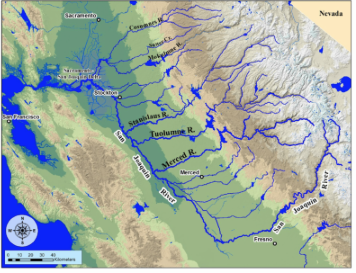 The San Joaquin River Restoration settlement is looking like it may be the better game in town for Friant farmers.
Especially now that the State Water Resources Control Board is considering a proposal to require tributary rivers to the lower San Joaquin (the Stanislaus, Tuolumne and Merced rivers) to deliver an average of 40 percent unimpaired flows to the delta.
The range is a low of 30 percent to a high of 50 percent unimpaired flows. Unimpaired flows are essentially what would come down the river naturally.
That’s a potentially huge bite out of water used by farms and cities throughout the Central Valley.
“It’s a big deal,” agreed Dan Vink, Executive Director of South Valley Water Association (SVWA). “And it’s a clear indication that if we didn’t have the settlement on the upper San Joaquin, the State Board would be in our backyard right now demanding the same type of flows.”
Vink added, “there has been a lot of talk since the settlement was agreed to about repealing it, but that perspective misses the full picture. Sure, at the time we could not have predicted what would be going on now with the State Board, but those are the facts on the ground today. Walking away without a plan makes for good political fodder, but it’s not relaitistic and would only take more water from Friant farmers than they are giving up today.”
The settlement, entered into in 2006, required South Valley farmers to give up a certain amount of river water, it’s true.
But not nearly as much as the State Board is seeking from the tribs (nearly double what growers release on the upper San Joaquin).The settlement also established a fishery habitat improvement plan and federal money was added to the mix to make it happen.
“In hindsight, we made a darn good deal,” said Alex Peltzer, General Counsel for SVWA
Actually, the state is hoping to make similar voluntary settlement deals with water users along the tributaries, according to State Water Resources Board Member Joaquin Esquivel.
“I’ve said over and over that voluntary settlements are more durable and have the potential to use less water” than the proposed 40 percent flows, Esquivel said.
Nothing is set in stone at this point, Esquivel said.
What the board really wants is a plan to improve fishery habitat and help multiple species survive. It only has authority over river flows, however.
In some cases, depending on the river landscape, how the water is used and at what times of the year, flow needs could be less than 40 percent.
“The proposal before us is just a way to define a block of water,” Esquivel said. “But the goal is functional flows, how the water is used.”
The board is scheduled to vote on the proposal toward the end of August.
Even after that vote, though, Esquivel said the board will be open to settlement proposals.
So far, settlements have been elusive even though this issue has been batted around for the better part of a decade.
In an interview on Valley Public Radio Tuesday, Cannon Micheal, farmer and Chair of the San Luis & Delta-Mendota Water Authority said settlements haven’t been forthcoming because the state is starting with a 40-percent target rather than seeking cooperation to formulate a fishery plan.
Micheal listed several areas in the state where water users have voluntarily found ways to restore fisheries, such as the salmon fishery in Butte Creek, without disruption to water rights.
That happened, he said, because water users’ options weren’t limited by an arbitrary number.
Esquivel reiterated the 40 percent figure is just a proposed starting point.
The real goal, he said, is the kind of habitat restoration Michael described.
“I get the anger, I do,” said Esquivel. “But there’s been a lot of misinformation. And, truthfully, even if the State Board decided to do nothing, there would still be the Endangered Species Act to contend with and the current ER method of addressing species survival.
“We need to all see ourselves as part of the same system. We need to get off the species treadmill.”
It seems like settlements, like the one Friant agreed to one the upper San Joaquin, may be the way of the future.