
Are Costs Higher Or Lower Than Estimates?
A recent LA Times report on California high-speed rail cites a 2013 report from Parson Brinkerhoff to the rail authority that estimates the costs to build the project to be 31% higher than the CHSRA adopted as its budget in their business plan only months later in early 2014.
Responding to the story the Authority says the Parsons Brinkerhoff numbers were “preliminary, still in development and subject to review clarification and refinement.” They go on to point out that now almost two years later, there are 100-miles of new rail line under contract with bids accepted on the two segments, both north and south of Fresno, having come in substantially under current budget estimates.
Work on the segment north of Fresno is underway along Highway 99.
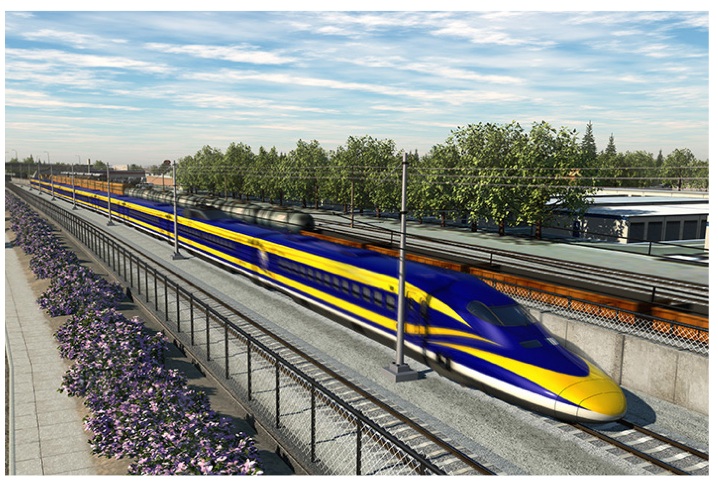 The Times quoted the Authority chair Dan Richard who has been responding to questions on the story.
“Richard, speaking on a Fresno radio talk show Tuesday, said the state is working to reduce the cost of the project below the current $68-billion estimate and that it has not withheld critical information from the public.”
Critics of the project including GOP congressmen jumped on the LA Times story demanding a hearing on the issue which now will be held , likely in Sacramento soon.
“Given the magnitude of the project, we have questions regarding the stewardship of federal funds by the California High Speed Rail Authority,” said the letter, co-signed by 11 Republicans from districts across the state” reports the Times.
The Times had done another story quoting doubts about the cost estimates and uncertainty in tunneling in the Tehachapis as the first phase of the statewide rail project approaches LA from Bakersfield.
Responding to that October 25 story,Authority CEO Jeff Morales wrote the Times.
“ The article also makes it seem as though no one has thought about the challenge of tunneling through mountain ranges. On the contrary, we have brought in some of the world’s leading tunneling experts and they’re confident of our ability to construct the needed tunnels.
Any infrastructure investment of this size will face risks associated with cost and schedules. To that end, we’ve employed the most advanced risk management strategies available. This approach has resulted in lower costs and faster timelines.”
Unlike estimates and speculation about cost overruns in the future the Authority asks the public to look at what the project has actually contracted for.
On both segments the costs are well below engineer’s estimates as they are on many road projects in California in recent years.
CP-1,a 29 mile segment is being built byTutor Perini/Zachry/Parsons joint venture, whose bid beat out four other bids to win the Fresno-Merced contract. The group, made up of construction companies from California and Texas, won out with their bid valued at $985,142,530 compared to the engineers estimate for this segment of the project of $1.2 billion.
In the second 65 mile segment south of Fresno awarded early this year the Authority had estimated the cost of CP 2-3 to be between $1.5 billion to $2 billion. The Authority determined that Dragados/Flatiron/Shimmick, who bid $1.2 billion was the “apparent best value.”
CP 2-3 includes approximately 36 grade separations in the counties of Fresno, Tulare and Kings, including viaducts, underpasses and overpasses. The contractor is acquiring land to begin construction on this leg of the rail line that goes to Kern County.
Adding the costs for actual construction for the two segments, the total,about $2.2 billion, is at least half a billion dollars less than official engineer’s estimates.
There may be questions about the future but to date that’s a pretty good “track record.”