
October 12,2015-
 Tulare County is expected to declare a Local Emergency due to widespread tree mortality in the southern Sierra caused by drought and insect pressure.
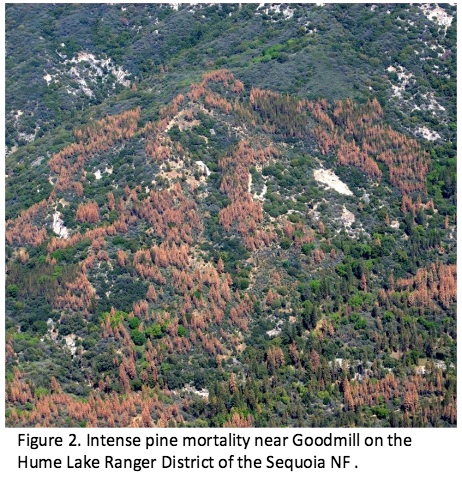
An agenda item for this week’s BOS meeting says a survey of tree mortality in the national forests including the southern Sierra and Sequoia National Forest showed a growing rate of mortality with an estimate of 300,000 trees killed by spring of 2014, growing to 5 million by April 2015 in the same area and now an estimated 10.4 million tree deaths on 835,000 acres or 20% of the 4.1 million acres surveyed. The severe conditions are likely to mean more tree deaths to come.
The agenda item says along with all the impacts on the local economy the tree deaths are likely to mean more fires, bad air, less tourism and more health impacts including cancellation of school days.Wildlife too will be impacted as well as water supply.
The report cites the recent Rough Fire that burned 151,633 acres in two National Parks locally costing in excess of $100 million in direct fire fighting costs alone.
Yet to come are a likely decrease on water retention in the Sierra if predictions of an El Nino wet year happen, worsening potential flooding and damage downstream from major storms.
The proclamation by the county says restrictions on fuel reduction and limitations on timber exports have worsened the overgrowth conditions.
U.S. Forest Service aerial monitoring surveys this year showed a large increase in tree mortality in the southern Sierra Nevada coming up with the 10.1 million tree number on both public and private land, according to the University of California’s Division of Agriculture and Natural Resources.
A lack of water from drought is leaving trees without the pitch necessary to prevent beetles from burrowing into the tree through the bark, leading to an infestation that overcomes the tree, explained Susie Kocher, a UC Cooperative Extension advisor recently.
A UC Merced study suggests that increasing projects to thin trees and clear brush from forest floors could boost water yields from mountain forests by as much as 10 percent.