
First Published in Fresno Business Journal
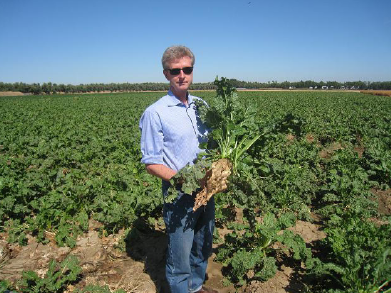
Fresno County Planning Commission will meet September 13 and is expected to approve construction plans for a pilot “Beet Energy” plant near Five Points. The long awaited project will break ground in October and will be up and running by June says proponent and area farmer John Diener.
“We’re going to do it” exclaims Diener, known as an ag innovator who will house the pilot facility on his Red Rock Ranch where the beets will be grown.
Sugar beets – once a major crop in Fresno County – is no longer grown for sugar because there is no processing plant anymore. Now, the California Energy Commission(CEC) is eager to explore ways to produce low-carbon motor fuels from plants and is funding this pilot facility that could lead to a much larger $200 million privately-funded biofuel production plant in Mendota.
In the planning stage since 2009, the integrated project includes the Mendota Advanced Bioenergy Beet Cooperative who together with Diener have been awarded $5 million by the CEC to build the model plant expected to produce 1 million gallons of ethanol processed from 250 acres of energy beets. The beets – larger than common sugar beet -would be harvested all year round. The project had already received a $1.5 million matching grant to examine the feasibility of the idea and now has the green light to move forward.
Sugar beets, that once covered over 300,000 acres statewide has now dwindled to 70,000 acres,all in Imperial County. The Central Valley once had 100,000 acres of sugar beets before Spreckels Sugar closed its doors after a 100 year run leaving farmers high and dry. California that once had 11 sugar mills is now down to one in the south state.
But now, a number of former Spreckels growers – members of the beet cooperative – hope the crop makes a comeback added to the growing number of plant materials harvested for low carbon fuels to help cut greenhouse gases.
Cut to Corn Ethanol Support
While the State of California appears to be backing away from full support for more ethanol made from corn,interest in cellulosic ethanol projects is gaining support. This week Gov. Jerry Brown signed AB 523 by Assemblyman David G. Valadao into law. AB 523 eliminates all future state funding for the production of ethanol derived from corn after July 2013. Currently, approximately $6 million is provided to a very small group of corn ethanol producers. AB 523 would redirect that money away from corn ethanol and towards other forms of renewable energy, including ethanol not derived from corn.
Beet Energy’s project consultant Jim Tischer of Fresno State says the benefits of turning beets into biofuel are attractive.”We’re talking about a much higher BTU content with three times the ethanol production per acre compared to corn.” The result is this biofuel would be much “greener’ than corn-based ethanol – lower carbon content than Brazilian ethanol as well he says. This will be important is meet the state’s low carbon fuel standard as it kicks in in coming years.
The integration that helps make the fuel “greener” includes four different technologies in one facility to produce ethanol, renewable biomethane, compost and fertilizer, and green electricity. The primary feedstocks will be sugar beets and almond orchard prunings. This integrated biorefinery combines the following renewable technologies: advanced ethanol production, anaerobic digestion, biomass gasification, water recycling, and wastewater treatment.
If the pilot proves successful Tischer says investors and lenders are in the wings that could be eager to build the full-scale production plant that would covert both ag waste and beets into ethanol and other fuel, green electricity and other green products.
Multiple Green Products
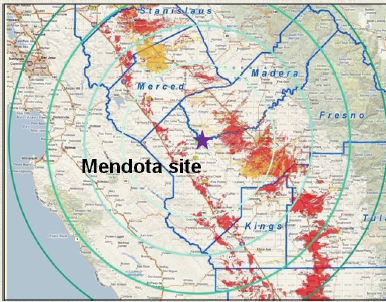
The plant to be build in Mendota by 2016 would convert 840,000 tons of beets and 80,000 tons of almond clippings each year into 33.5 million gallons of ethanol; 1.6 million standard cubic feet of biomethane for making compressed natural gas; 6.3 megawatts of certified green electricity; and high-nutrient compost and liquid fertilizer.
For waste water treatment the processes could add 400 acre ft of treated water for irrigation of crop land.
The project could create approximately 250 direct and 50 indirect construction jobs in the Fresno County agricultural community of Mendota, along with 50 long-term jobs at the biorefinery and an additional 50 jobs for feedstock operations.
Help For Western Fresno County
“We estimate that the plant would mean about $110 million a year in economic activity to the area” says Tischer.The Mendota area has been particularly hard hit by years of recession and drought and would welcome some positive news that could provide both steady work and help clean the air too.
A key factor in the feasibility is whether the plan to grow beets year round on 35,000 acres within a 60 mile radius of Mendota works out. “Our pilot project should determine if we can prove out year-round harvest” suggests Diener. To compete with corn that can be stored,beet growers contracted with the plant would need to keep feeding the plant with about 4000 tons a day.Winter months are typically when beets grow in the Valley. Beets grown too far away would face high transportation costs making the facility less efficient.
Already the beets that will be used in the pilot refinery have been planted.The whole beet plant can be processed.
California is not the only place where the experiments with beets for biofuel is going forward. A mothballed corn ethanol plant in North Dakota is being converted this year to accept 12,000 acres of beets near Fargo.
Other Valley companies are experimenting with varied crops to make biofuel including sorghum, switchgrass and South American root crops by Aemetis Inc who own a 60 million gallon ethanol facility in Keyes and say one root crop could generate 2000 gallons per acre of ethanol according to a study.